
died c. 1050·Feast February 3
St. Oliver of Ancona
Benedictine Monk of Santa Maria di Portonuovo
Overview
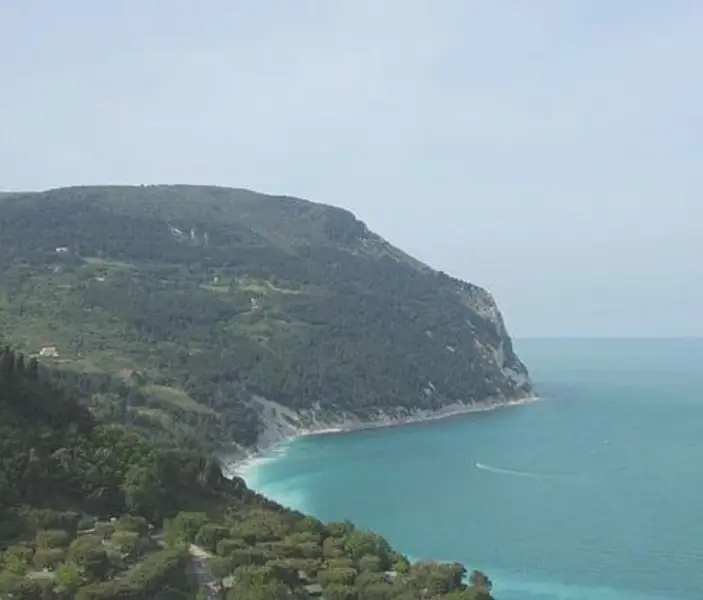
Oliver of Ancona — also called Oliver of Portonuovo, Oliverius, or Liberius — died around 1050 and is honored as a saint in both the Catholic and Orthodox traditions. His origins are debated: some accounts trace him to Armenia, others make him a Camaldolese monk from Dalmatia before his appearance on the Adriatic coast of Italy. What is certain is his monastic home: at Santa Maria di Portonuovo he professed the Benedictine habit — a small community lying beneath Monte Conero, south of Ancona — where prayer and handwork were ordered by the Rule of Saint Benedict within sight of the sea. There he lived out the hidden life of the cloister — a life the medieval Church prized precisely because it sought no audience. The monastery he served did not long survive him: earthquakes and landslides eventually forced its abandonment, and the community of which he was part passed into silence. Yet his memory endured at Ancona and beyond, fixed by his feast on 3 February, and he remains one of the local saints of the Marche coast honored by East and West alike.
The Complete Life
From Armenia or Dalmatia to the Adriatic
Where Oliver came from is a question the sources answer in two ways, and neither has prevailed. One tradition holds that he came from Armenia, that ancient Christian kingdom of the Caucasus whose monks and pilgrims traveled astonishing distances in the medieval centuries, appearing in the religious life of Italy and the Balkans at every period. Another identifies him as a Camaldolese monk from Dalmatia, the mountainous Croatian coast across the Adriatic from Italy, whose eremitical reform at Camaldoli sent its influence throughout the Italian peninsula in his century. The discrepancy is itself informative: a holy man of the eleventh century could plausibly have arrived at Ancona from either the far side of the Byzantine world or the near shore of the Adriatic, and the hagiographers preserved the uncertainty rather than inventing a single tidy origin for him. His several names — Oliver, Oliverius, Liberius, and Oliver of Portonuovo, taken from his monastery — reflect the same layering of memory as his dual homeland. What can be said with confidence is that by the middle of the eleventh century he was on the Italian shore, drawn to a small monastic foundation at the foot of Monte Conero, the great promontory that rises south of Ancona above the Adriatic. There the wandering ended, and the settled discipline of the cloister began.
§ Introduction
Benedictine of Santa Maria di Portonuovo
Oliver professed himself a monk of the Benedictine observance at Santa Maria di Portonuovo, a community dedicated to the Mother of God at the seaward foot of Monte Conero. The monastery stood on one of the most exposed and beautiful reaches of the Italian Adriatic — a place of pilgrims and fishermen, of storms from the east and of the long horizon toward the Holy Land. Within its walls his vocation took the classic Benedictine shape: stability in one house, obedience to an abbot, the alternating song of the Divine Office and the labor of the fields and workshops. If he was, as some traditions say, first formed at Camaldoli or in Dalmatia, his moving to Portonuovo represents the monastic principle of the seeking heart: the monk goes where God is served, and stays. No writings, foundations, or recorded miracles are attached to his name. His sanctity was of the kind the Rule itself describes — that he did indeed live out his days in the monastery, persevering in the school of the Lord's service until his death around 1050.
§ Introduction
The Silence of the Abandoned Monastery
The house that held Oliver did not long endure. In the centuries after his death, earthquakes and landslides — the same unstable slopes of Monte Conero that made the site dramatic made it perilous — forced the abandonment of Santa Maria di Portonuovo, and the monastic family of which he had been a member dispersed or died out. It is a fate that befell many small foundations of the eleventh and twelfth centuries, squeezed between war, malaria, and the geology of the Adriatic coast, and it nearly swallowed his memory along with his monastery. That his name survived at all owes much to the devotion of the local church of Ancona, which kept his feast on 3 February and numbered him without hesitation among its saints. Medieval hagiography usually preserves the saints of large and enduring abbeys, whose libraries copied their vitae; Oliver is remembered by a house that no longer exists, a rare case of local affection outliving the institution that fostered it. His death around 1050 closed a life of which almost nothing is recorded but its essential shape — arrival from afar, profession at Portonuovo, perseverance unto death — and that shape proved durable enough to reach the calendars and lexica of both East and West.
§ Introduction
Honored by East and West
Oliver is reckoned a saint by the Catholic Church and the Orthodox churches alike, a shared veneration befitting a figure of the undivided eleventh century — though he died within a generation of the schism of 1054 that would divide the two lungs of Christendom he straddled by origin and by profession. No formal canonization process exists for him; his cult is pre-congregation, resting on local liturgical memory rather than papal decree. His feast is kept on 3 February. Devotion to him has been carried in hagiographic reference works in several languages — Latin, Norwegian, Dutch, and German calendars and lexica of the saints record him under his various names — and the site of his monastery, though abandoned, has never entirely lost its association with his memory; a photograph of the church of Santa Maria di Portonuovo from the era of Saint Oliver circulated among the places of his cult. For the faithful of Ancona he remains the monk of Monte Conero, the holy man of the promontory, whose hidden life the Church of both traditions continues to honor.
§ Introduction
The Record
- Canonization
- Pre-congregation; venerated as a saint by the Catholic and Orthodox churches
Prayer
Bibliography
Show 4 sources
- "Latin Saints of the Orthodox Patriarchate of Rome".
- "Den hellige Oliver av Portonuovo (-1050)", Den katolske kirke.
- Van den Akker, A., "Oliver van Ancona", Heiligen.
- Schäfer, Joachim. "Oliver von Portonovo", Ökumenischen Heiligenlexikon.
Profile text adapted from the Wikipedia article, licensed CC BY-SA 4.0.
Pray with this saint every day
Save St. Oliver of Ancona to your favorites, read the full profile, and get feast-day reminders in the Saints app.
Get the Saints AppFree on the App Store for iPhone and iPad