
1625-1681·Feast July 1
St. Oliver Plunkett
Bishop and Martyr
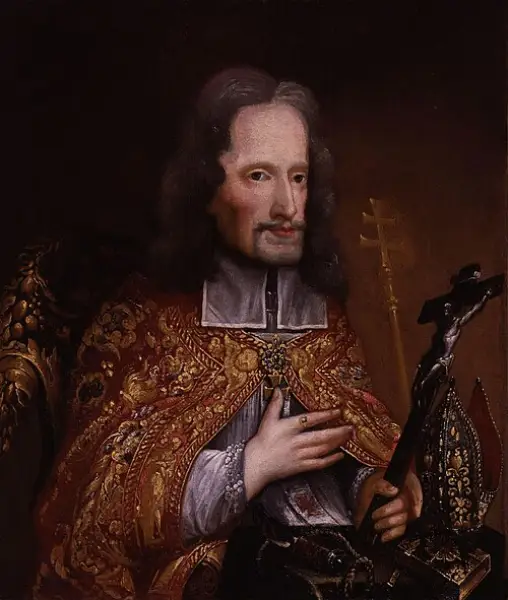
Overview
Oliver Plunkett, born on 1 November 1625 at Loughcrew in County Meath to well-to-do Hiberno-Norman parents, went to Rome in 1647 to study for the priesthood while the Confederate Wars ravaged his country. Ordained in 1654, he stayed on as a professor of theology and as the Irish bishops' representative in Rome, because Cromwell's conquest had made Catholic ministry at home a capital offense. Appointed Archbishop of Armagh and Primate of All Ireland in 1669 and consecrated at Ghent, he finally landed on Irish soil again in March 1670. His brief season of open work was fruitful: a Jesuit college at Drogheda that drew 150 students, including some forty Protestants, and a confirmation campaign said to have reached tens of thousands. The Test Act of 1673 forced the college's demolition and drove him into years of disguise and hiding. Swept up in the fabricated Popish Plot, he was arrested in December 1679. When his Dundalk trial collapsed for lack of witnesses, he was moved to London, denied proper counsel and time to prepare a defense, convicted of high treason in June 1681 on the charge of 'promoting the Roman faith,' and answered the verdict with the words Deo Gratias. The sentence was carried out at Tyburn on 1 July 1681: he was hanged, drawn and quartered, the final Catholic martyr to die in England.
The Complete Life
Early Life
Oliver Plunkett was born on 1 November 1625 at Loughcrew, near Oldcastle in County Meath, into a well-to-do family of the old Hiberno-Norman gentry — a class that had kept the Catholic faith through the Elizabethan conquest at the price of exclusion from office, university, and the professions. His relatives included the earls of Fingall and the Plunketts of Killeen, and his upbringing was that of a recusant household in a country where the public church and the church of the people had been forced apart. Ireland in his youth was breaking into the Confederate Wars; a Catholic education at home had become impossible, and in 1647, at twenty-two, he was sent to Rome to study for the priesthood at the Irish College.
§ Biography
Conversion and Vocation
Plunkett was ordained in Rome in 1654, at the depth of Cromwell's conquest of Ireland — a moment when Catholic ministry at home was a capital offense and the Irish church existed, where it existed at all, in hiding. Rather than return to almost certain death, he stayed and made himself useful in the center of the Church: he became a professor of theology at the Propaganda college, and served as the representative, or agent, of the Irish bishops in Rome, the channel through which a broken hierarchy kept contact with the Holy See. He spent the twenty-three years of his Roman exile in study and in the practical service of a persecuted church, becoming in the process exactly the learned, connected pastor the Irish church would need if the persecution ever lifted.
§ Biography
Mission and Ministry
In 1669 Plunkett was appointed Archbishop of Armagh, primate of all Ireland, and consecrated at Ghent on 30 November; he landed on Irish soil again in March 1670. The years that followed were the brief open season of his life, and he used them with energy. At Drogheda he established a Jesuit college that drew some hundred and fifty students, among them about forty Protestants — an Irish Catholic school attracting the sons of the established church. He held synods, reformed the clergy, and conducted a campaign of confirmations said to have reached tens of thousands. Then the window closed: the Test Act of 1673 and the renewed enforcement of the penal laws forced the college's demolition and sent the primate himself into years of disguise, hiding in the houses of the faithful while continuing to govern his province.
§ Biography
Trial and Final Years
In December 1679, swept up in the fabricated Popish Plot — the wave of panic that had been engineered in London and that claimed many innocent lives — Plunkett was arrested in Dublin. His trial at Dundalk collapsed: the prosecution's witnesses, drawn from his own diocese and hostile to him, failed under the court's own procedures, and no Protestant would testify against him. Rather than acquit, the authorities moved him to London, where he was denied proper time and counsel, tried again at Westminster in June 1681, and convicted of high treason on the charge of 'promoting the Roman faith' — a formulation that made the primate's religion itself the treason. He answered the verdict with the words Deo Gratias. The sentence was carried out at Tyburn on 1 July 1681: he was hanged, drawn and quartered, the final Catholic martyr to die in England.
§ Trial
Canonization
Plunkett's fate shocked even the England that had condemned him; the judge in his own trial was later said to have remarked that he had condemned the fairest character he had ever known. His head was recovered and preserved, and his cause was kept alive by the Irish church through the penal era. Pope Benedict XV beatified him in 1920, and on 12 October 1975 Pope Paul VI canonized him — the first canonized Irish saint in roughly seven centuries, since Laurence O'Toole. His canonization was a national event for Ireland and a belated formal acknowledgment of the injustices of the Popish Plot era.
§ Introduction
Legacy
Plunkett is the great martyr of the Irish penal church, and his relics have made two pilgrimages of their own: his head is venerated at Saint Peter's Church in Drogheda, and his body rests at Downside Abbey in England. His shrine at Drogheda remains one of Ireland's most visited, and in recent decades his memory has taken on a further role in reconciliation, since his trial and death in London made him, for English Catholics too, one of the Tyburn martyrs. As primate, scholar, fugitive, and judicial victim, he compresses the whole Catholic experience of seventeenth-century Ireland into one life.
§ Introduction
Timeline
- 1625
Born at Loughcrew, County Meath on 1 November
§ Introduction
- 1647
Sent to Rome to study for the priesthood
§ Biography
- 1654
Ordained a priest; serves as agent of the Irish bishops in Rome
§ Biography
- 1669
Appointed Archbishop of Armagh on 9 July; consecrated at Ghent on 30 November
§ Biography
- 1670
Returns to Ireland on 7 March; establishes a Jesuit college at Drogheda
§ Biography
- 1673
Test Act forces the college's closure; goes into hiding
§ Popish Plot
- 1679
Arrested in Dublin on 6 December during the Popish Plot panic
§ Trial
- 1681
Convicted at Westminster and executed at Tyburn on 1 July
§ Introduction
- 1920
Beatified by Pope Benedict XV
§ Introduction
- 1975
Canonized by Pope Paul VI, the first new Irish saint in almost 700 years
§ Introduction
In Their Own Words
Let us remove this defect from an Irish priest, and he will be a saint.
Deo Gratias
The Record
- Patron of
- Peace and reconciliation in Ireland
- Canonization
- Beatified by Pope Benedict XV on 23 May 1920; canonized by Pope Paul VI in 1975 — the first new Irish saint in almost seven hundred years, with the customary second miracle waived
Prayer
Bibliography
Show 12 sources
- 1 2 Glinert (2009) , p. 80.
- ↑ Earlier biographers gave his date of birth as 1 November four years later, but since the discovery of an ancient reference to Oliver Plunkett’s birth in the Bodleian Library, Ashmolean, MS.436, which stated "He was born on 1st. November 1
- 1 2 3 4 Comyn (1981) , p. 4.
- ↑ Comyn (1981) , p. 5.
- ↑ Kenyon (2000) , p. 225.
- 1 2 Kenyon (2000) , p. 233.
- ↑ Cobbett (1810) , p. 450.
- ↑ Cobbett (1810) , p. 481.
- ↑ Gilbert Burnet , History of his Own Time Everyman Abridgment 1991, p. 182.
- ↑ Comyn (1981) , p. 9.
- ↑ Cobbett (1810) , p. 492.
- ↑ Glenn Burgess and Charles W A Prior, England's Wars of Religion Revisited , p. 286, Ashgate, 2013
Profile text adapted from the Wikipedia article, licensed CC BY-SA 4.0.
Pray with this saint every day
Save St. Oliver Plunkett to your favorites, read the full profile, and get feast-day reminders in the Saints app.
Get the Saints AppFree on the App Store for iPhone and iPad