
448 – 463 (another tradition: 9th–10th century)·Feast June 10
St. Olivia of Palermo
Virgin Martyr and Patroness of Palermo
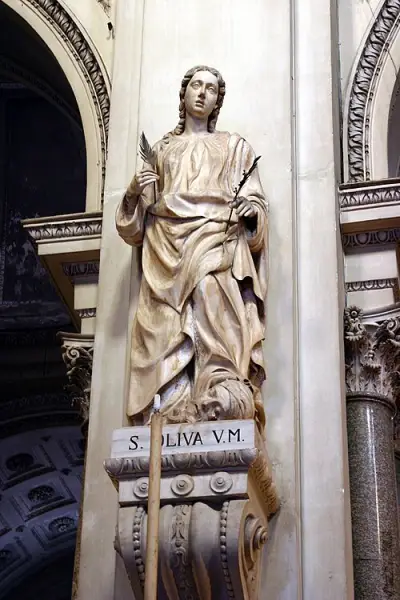
Overview
Olivia of Palermo is a Christian virgin-martyr venerated as a patroness of Palermo since the Middle Ages, and honored also in Monte San Giuliano, Termini Imerese, Alcamo, Pettineo, Cefalù, and Olesa de Montserrat in Catalonia. According to her hagiographic legend she was born to a noble Sicilian family, in the Loggia district of Palermo, in 448 — though a rival tradition places her in the ninth or tenth century under Muslim rule. Consecrated to the Lord from youth, she declined riches and gave to the poor. When Genseric's Vandals conquered Sicily in 454 she comforted Christian prisoners, and the impressed conquerors exiled her to Tunis, hoping their governor could break her constancy. There she worked miracles, converted pagans, survived banishment among wild beasts, converted the hunters who found her, and cured the sick of the region. Arrested at last and pressured to apostatize, she endured scourging and a cauldron of boiling oil unharmed, and was beheaded on 10 June 463 — or, in the other tradition, in the tenth century — her soul, says the legend, flying to heaven in the form of a dove. Her cult, richly documented in Sicilian breviaries and martyrologies, made her one of Palermo's four historic patronesses.
The Complete Life
A Daughter of the Palermitan Nobility
The Olivia whom Sicily venerates was, in the hagiographic tradition, the beautiful daughter of a noble family of Palermo, born — in the older and better-attested version — around 448, when the island belonged to the waning Roman West. Local hagiographers specify the Loggia quarter of the city as her birthplace. From her early years she belonged to the Lord: she refused the honors and riches her station offered and distributed charity to the poor, the classic portrait of a consecrated virgin of late antiquity. Her name and cult reach us through a layered textual tradition: a Gallo-Siculo Breviary of the twelfth century preserved at Palermo, a fourteenth-century text in vulgar Sicilian recovered at Termini Imerese, and a Life contained in a fifteenth-century lectionary. An ancient icon — perhaps twelfth-century, now in the Diocesan Museum — shows her alongside the saints Elias, Venera, and Rosalia. A rival tradition, attested by other lines of the legend, makes her a girl of the ninth century, enslaved in 906 under the Muslim emirs; the double chronology is the oldest unsolved question of her story.
§ Hagiographic life
Faith in the Vandal Storm
In 454, by the traditional chronology, Genseric king of the Vandals crossed from Africa and conquered Sicily, occupying Palermo, and began to put many of the island's Christians to death. Olivia, then a girl approaching adolescence, went out to the prisoners: she comforted them in their chains and urged the Christians of the city to stand firm in their confession, whatever it cost. Her boldness was noted on both sides — the persecutors, seeing that nothing could prevail against her spirit, and out of deference to her noble house, chose not to kill her but to remove her, sending her across the sea to Tunis so that the governor there might try to wear down her constancy at leisure. The other version of her legend tells the same displacement in a different age: in 906, under Saracen rule and the Muslim Emirate of Sicily, she was enslaved and shipped to Tunis on the orders of the Emir. Either way, the heart of her vocation is exile — the consecrated virgin who would not bend carried away from her own city, a noblewoman made a slave, whose fidelity was to be tested far from every support of family, fortune, and homeland, and who turned the test into a mission.
§ Hagiographic life
Apostle of Tunis
In Tunis Olivia's exile became an apostolate. She worked miracles and began converting the pagans — or, in the later version, the Muslim Saracens — among whom she lived. The governor's reply was banishment to a desolate spot fit only for a hermit, among roaming wild animals, expecting that hunger or the beasts would finish what persuasion could not. The beasts, the legend says, lived peacefully around her. Huntsmen from the city found her there and, struck by her beauty, attempted violence; she converted them instead by the word of the Lord, and they received baptism. Curing many of the sick and suffering of the region, she drew still more converts to the Christian faith. The hagiographic pattern is deliberate and ancient — Daniel among the lions, the persecuted maiden whose innocence tames creation and converts her enemies — and critics have long noted that her story draws on archetypes dear to the medieval imagination rather than on biography. Yet within the legend the missionary logic is clear: the slave girl of Palermo becomes, in Tunis, the apostle her captors cannot silence.
§ Hagiographic life
Constancy Under Torture
When word of her successes reached the governor, he had Olivia arrested and imprisoned within the city, determined to make her apostatize. What followed was the martyr's proof: she was scourged, stripped, and submerged in a cauldron of boiling oil, and neither the torments harmed her nor the fear of them bent her will. The Sicilian breviary entry for her feast enumerates the trials — the cauldron, the iron nails, the fire — through which, it says, she was divinely delivered before the final blow. The spirituality the legend commends is one of unmoved fidelity: a faith that survives the loss of home, freedom, and finally life itself, and that converts its tormentors more often than they convert it. At the end she was beheaded on 10 June — 463 in the Vandalic chronology, sometime in the tenth century in the other — and the legend closes with its tenderest image: her soul took wing for heaven in the shape of a dove — the bird of baptism and of peace, and the bird whose olive branch is her emblem and her very name.
§ Hagiographic life
Martyrdom and the Dove of Tunis
The beheading of Olivia on 10 June — whether in 463 or under the later emirate — is the fixed point around which all her cult turns. The Sicilian liturgical books gave the date its annual place, and the Italian phrase in which the legend ends — that under the form of a dove she flew to heaven — passed into the very way Sicilians speak of her. Her body, according to the tradition preserved in the city's records, lay at Tunis, and the supposed site of her burial in Palermo received a church dedicated to her as early as 1310, today the Chiesa di San Francesco di Paola. In Tunisia her memory took deeper root than martyrs' cults usually do: a Byzantine Christian church dedicated to Santa Olivia is reported by the seventeenth-century historian Ibn Abi Dinar at the very site where the Zaytuna — the Mosque of Olive — later rose, and excavations of 1969–1970 showed a Byzantine-era building beneath it. To this day she is venerated in Tunisia, where popular belief holds that her relics' recovery would mark the end of Islam there.
§ Saint Olivia and Islam in Tunisia
Patroness of Palermo
Olivia's sanctity was never the work of a canonization process; as the tradition itself admits, her name appears in no mainstream Latin or Greek martyrology, and she was sanctified by popular devotion alone. As the fifteenth century closed, the Franciscans took up her cause in their search for her remains. On 5 June 1606 the citizens and Senate of Palermo chose her as the city's patroness together with Saints Agatha, Christina, and Nympha, one for each of the four great quarters of the city, and in 1611 Cardinal Giannettino Doria entered their commemoration in the Palermian Calendar. Her veneration receded after 1624, when the relics of Saint Rosalia, the rescuer of the city from plague, added a fifth patroness. Yet her place in the city's devotion long endured: a parish was dedicated to her in 1940, and she was kept by the Church in Palermo as an obligatory memorial until 1980, her feast being deleted from the local calendar only in 1981. In Tunis the Roman Catholic cathedral of St. Vincent de Paul and Saint Olivia, opened on Christmas Day 1897, still bears her name.
§ Patronage of Palermo
Legend, Poetry, and the Scholars' Scales
Few local saints of Italy generated so much literary afterlife. Numerous Lives of Olivia were published in Sicily in prose and verse, with sacred representations performed into the eighteenth century; the seventeenth-century poet Petru Fudduni devoted a poem of 114 octaves to her, and Gioacchino Bona Fardella's tragedy in three acts was famous in its day. The Bollandists printed her Acts in 1885 from the Palermo lectionary, and she stands in the Sicilian martyrology of Ottavio Gaetani and the Palmerian martyrology of Antonio Mongitore of 1742. Scholarship, however, has weighed the legend carefully: Giuseppe Agnello, sifting hagiography from literature, saw only a homonymous Palermo saint conflated with the heroine of her own mystery play, and critics observe that every element of her story derives from ancient archetypes of the persecuted maiden. Paul Collura answered that the Arab conquest destroyed the island's written records, so that several saints survive only on the thread of memory. The debate is unresolved — but the olive-crowned girl on Palermo's cathedral façade, cross in hand, keeps her place in the city's affection and in the calendar of 10 June.
§ Veneration
Timeline
- 448
Born, by the traditional account, into a noble family of the Loggia district of Palermo
§ Hagiographic life
- 454
Genseric's Vandals conquer Sicily and occupy Palermo, beginning the persecution in which she is exiled
§ Hagiographic life
- 10 Jun 463
Beheaded at Tunis after scourging and the cauldron of boiling oil, faithful to the end
§ Hagiographic life
- 1310
A church dedicated to her rises in Palermo on the supposed site of her burial
§ Hagiographic sources
- 1402
King Martin I of Sicily asks the Caliph of Ifriqiya for the return of her relics and is refused
§ Saint Olivia and Islam in Tunisia
- 5 Jun 1606
Elected patroness of Palermo by the people and Senate, together with Agatha, Christina, and Nympha
§ Patronage of Palermo
- 1611
Cardinal Giannettino Doria enters the four patronesses' commemoration in the Palermian Calendar
§ Patronage of Palermo
- 1885
The Bollandists publish the Acts of Saint Olivia taken from the lectionary of the church of Palermo
§ Hagiographic sources
- 1893
The cathedral of St. Vincent de Paul and Saint Olivia is begun in Tunis, replacing Le Vacher's 1650 chapel
§ Veneration
- 25 Dec 1897
The Tunis cathedral dedicated in part to Saint Olivia is opened on Christmas Day
§ Veneration
- 1940
A parish is dedicated to Saint Olivia in the city of Palermo
§ Patronage of Palermo
- 1981
Her feast is deleted from the local liturgical calendar of Palermo after centuries as an obligatory memorial
§ Patronage of Palermo
In Their Own Words
the core of our ancient legends has a substrate that should not be underestimated, and since the Arab domination in Sicily (827–1092) made a clean sweep of all the written documents, sacred and profane, the memory of several Saints has been handed down only on the thread of memory.
The Record
- Patron of
- Palermo·Monte San Giuliano·Termini Imerese·Alcamo·Pettineo·Cefalù·Olesa de Montserrat (Catalonia)
- Symbols
- Olive branches·Cross
- Canonization
- Sanctified by popular tradition alone as a local saint since the Middle Ages; never formally canonized
Prayer
Bibliography
Show 6 sources
- "Sant' Oliva di Palermo Vergine e martire". SANTI, BEATI E TESTIMONI. 10 giugno. Retrieved: February 2, 2015 (in Italian).
- Ronco, Daniele (2001). Il Maggio di Santa Oliva: Origine Della Forma, Sviluppo Della Tradizione. ETS, Pisa University. 325 pages (in Italian).
- "ACTA SANCTAE OLIVAE." In: ANALECTA BOLLANDIANA. Tomus IV. Geneve: Societe Generale de Librairie Catholique, 1885. pp. 5–9 (in Latin).
- Chater, Khalifa (2002). "Zaytūna". In Encyclopaedia of Islam, Second Edition. Vol. XI. Brill. pp. 488–490. ISBN 9789004161214.
- Agnello, Giuseppe (1955). La S. Oliva di Palermo nella leggenda popolare e nella tradizione letteraria. Archivio storico siciliano, n.s., VII, p. 109 (in Italian).
- Di Tota, Mia (May 1981). "SAINT CULTS AND POLITICAL ALIGNMENTS IN SOUTHERN ITALY." Dialectical Anthropology, Vol. 5, No. 4, pp. 317–329.
Profile text adapted from the Wikipedia article, licensed CC BY-SA 4.0.
Pray with this saint every day
Save St. Olivia of Palermo to your favorites, read the full profile, and get feast-day reminders in the Saints app.
Get the Saints AppFree on the App Store for iPhone and iPad