
flourished c. 65 AD·Feast November 10
St. Olympas
Disciple of the Seventy Greeted by Saint Paul
Overview
Olympas — in Greek Olympas, a name meaning "heavenly" — was a Roman Christian whom the Apostle Paul saluted in his Letter to the Romans, written around 65 AD. His name stands in the sixteenth chapter of that epistle, among the long roll of believers in the imperial capital to whom Paul sent personal greetings before his own journey to Jerusalem; he appears in company with such figures as Epaenetus, Mary, Persis, and the household of Narcissus. The Eastern Orthodox Church honors him as one of the Seventy disciples, the wider circle sent out by the Lord beyond the Twelve, and keeps his feast on 10 November, together with his fellow apostles of the Seventy Erastus, Rodion, Sosipater, Quartus, and Tertius. Beyond these facts — his name, his Roman residence, the apostolic greeting, and his liturgical commemoration — the ancient sources are silent. Yet his single verse has carried his memory for nineteen centuries, a reminder that the first Christian communities of Rome were built of many names, most of them now known only to God and to the Church's calendar.
The Complete Life
A Name in Paul's Farewell
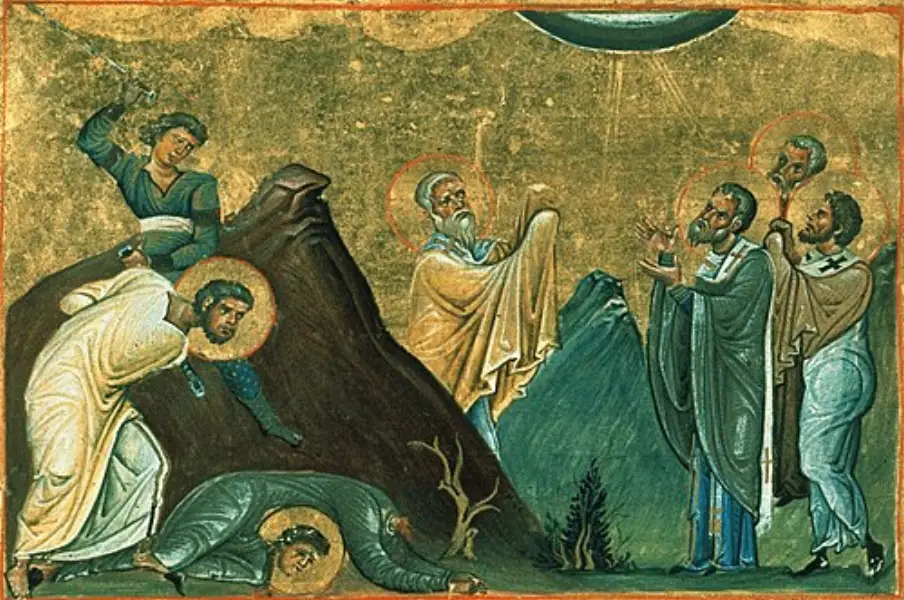
Around the year 65, writing to a church he had never visited, Paul of Tarsus closed his Letter to the Romans with a series of personal greetings — an unmatched window into the membership of the earliest Christian community in the imperial capital. Among those greeted was Olympas, a Roman Christian whose Greek name means "heavenly." The greeting is his entire appearance in the New Testament: no office is named, no deed recorded, no biography attached. For the Church, however, that single verse was enough to establish his standing. The Eastern Orthodox tradition counts him among the Seventy disciples, the company beyond the Twelve whom the Lord commissioned for the work of the Gospel, and venerates him with the title of apostle of the Seventy. In the Menologion of Basil II, the great illustrated ménologion of the Byzantine court, he is depicted alongside Erastus, Rhodion, Sosipater, Quartus, and Tertius — the fellowship of Romans 16 transposed into the iconography of the saints. His case illustrates how the apostolic age was remembered: a name spoken in scripture became a life claimed by liturgy.
§ Introduction
One of the Seventy
Olympas belongs to the pre-congregation saints: he was never canonized by any process, but passed directly from apostolic mention into the Church's veneration. The Eastern Orthodox Church regards him as one of the Seventy disciples and keeps his feast on 10 November. His commemoration is joined to that of a whole company of the Seventy whom tradition associates with the Roman church and with the final chapter of the epistle to the Romans — Erastus, Rodion, Sosipater, Quartus, and Tertius among them — so that his feast is at once personal and collegial, the memory of one disciple embracing the memory of many. Sanctity of this kind rests on apostolic witness rather than miracle or martyrdom tradition: the Church received from Paul's own hand the testimony that Olympas was among the beloved in Rome, and asked nothing further. In the West his cult is fainter, as is common for the members of the Seventy, but the universal calendar of Eastern Christianity has kept his day for well over a thousand years, and the biblical dictionaries that descended from the older scholarship — Easton's among them — still carry his entry.
§ Introduction
Memory in Scripture and Icon
Olympas afterlife is twofold: the word of scripture and the imagery of the Church. In the first, he endures simply by standing in the canon — every reader of the sixteenth chapter of Romans passes his name, and every commentary on the epistle pauses on the roster of the Roman believers. In the second, the Menologion of Basil II, produced at Constantinople around the year 1000, gave him a painted presence, grouping him with Erastus, Rhodion, Sosipater, Quartus, and Tertius as apostles of the Seventy; the image fixed the traditional fellowship that the Orthodox Church still commemorates on 10 November. He is also a saint of the undivided memory of Rome: a Roman Christian, Greek by name, celebrated chiefly in the East, belonging to a church whose members Paul knew by name before he knew their city. For ordinary believers his legacy is the quietest kind — the assurance that faithfulness in the first generation, even when it left no other record, was seen, named in an apostolic letter, and rewarded with an everlasting place in the communion of saints.
§ Introduction
The Record
- Canonization
- Pre-congregation; venerated as one of the Seventy disciples in the Eastern Orthodox Church
Prayer
Bibliography
Show 2 sources
- "Erastus, Olympas, Rodion, Sosipater, Quartus, Apostles of the 70".
- Easton, Matthew George (1897). "Olympas". Easton's Bible Dictionary (New and revised ed.). T. Nelson and Sons.
Profile text adapted from the Wikipedia article, licensed CC BY-SA 4.0.
Pray with this saint every day
Save St. Olympas to your favorites, read the full profile, and get feast-day reminders in the Saints app.
Get the Saints AppFree on the App Store for iPhone and iPad