
c. 365 – 408·Feast July 25
St. Olympias the Deaconess
Noblewoman, Deaconess, and Friend of John Chrysostom
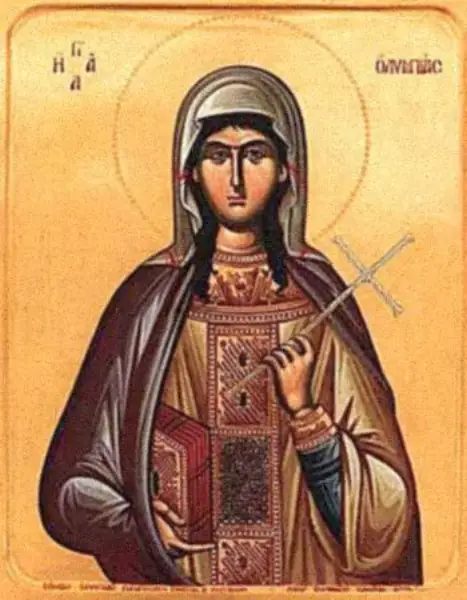
Overview
Called Olympias the Younger, so as not to be confused with the aunt who bore her name, she came of a noble Greek family in the Roman world; her birth fell between 361 and 368 — conventionally c. 365 — and she grew up at Constantinople or else Antioch. Her mother was the noblewoman Alexandra, her father the wealthy rhetor Seleucus; she was named for a paternal aunt once betrothed to the emperor Constans, and her grandfather Flavius Ablabius had held consular rank. Orphaned of expectations at eighteen, she married the prefect Nebridius and was widowed within two years. Every later proposal of marriage she declined; her vast fortune and her own life she gave instead to the Church, taking the order of deaconess. She raised a hospital and an orphanage, supported monks exiled from Nitria, and founded a nunnery that came to hold 250 nuns served by fifty of her own dedicated servants. Her closest spiritual friendship was with John Chrysostom, whose cause she defended at the cost of everything: exiled in 404, deprived of her house, she died at Nicomedia on 25 July 408 after a long illness. She is among the 140 saints whose statues stand in the colonnades of Saint Peter's Square.
The Complete Life
Born to the Purple of Constantinople
Her birth came in the years from 361 to 368, the generation in which Constantinople was rising as a Christian capital, and was raised in the great city or in Antioch. Her lineage was among the most distinguished of the Greek East. Her mother was the Antiochian noblewoman Alexandra; her father the wealthy rhetor Seleucus, who called her his beloved daughter. She was named for her late paternal aunt, a celebrated Olympias who had once been engaged to the emperor Constans and later married Arsaces II, king of Arsacid Armenia. Her paternal grandfather, Flavius Ablabius, had held consular rank at Constantinople; her maternal uncle, Calliopius the Rhetor, served as assistant to the famous teacher Libanius and afterward as a Roman official under the emperors Constantius II and Julian the Apostate. She had a sibling whose own child would continue the family names. It was into this world of office, eloquence, and inherited wealth — a family threaded through the highest circles of both Constantinople and Antioch — that the future deaconess was born, and from it she would one day take the fortune she spent entirely upon the Church.
§ Introduction
Widow at Twenty, Deaconess by Choice
At eighteen Olympias was married to Nebridius, a nobleman serving as prefect of Constantinople — a match of the highest propriety, sealing her place among the city's elite. Within two years she was a widow, and the whole machinery of aristocratic expectation turned toward remarriage. She refused every offer. The young widow took the extraordinary step that defined the rest of her life: she dedicated herself to the Church and accepted the order of deaconess, one of the most demanding vocations open to a woman of the ancient Church, binding her to service, prayer, and the care of the poor. Her consecrated state did not sever her from society; rather, it redirected her wealth through it. The sources describe a woman of intense energy and giving, so generous that the bishop at one point felt obliged to restrain her, and John Chrysostom himself would later tell her she had done almost too much. In an age when noble widows commonly administered great estates, Olympias administered hers for a single purpose: the support of the Church, its monks, its strangers, and its poor.
§ Introduction
Almoner of the Church of Constantinople
Olympias's good works took permanent form. She built a hospital and an orphanage, institutions of the first importance in a city where sickness and abandonment were answered by no public system, and she took under her care the monks who had been driven in exile from Nitria, the ascetic heart of Egypt, when persecution scattered them — a charity that placed her at the center of the age's ecclesiastical storms. She founded a nunnery which grew with astonishing speed to hold 250 nuns, aided by fifty of her own household servants whom she dedicated to its use; the house would remain a fixture of Constantinopolitan religious life into the seventh century. Above all she gave to the Church itself, in such abundance that Chrysostom, her friend and the great preacher of responsibility for the poor, told her she had gone almost too far in her giving — a word she received, tradition says, with the joy of one who counted nothing lost that was given to God. Her estate became, in effect, an endowment of mercy: hospitals, orphans, exiled monks, and a monastery of 250 women praying without ceasing.
§ Introduction
The Friendship with Chrysostom
The great friendship of Olympias's life was with John Chrysostom, patriarch of Constantinople, whose golden-mouthed preaching and relentless demands upon the wealthy found in the deaconess both a disciple and a patron. The relationship was spiritual rather than merely philanthropic: he guided her conscience, moderated her almsgiving, and entrusted her with commissions for the Church, while she looked to him for direction in her ascetic vocation. That friendship demanded everything. When Chrysostom fell afoul of the court of Arcadius and Eudoxia and was condemned, Olympias refused to abandon him; her loyalty was repaid with exile in 404, the seizure of her house, and the dispersal of much that she had built. She followed the model she had served — the confessors of Nitria, the exiled prelate himself, the crucified Lord — and did so while her health was failing. Her final years at Nicomedia were lived in illness and perseverance, sustained by correspondence with the banished bishop until his death. Hers was an asceticism of circumstance: not the desert, but fidelity amid confiscation, sickness, and the loss of everything except the friendship of God.
§ Introduction
Exile and Death at Nicomedia
In 404 the price of loyalty came due: for her support of Chrysostom, Olympias was exiled from Constantinople, and her house was lost. The widow who had endowed hospitals and a great monastery now possessed nothing of what her giving had built. She settled at Nicomedia, across the Propontis, where she lived out the remainder of her life in exile. Her health, always delicate, declined into a long illness, and she bore its sufferings — so the tradition records — with the same patience she had brought to her confiscation and banishment. She died at Nicomedia on 25 July 408, aged about forty, having outlived her friend and teacher by roughly a year and having seen, perhaps only in hope, the vindication that would come to Chrysostom's memory within a generation. The Church enrolled her among its saints, keeping her feast on 25 July, the day of her death. Her end was the seal of her vocation: the woman who had given away a great fortune for Christ finished her days with nothing but faith — and the universal judgment of the Church that she had spent everything precisely well.
§ Introduction
Saint of the Undivided Church
Olympias was never canonized by any process; her sanctity was recognized from the generation after her death, and she is venerated in the Catholic Church, the Eastern Orthodox Church, and the Oriental Orthodox Church alike — one of the saints of the undivided early Church whom East and West have always honored in common. Her feast is kept on 25 July. Her memory has also been given monumental form in the modern papacy: her figure counts among the 140 statues of saints that line the colonnades around Saint Peter's Square in the Vatican, set there to stand for the holy ones of every era of Christian history. Ancient and modern witnesses agree on the essentials of her sanctity: a noblewoman who became a deaconess, a benefactor whose giving was disciplined by her bishops, a friend who would not desert the persecuted, and an exile who died in patience. The liturgical calendars of three traditions, the colonnade of the Vatican, and the surviving accounts of her hospital, her orphanage, and her 250 nuns together constitute the canonization that antiquity pronounced and the Church has never revised.
§ Introduction
The House of 250 Nuns
The most durable of Olympias's foundations outlived her by more than two centuries. The nunnery she established in Constantinople grew quickly to 250 nuns, served by fifty of her household servants whom she had dedicated to its use, and it remained a pillar of the city's monastic life into the seventh century — surviving the fall of her friend, her own exile, and the upheavals of the age. Its Abbess Sergia, a successor in that long line, recorded that relics relating to Olympias were recovered, a sign that the founder's memory had passed into the sacramental life of her own foundation, where her remains or tokens were honored as those of a saint. Through that house her model of female consecrated life — wealthy, free, institutional, and bound to the poor — entered the bloodstream of Byzantine monasticism. Later generations remembered her chiefly through her connection to Chrysostom, in the lives and letters of the exiled patriarch, but her own legacy stands independent: hospitals and an orphanage raised by one woman's fortune, a monastery that prayed for the city into the age of the Persian wars, and a name honored at Nicomedia, Constantinople, and Rome alike.
§ Introduction
Timeline
- 365
Born to the Greek noblewoman Alexandra and the rhetor Seleucus, and named for her paternal aunt
§ Introduction
- 404
Exiled for her support of John Chrysostom, and deprived of her house
§ Introduction
- 25 Jul 408
Dies at Nicomedia after a long illness, an exile for the sake of the Church
§ Introduction
- 600
In the seventh century her nunnery still survives; its abbess Sergia reports the recovery of relics relating to Olympias
§ Introduction
The Record
- Major works
- Hospital built from her good works·Orphanage·Nunnery of 250 nuns, served by fifty dedicated servants
- Canonization
- Pre-congregation; venerated since antiquity by the Catholic, Eastern Orthodox, and Oriental Orthodox churches
Prayer
Bibliography
Show 7 sources
- Swan, Laura. The Forgotten Desert Mothers: Sayings, Lives, and Stories of Early Christian Women. Paulist Press, 2023.
- Jones, A.H.M.; Martindale, J.R.; Morris, J. The Prosopography of the Later Roman Empire: Volume 1, AD 260–395. Cambridge University Press, 1971.
- Moret, P.; Cabouret, B. Sertorius, Libanios, iconographie: a propos de Sertorius. Presses Univ. du Mirail, 2003.
- Smith, W.; Wace, H. A Dictionary of Christian Biography, Literature, Sects and Doctrines N to S Part Seven. Kessinger Publishing, 2004.
- Stephenson, Paul. New Rome: The Roman Empire in the East, AD 395–700. Profile, 2022.
- "Catholic Online - St. Olympias".
- "New Advent Catholic Encyclopedia - St. Olympias".
Profile text adapted from the Wikipedia article, licensed CC BY-SA 4.0.
Pray with this saint every day
Save St. Olympias the Deaconess to your favorites, read the full profile, and get feast-day reminders in the Saints app.
Get the Saints AppFree on the App Store for iPhone and iPad