
died in the 1st century·Feast September 6
St. Onesiphorus
Loyal friend who sought Paul in his Roman prison
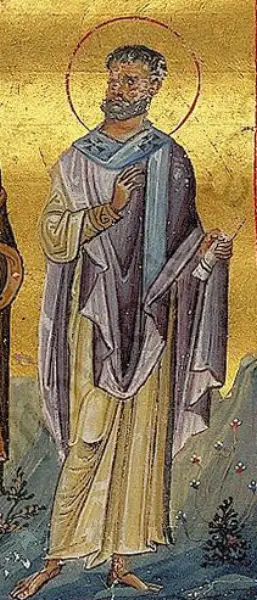
Overview
Onesiphorus, whose Greek name means bringing profit or useful, was an early Christian honored in the New Testament letter of Second Timothy. Orthodox tradition reckons him among the seventy disciples whom the Lord dispatched to preach, and it makes him a bishop, first at Colophon in Asia Minor and afterwards at Corinth. His enduring claim on the church's memory, however, is an act of friendship. When Paul lay imprisoned in Rome during the persecution of Christians under Nero's reign, when other Christians of Asia had deserted the apostle and only Luke remained with him, Onesiphorus made a journey of a thousand miles, crossing three seas from one continent to another, and combed the capital until he had found the apostle's prison and could comfort him. He had shown the apostle similar kindness years earlier in Ephesus, where Timothy led the church and knew his service well. Paul praised his hospitality, kindness, and courage, saying the visitor refreshed him and refused to be embarrassed by his chains. Since Paul remembers him in the past tense and begs mercy for him when that day comes, some scholars conclude that Onesiphorus was already dead when the letter was sent. Both the Orthodox and Catholic churches hold that he himself died a martyr at Parium on the shores of the Hellespont.
The Complete Life
Among the Seventy and Their Shepherds
Orthodox tradition numbers Onesiphorus among the seventy disciples whom Jesus chose and sent out to preach, a band commissioned after the Twelve had been chosen, recalled in the tenth chapter of Luke. To belong to that band was to belong to the first generation of the church's missionaries, men commissioned by the Lord himself before his Passion and sent ahead of him to every town and place he intended to visit. Whatever the historical reach of that listing, the tradition assigns Onesiphorus a life of episcopal service: he was bishop at Colophon, a city of Asia Minor, and later served in the same office at Corinth, the great Greek city where Paul himself had once labored long. His name, of Greek origin, means bringing profit or useful, and the churches that remember him have judged that he earned it. The see at Colophon placed him among the shepherds of the second rank of apostolic Christianity, close both geographically and personally to Ephesus, where the letter of Second Timothy would later place his household and where Timothy presided over the church. It was from that Ephesian connection that the single recorded episode of his life would unfold, an act of loyalty that carried him across the Roman world.
§ Life
A Thousand Miles to a Prison Cell
The defining act of Onesiphorus's life is preserved in the personal passages of Second Timothy. Paul, held in Rome during the persecution of Christians under Nero, was in desperate straits: the Christians of Asia had deserted him, and at the time of writing only Luke remained at his side. Into that abandonment came Onesiphorus, who had traveled from Ephesus to Rome, a journey the letter's readers have reckoned at a thousand miles across three large bodies of water and from one continent to another. He did not merely arrive; he searched the city specifically to find where the apostle was held, navigating an imperial capital in which being known as a Christian had become dangerous. Having found Paul in prison, he refreshed him, unashamed of the chain that bound him. Paul's thanksgiving records that this was not the first such service: when Onesiphorus had been in Ephesus, he had often helped the apostle there, and Timothy, who led the Ephesian church, knew well those earlier acts of kindness. The apostle's response was to bless the man's household, to pray that the Lord would grant him mercy from the Lord in that day, and to hold him up as the very contrast to those who had fled.
§ 2 Timothy
Not Ashamed of the Chain
The spirituality the church has drawn from Onesiphorus is a spirituality of courage and constancy in friendship. Paul's praise, written shortly before the apostle's death as a final encouragement to Timothy, singled out hospitality, kindness, and courage as the marks of the man, and its most quoted line names what set him apart: the visitor refreshed the prisoner and was not ashamed of his chains. In Nero's Rome, shame and danger went together, and the other Christians of Asia had calculated the cost and withdrawn. Onesiphorus instead treated a prisoner awaiting death as the treasure of the church and traveled a continent to serve him. A quieter question hovers over the apostle's words. Paul speaks of his friend in the past tense, asks blessings upon his house, and prays for mercy for him in that day, and at the letter's end he sends greetings to Priscilla and Aquila together with Onesiphorus's household, seemingly setting the man's case apart from that of the living pair. On these grounds some scholars believe Onesiphorus had already died when the letter was written. Catholics, reading the passage alongside Second Maccabees, have long cited it as an early witness to prayer for the dead, while some Protestants reject that interpretation of the text.
§ 2 Timothy
Martyrdom at Parium
The New Testament records nothing of how Onesiphorus's life ended, but the undivided tradition of East and West supplies the conclusion. Orthodox and Catholic tradition alike reckon him a martyr, and on where he died they agree: Parium, a city on the shores of the Hellespont in the Roman province of Asia, in what is now Turkey. There the bishop who had shepherded Colophon and Corinth, and who had once crossed the empire to comfort a condemned prisoner, was himself condemned and put to death for his faith. The reversal is exact and has not been lost on his commemorators: the man who sought out Paul in prison became a prisoner for Christ himself, the comforter of a martyr joined the martyrs, and the courage he showed in visiting the condemned was demanded of him at last in his own person. No year is attached to his death in the sources that survive, though the setting of Paul's Roman imprisonment under Nero places him among the earliest generation of Christian martyrs. His image was later included among the saints in the Menologion of Basil II, the great Byzantine collection of the lives of the holy ones.
§ Life
Feast Days of East and West
Like the other companions of the apostles, Onesiphorus was never subjected to a formal process of canonization; his cult arose from the devotion of the churches themselves and belongs to the first ages of Christianity. The Eastern Orthodox Church commemorates him on 7 September, and the Roman Catholic Church on 6 September, the two dates standing a day apart in the same early autumn week. In both communions he is honored as a martyr and as one of the seventy disciples, a double title that unites his witness of blood with his commission from the Lord. His veneration required no decree because it rested on the apostolic record itself: the letter of Second Timothy, read aloud in every church, preserved his name and his deed for every generation that recited it. Care has always been taken to distinguish him from a later saint of the same name, the Ephesian namesake put to death alongside Porphyrius in Diocletian's persecution, whose feast falls on 9 November. The two men, both martyrs of Asia Minor and both named for usefulness, are easily confused, but the church's calendars keep them separate, allotting to the companion of Paul the September days and to the Diocletian-era martyr the feast of November.
§ Life
The Friend Who Came When Others Fled
Onesiphorus has outlived the empire that killed him largely because a few verses of a farewell letter kept his memory alive. In Second Timothy his name stands as the counter-image to desertion: where others abandoned the aging apostle, one man searched Rome until he found the prison and refreshed its prisoner. Preachers and commentators have returned to that contrast for centuries, holding him up as the model of friendship that does not fail and of charity that seeks out the disgraced. His story also entered the theological record in a less expected way. The apostle's prayer for mercy for him in that day, together with the passage from Second Maccabees concerning sacrifices for the dead, has been cited by Catholic writers as one of the earliest witnesses to prayer for the dead, an interpretation that Protestant readers challenging the practice have contested on the same verses. The debate has kept his name alive in controversies far removed from his own world. For the Orthodox Church in America, which keeps his feast, and for the wider communion of the churches, he remains the Apostle Onesiphorus of the Seventy, a bishop of Asia Minor and Greece whose single recorded act, a thousand-mile journey to a prison cell, became the measure of Christian loyalty.
§ 2 Timothy
In Their Own Words
He often refreshed me and was not ashamed of my chain.
The Record
- Major works
- Episcopal service at Colophon and Corinth·Ministry of consolation to Paul during his Roman imprisonment
- Symbols
- Christian martyrdom
- Canonization
- Pre-congregation; venerated as a martyr since antiquity by the Eastern Orthodox and Roman Catholic churches
Prayer
Bibliography
Show 5 sources
- Vailhé, Siméon. "Parium." The Catholic Encyclopedia. Vol. 11. New York: Robert Appleton Company, 1911.
- Toner, Patrick. "Prayers for the Dead." The Catholic Encyclopedia. Vol. 4. New York: Robert Appleton Company, 1908.
- Rutherford, John. "Onesiphorus." The International Standard Bible Encyclopedia.
- "Apostle Onesiphorus of the Seventy." Orthodox Church in America.
- "St. Onesiphorus." Catholic Online.
Profile text adapted from the Wikipedia article, licensed CC BY-SA 4.0.
Pray with this saint every day
Save St. Onesiphorus to your favorites, read the full profile, and get feast-day reminders in the Saints app.
Get the Saints AppFree on the App Store for iPhone and iPad