
c. 320 – 400·Feast June 12
St. Onuphrius
Hairy hermit of the Egyptian desert who lived on angels bread
Overview
Onuphrius was a hermit of the Egyptian desert, honored by Catholics as Saint Onuphrius, by the Orthodox as Venerable Onuphrius, and by Coptic Christians as Saint Nofer the Anchorite. His life is known almost entirely through the account of Paphnutius the Ascetic, who met him deep in the wilderness of Upper Egypt. According to that story, Onuphrius had been a monk in a large monastery of the Thebaid that kept the rule of strict silence before his guardian angel led him into the desolate interior, where he spent seventy years as a hermit, enduring thirst, hunger, and discomfort. In that solitude he became a wild figure wholly covered in hair, clothed only in a girdle of leaves, and his sole regular visitor was an angel who brought him the Eucharist every Sunday. When Paphnutius, wandering on pilgrimage to learn the hermits' way, stumbled upon him on the seventeenth day of his journey, the frightened traveler fled up a mountain until the hermit called him back. They prayed together through the night, and in the morning Onuphrius, near death, blessed his visitor, asked for a memorial in Egypt, and died. Paphnutius laid the body in a cleft of rock, the hermit's cell crumbled behind him, and the memory of the holy recluse spread through the churches of East and West.
The Complete Life
The Perfect One of the Desert
The name of the hermit carries the oldest clue to his story. Onuphrius is generally taken as the Greek rendering of the Coptic Unnufer, drawn from the Egyptian wnn-nfr, a phrase signifying the perfect one, the man who is always good, once an epithet of Osiris; in Arabic he was known as Nofer or Abū Nufir, a word that also happens to mean herbivore. A tradition not found in the earliest account holds that before his monastic life he had studied jurisprudence and philosophy, a learning that later made him patron of jurists as well as weavers, and that he first became a monk near Thebes before withdrawing to the hermit life. The account of Paphnutius supplies the details of his formation: the years of his youth were passed in a large monastery of the Thebaid that observed the rule of strict silence, and, in one of the story's most distinctive touches, a hind instructed him in the Christian rites and liturgy. Tradition fixes his birth around the year 320 in Ethiopia, though the writer of his life cannot say with certainty in which century he lived. What every source agrees upon is the outcome: the learned young monk became one of the Desert Fathers whose prayers shaped the spirituality of the East.
§ Life and legends
Led by an Angel into the Wild
Onuphrius belonged to the great movement of the third and fourth centuries in which Christians of Egypt abandoned the cities for the wilderness, leaving the settled world to pray in a wilderness of savage heat and cold, short of food and water, exposed to beasts and bandits, precisely as the Christian faith was becoming the religion of the Roman world. The account of his life names the agent of his calling: it was his guardian angel who brought him to the desolate place where he would spend the rest of his days. There the disciplined monk of the Thebaid was transformed into an anchorite of a radically different kind. Cut off from the liturgy of the monastery, he received his communion directly from heaven, for in six decades of solitude the Eucharist reached him only through an angel, who brought a Host each Sunday. His clothing wore away until, as painters show him, he was clad in nothing but his luxuriant hair and a girdle of leaves, and his body grew so shaggy that a stranger could mistake him for a beast. Seventy years he endured extreme thirst, hunger, and discomfort in that solitude, a span of hidden fidelity that made him, in the eyes of later generations, the very image of the desert sanctity of Egypt.
§ Life and legends
The Meeting with Paphnutius
The whole human record of Onuphrius rests on a single encounter. Paphnutius the Ascetic traveled into the wastes to observe how hermits lived and to learn whether such a calling was his own; for sixteen days he wandered before coming on the seventeenth upon a wild figure covered in hair and girdled with leaves. Terrified, he ran and climbed a mountain, until the figure called him back with the assurance, retold ever after, that the wild creature was only a man like himself, keeping to the wilderness out of love for God. Returning, Paphnutius heard the hermit tell his story: once a monk of a great Thebaid monastery, now seventy years a solitary, brought to that place by his guardian angel. Onuphrius brought the pilgrim to his dwelling, where they talked until sundown, at which hour food and water appeared outside by miracle. They kept the night in prayer together, a communion of the searching and the found. A later scholar has observed that although the life fits the mold of countless desert anchorites, Paphnutius's telling is marked by unique details, the monastery of silence, the hind who taught the child the rites, the Sunday Host brought by an angel, that set Onuphrius apart from every other father of the wilderness.
§ Life and legends
Death in a Cleft of the Rocks
The encounter that preserved Onuphrius's memory also witnessed his death. In the morning after their night of prayer, Paphnutius discovered that the hermit was near his end. Distressed, he asked whether he might remain and occupy the dead man's cell, but Onuphrius refused the offer with a prophetic word, telling him that his work lay in Egypt with his brethren. The dying anchorite had one request: that a memorial with incense be made in Egypt in remembrance of him. Then, having blessed the traveler, he died, in the desert of Upper Egypt where tradition places his death around the year 400. Paphnutius found the ground too hard and rocky to dig a grave, and so he covered the body with his cloak and left it resting in a cleft of the rocks, a burial as austere as the life it concluded. When he had finished, the hermit's cell crumbled before his eyes, and he took the collapse as a sign that he was not to stay in that place. Later Greek tradition, preserving a separate memory, states that the saint died on 11 June, while the calendars of the Eastern Church, from an early date, celebrated him on the day following.
§ Life and legends
Feasts of East, West, and Egypt
Onuphrius belongs to the saints of the undivided church, honored long before any formal canonization process existed. The Eastern Orthodox and Roman Catholic churches traditionally keep his feast on 12 June, the date celebrated in the Eastern calendars from the earliest period, and the Eastern Catholic and Oriental Orthodox churches venerate him alongside them; in Orthodoxy he bears the title Venerable Onuphrius the Great, while Coptic Christianity remembers him as Saint Nofer the Anchorite with two feasts of its own, 16 Paoni in commemoration of his departure and 16 Hathor in memory of the consecration of a church in his name. His relics drew medieval pilgrims: Archbishop Antony of Novgorod, writing around the year 1200, saw the saint's head preserved in the church of Saint Acindinus at Constantinople. In the West his cult flourished strikingly in the German lands, where he was honored at Munich, Basel, and across the country's south; the Basel humanist Sebastian Brant gave his own boy the name Onuphrius and printed a broadside praising the divine hermit and his fellow saints of the desert. In Sicily, S. Onofrio was named co-patron of Palermo in 1650, and at Sutera a sanctuary holds a reliquary of his remains carried in feast each first Sunday of August.
§ Veneration
The Wild Man of Christian Art
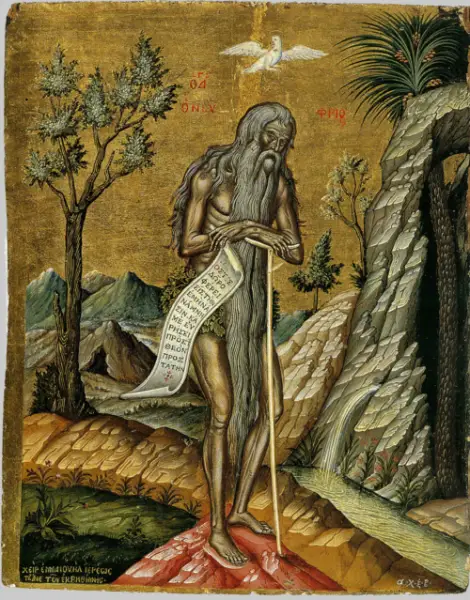
No hermit of the desert left a deeper mark on the Christian imagination. Artists early merged his likeness with that of the medieval wild man: he is painted as a creature covered entirely in hair and girdled with foliage, an appearance so characteristic that it made him patron saint of weavers, depicted as he was dressed only in his abundant hair and a loincloth of foliage. His figure shines from the frescoes of the Snake Church in the Göreme valley of Cappadocia, from the camposanto of Pisa, and from canvases by Battistello Caracciolo in Rome and Emmanuel Tzanes, whose painting of 1662 became the classic image of the bearded recluse. Rome dedicated the church of Sant'Onofrio to him on the Janiculan Hill during the 1400s. The monastery of Saint Onuphrius at Jablechna on the river Bug has for decades been where Orthodox seminarians in Poland begin their spiritual training; tradition says the saint chose the site himself, appearing to fishermen nearly four hundred years ago and leaving them an icon on the riverbank. In Jerusalem the monastery of Saint Onuphrius stands in the valley of Hinnom at Hakeldama, the field said to hold the grave of Judas, where a stone carving above the entrance shows the hermit bowing to an angel. Sicilians still pray to him when something is lost, trusting the miraculous properties of his hair.
§ Art
Timeline
- 320
Tradition records his birth in Ethiopia around this year, though the century of his life remains uncertain.
§ Life and legends
- 400
Tradition records his death in Egypt around this year after seventy years as a hermit.
§ Life and legends
- 1200
Archbishop Antony of Novgorod reported that Onuphrius's head was preserved in the church of Saint Acindinus in Constantinople.
§ Veneration
- 1520
Hans Schäufelein depicted the saint in a painting, part of the German veneration of the desert hermits.
§ Veneration
- 1650
In his Italian form, S. Onofrio, he was proclaimed joint patron of Palermo.
§ Art
- 1662
Emmanuel Tzanes painted his celebrated image of the saint, showing the wild hermit with long beard and leaf girdle.
§ Art
In Their Own Words
Come down to me, man of God, for I am a man also, dwelling in the desert for the love of God.
That may not be, thy work is in Egypt with thy brethren.
The Record
- Major works
- A life of seventy years of solitary prayer in the Egyptian desert
- Patron of
- patron of weavers·patron of jurists·patron of Centrache, Italy·co-patron of Palermo·helper in finding lost things (Sicilian folk devotion)
- Symbols
- loincloth of leaves·long beard and hair·hermit with an angel bringing him the Eucharist or bread·hermit with a crown at his feet
- Canonization
- Pre-congregation; venerated as a saint since late antiquity by the Catholic, Eastern Orthodox, and Oriental Orthodox churches
Prayer
Bibliography
Show 5 sources
- Butler, Alban; Burns, Paul (2000). Butler's Lives of the Saints. Continuum International Publishing Group, pp. 94-96.
- Gardiner, Alan H. (1936). "The Egyptian Origin of Some English Personal Names". Journal of the American Oriental Society 56 (2): 189-197. doi:10.2307/594666.
- Parshall, Peter W.; Schoch, Rainer (2005). Origins of European Printmaking. National Gallery of Art / Yale University Press, pp. 318-319.
- Stracke, Richard (20 October 2015). "Saint Onuphrius: The Iconography". Christian Iconography.
- "Saint Onuphrius". Patron Saints Index, 4 August 2008.
Profile text adapted from the Wikipedia article, licensed CC BY-SA 4.0.
Pray with this saint every day
Save St. Onuphrius to your favorites, read the full profile, and get feast-day reminders in the Saints app.
Get the Saints AppFree on the App Store for iPhone and iPad