
died 22 April 770·Feast April 22
St. Opportuna of Montreuil
Frankish abbess who mothered her nuns with gentle correction
Overview
Opportuna of Montreuil was a Frankish Benedictine nun and abbess who died on 22 April 770. Born at the castle of Exmes in Normandy into a family of rank, she entered the convent called the Monasteriolum near Almenêches while still young, where her cousin Lantildis served as abbess, and received the veil from her own brother Chrodegang, bishop of Séez. She later succeeded her cousin as abbess, governing the community with such patience that the conventional praise of her vita calls her a true mother to all her nuns, correcting their faults with words rather than blows. Her family paid a violent price for its position: Chrodegang, who had entrusted the administration of his diocese to the powerful Chrodobert during seven years in Rome, was murdered on the road while traveling the three miles from Séez to visit his sister at Montreuil. Opportuna, who had foreseen the killing in a prophetic vision yet could not prevent it, buried her brother in her own convent and died herself within the year, on 22 April 770, her brief illness compounded, some sources say, by grief. Within a century the bishop of Séez Adalhelm wrote her Vita et miracula, crediting her with saving his life and his see, and her relics, scattered by Viking raids, were honored at Moussy, Senlis, Almenêches, and Paris.
The Complete Life
A Noble Daughter of Normandy
Opportuna was born at the castle of Exmes, near Argentan and the place called Ayesmes, into the Frankish aristocracy of Normandy. Her family was bound to the church by ties of blood and office: her brother Chrodegang rose to become bishop of Séez, and her cousin Lantildis was abbess of a convent near Almenêches. While she was still young, Opportuna followed her cousin into religion, becoming a Benedictine nun at the convent known as the Monasteriolum, a name that translates as little monastery and that later passed to Montreuil-la-Cambe. It was from her brother's hands that she received the veil, an unusually personal bond between a religious sister and her diocesan bishop, though learned readers caution against confusing her Chrodegang with the more famous Chrodegang of Metz, whose recorded life contains nothing of the murder her story tells. The geography of her life remained intimate: Montreuil, the abbey she would one day govern, stood only three miles from the episcopal city of Séez, so that the two houses of her family, the convent and the cathedral, lay within an easy walk of each other. That short distance would become the setting of the tragedy that closed her life, for it was on the road between the two that her brother met his death.
§ Life
A True Mother to Her Nuns
In time Opportuna succeeded her cousin Lantildis as abbess of Montreuil, taking up the government of a Benedictine community in an age when the abbess's office carried both spiritual and temporal authority. The portrait her vita draws is one of maternal firmness. Traditional praise names her a true mother to every sister in her charge, and the record is careful to note something her biographers thought significant enough to single out: she corrected the faults of the sisters with words, not blows, in an era when corporal discipline in religious houses went largely unremarked. The miracle story attached to her governance shows the same character. In the tale told of her governance, a countryman made off with one of the convent's donkeys and would not own to the theft. Opportuna left the matter in heaven's hands rather than pursue him, and by morning the man's field lay sown with salt; the chastened thief brought back the animal and handed the field over to the nuns as well. The tale belongs to the literature of saintly justice rather than charismatic power, and it presents the abbess as an intercessor whose patience converts wrongdoers. In it, the mother of the community extends her protection beyond the cloister walls to the convent's lands, its animals, and even its neighbors.
§ Hagiography
Sanctity Without Signs
The hagiography of Opportuna reveals a distinctively Carolingian ideal of holiness. In Julia Smith's reading, sanctity of the Carolingian type never announced itself through charismatic deeds while the saint lived, and Opportuna performed no wonders in her own day. Smith judges the whole Carolingian period an interlude in the story of sainthood: an age in which ascetics, healers, prophets, and visionaries left no imprint, because its bishops fought every such expression of holiness. The miracles in Opportuna's story belong instead to the site of her tomb, where the account of wonders worked at her grave reminded readers and hearers that the abbess had never left the precincts she once governed, and watched over her sisters' successors across the generations. Yet the vita does record one exercise of the prophetic gift, handled carefully by its author: Opportuna foresaw her brother's murder in a vision, but was powerless to intervene. The vision serves the story's theology rather than the saint's reputation for wonders, showing a holy woman who sees and suffers but does not perform. In the vision Adalhelm describes, she is summoned to heaven by the martyrs Cecilia and Lucy. Holiness, in her case, meant fidelity in office, gentleness in correction, and endurance of grief rather than any display of power.
§ Hagiography
The Murdered Brother and the Mourning Sister
The last year of Opportuna's life was overshadowed by violence within her own family. Her brother Chrodegang had entrusted the administration of his diocese of Séez to Chrodobert, a powerful relation, during an absence of seven years in Rome. When the bishop returned, the trust proved fatal: Chrodobert plotted his murder, and on the road to visit his sister at the abbey of Montreuil, barely three miles from his own cathedral city, Chrodegang was killed. He died on 3 September 769. Opportuna, who had foreseen the crime in a prophetic vision, could do nothing to stop it; her power, like that of most women of her rank and century, stopped at the edge of the political intrigue that destroyed him. What she could do, she did: she buried her brother in her own convent at Montreuil, keeping his remains within the walls where she ruled. The loss broke her health. Some sources relate that she died of a brief illness compounded by grief for her brother's death, and Adalhelm's account envisions the dying abbess being called to heaven by Saint Cecilia and Saint Lucy. Whatever the precise cause, she survived him by little more than half a year, dying on 22 April 770 at Montreuil, where her community laid her to rest.
§ Life
A Local Cultus That Endured
Opportuna was never entered in the general martyrologies, and no formal act of canonization ever named her a saint; her veneration belongs entirely to the local tradition of the Frankish church. The devotion paid her there, however, has never been interrupted. Almenêches claimed her as patroness, Paris counted her among its protecting saints, and the acta of Chrodegang, her murdered kinsman, sang her praises, linking the two memories together. Within a century of her death, between about 885 and 888, Adalhelm, bishop of Séez, composed her Vita et miracula, a work he undertook in the conviction that he owed the saint his life and his see; the bishop later rendered in tradition as Adelin thus became the first and chief witness to her story. The Diocese of Séez keeps her as its own patroness to this day. Her feast falls on 22 April, the anniversary of her death, and she is venerated in both the Roman Catholic and Eastern Orthodox churches. The miracle literature gathered around her tomb, in which the abbess continues to protect her former precincts, sustained a devotion strong enough to survive the destruction of her monasteries and the scattering of her relics across northern France.
§ Veneration
Relics Scattered and Gathered
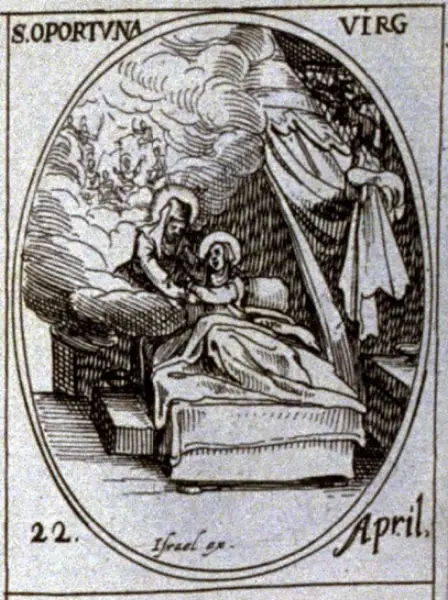
The afterlife of Opportuna's relics traces the troubled history of the Norman church. The sources place the catastrophe in the days of Charles the Bald, when Norse raiders overran the region: Montreuil's convent and the abbey of Almenèches alike went up in flames, and the abbess's remains were carried for safety to the priory of Moussy before journeying on to Senlis. In 1374 an arm bone and a rib of hers were placed in a modest Paris chapel that bore her name, beside the hermitage known as Notre Dame des Bois, and the building expanded as the capital grew around it. Her relics remain divided among the houses that protected them: the greater part of her head lies at Moussy, her left arm and a portion of skull at Almenèches, and a jawbone in the priory of Saint Chrodegang at Île-Adam, while her Paris shrine is carried in procession alongside the relics of Saints Honoré and Geneviève. Her story continued to attract writers long after the Middle Ages; Nicolas Gosset published a Vie et Miracles de Ste Opportune in the seventeenth century, and Jacques Callot engraved the scene of the Virgin appearing at her deathbed around 1630. In art she bears the abbess's crozier and a casket of relics, or is shown in princessly guise holding cherries in a basket beneath the royal lily of France.
§ Iconography
Timeline
- 3 Sep 769
Her brother Chrodegang, bishop of Séez, was murdered on the road to Montreuil in a plot planned by Chrodobert.
§ Life
- 22 Apr 770
Died at Montreuil, her illness compounded by grief for her murdered brother, and was buried in her own convent.
§ Life
- 885
Adalhelm, bishop of Séez, composed the Vita et miracula Sanctae Opportunae, crediting the abbess with his life and see.
§ Hagiography
- 1374
Her right arm and one rib were placed in a small church bearing her name in Paris, beside the hermitage of Notre Dame des Bois.
§ Veneration
- 1659
Nicolas Gosset published La Vie et Miracles de Ste Opportune Abbesse, a new account of her life and wonders.
§ Hagiography
In Their Own Words
A true mother to all her nuns
The Record
- Major works
- Benedictine convent of Montreuil, governed as abbess·Burial and shrine of her brother Chrodegang at Montreuil
- Patron of
- patroness of Almenêches·among the patrons of Paris·patroness of the Diocese of Séez
- Symbols
- abbess's crozier·casket of relics·the Virgin appearing at her deathbed·princess with a basket of cherries·fleur-de-lys
- Canonization
- Pre-congregation; cultus flourished locally from the time of her death, praised in the acta of her kinsman Chrodegang
Prayer
Bibliography
Show 5 sources
- Smith, Julia M. H. "The Problem of Female Sanctity in Carolingian Europe c. 780-920". Past and Present, No. 146 (February 1995), pp. 3-37.
- Rabenstein, Katherine (April 1999). "Opportuna of Montreuil, OSB". Saints O' the Day for April 22.
- Smith, William and Wace, Henry. A Dictionary of Christian Biography, Literature, Sects and Doctrines, "Opportuna".
- Butler, Alban (1864). "St. Opportuna". Butler's Lives of the Saints.
- Gosset, Nicolas (1659). La Vie et Miracles de Ste Opportune Abbesse (first ed. 1654).
Profile text adapted from the Wikipedia article, licensed CC BY-SA 4.0.
Pray with this saint every day
Save St. Opportuna of Montreuil to your favorites, read the full profile, and get feast-day reminders in the Saints app.
Get the Saints AppFree on the App Store for iPhone and iPad