
died c. 387·Feast June 4
St. Optatus of Milevis
Bishop whose writings answered the Donatist schism
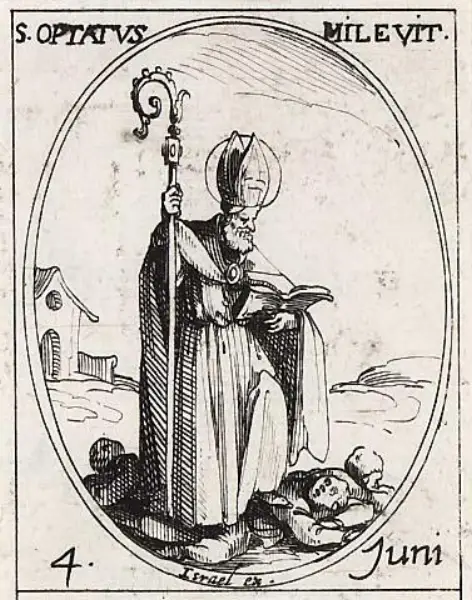
Overview
Optatus was bishop of Milevis in Numidia during the fourth century, remembered chiefly for his writings against Donatism. Augustine of Hippo counted him among those illustrious converts who came forth out of Egypt as a booty of gold and silver, grouping him with Cyprian, Lactantius, Victorinus, and Hilary. His great work, an untitled treatise now known as Against the Donatists, answered Parmenianus, who held the Donatist throne at Carthage as heir of Donatus himself. Jerome reports that it appeared in six books under the emperors Valens and Valentinian I; seven books are now known, the seventh being an appendix to a revised edition in which Optatus updated his lists of popes and Donatist antipopes. The original books were published around 366 to 370, and the second edition around 385 to 390. Among the church fathers Optatus is notable for his mildness toward schismatics: he distinguished them from heretics, granting them true doctrine and true sacraments, and argued that the one church must be the catholica spread throughout the world rather than a faction confined to a corner of Africa. His teaching that the sacraments are holy in themselves, not through men, anticipated Augustine, and he urged that returning Donatists be received for the sake of charity and unity. He died around 387.
The Complete Life
A Convert of Roman Africa
Almost nothing is recorded of Optatus before his episcopate. He served as bishop of Milevis, a town in Numidia in the North African heartland that Donatism had torn apart, and his very name has sometimes been anglicized as Optate in the older literature. The single clue to his origins comes from Augustine of Hippo, who suggests that Optatus was a convert. In the De doctrina Christiana Augustine asks whether we do not see with what spoils of gold, silver, and raiment Cyprian, that gentlest of doctors, marched out of Egypt, naming Lactantius, Victorinus, Optatus, and Hilary alongside him, a figure of speech comparing learned men who passed from pagan culture to the service of the gospel with the Israelites despoiling the Egyptians. If Augustine's implication is right, the bishop of Milevis came to the faith from the educated pagan world, bringing its learning with him. He lived among a people for whom the memory of the Diocletian persecution, which had ravaged the African church in 303 to 305, remained the raw material of argument, for it was from that persecution's compromises that the Donatist movement had been born. Into that wounded church, still divided over who had stood fast and who had fallen, Optatus brought both charity and a lawyer's precision.
§ Biography and context
Bishop of a Divided Land
Optatus's ministry was defined by the see he held and the schism he confronted. As bishop of Milevis in Numidia, he shepherded a church whose unity had been broken by the Donatist movement, which claimed to be the one true and unsullied church of Africa and condemned the broader communion as betrayed and invalid. His answer to that claim was the work now known as Against the Donatists, composed as a direct reply to Parmenianus, heir of Donatus in the Donatist primacy of Carthage. According to Jerome, the treatise was written in six books under the emperors Valens and Valentinian I, between 364 and 375; internal evidence fixes the first books around 366 to 370, for Optatus remarks that more than sixty years had passed since the Diocletian persecution and treats the heretic Photinus as still living. Seven books survive, and the list of popes in the work runs as far as Siricius, elected in 384, which points to a second edition published around 385 to 390; the seventh book, which Jerome in 392 did not know, appears to be an appendix to that revised edition, extending both the Catholic and the Donatist episcopal lists. The work thus grew with the aged bishop's continuing care for the schism.
§ Biography and context
Answering Parmenianus
The argument of Against the Donatists turns on the question both sides shared: where is the one church that all agreed must exist? Optatus answers that it cannot be confined to a corner of Africa but must be the catholica, using the word as a substantive, the church spread throughout the whole world. Six dotes, or marks, of the church had been listed by Parmenianus; Optatus grants five of them and contends that the first, the cathedra or episcopal chair, belongs to the Christians, so that all the others follow with it. Strikingly, he does not defend the Catholic claim by tracing the legitimacy of the succession at Carthage, where the whole quarrel had arisen, but points instead to Rome: it was there, upon Peter first, that the episcopal chair was granted, the chair on which the head of the apostles had sat, and around that single seat all were to keep unity; whoever raises another against it makes himself a schismatic. He then mocks the recent line of Donatist antipopes at Rome, Victor, Bonifatius, Encolpius, Macrobius, Lucianus, and Claudianus, whose jumbled succession he catalogs. To the appended documents of his work we owe six letters attributed to Constantine that show the emperor's personal involvement in the controversy between 312 and 330.
§ Doctrine
Mildness Toward the Separated
Among the church fathers who wrote against schism, Optatus is notable for mildness. He distinguishes between schismatics and heretics, granting that the former have rejected unity but retain true doctrine and true sacraments, and he concludes that Parmenianus was wrong to hold the threat of eternal damnation over them. Behind the polemic stands a theology of the sacraments he shares with his opponents' own master: against the Donatist doctrine, inherited from Cyprian, that baptism administered outside the church cannot be valid, Optatus argues especially in his fifth book that the baptizer's own faith is irrelevant, because the grace comes from God alone. His formula has become famous: the sacraments are holy in themselves, not through men. Baptism requires three parties, the divine Trinity, the one baptized, and the minister, ranked in that order, with the minister the least of the three. His indignation is reserved for sacrilege against sacred things: what is so profane, he asks, as to break, scrape, or carry off altars on which those very accusers had once made their offerings, where the Almighty had been called upon and the Spirit had come down; an altar, he demands, is nothing less than the seat of Christ's Body and Blood. In the seventh book he pleads that returning Donatists be received for charity and unity, appealing to Peter's fall: after the denial none of the fellow apostles broke with him.
§ Doctrine
A Saint Without a Cultus
Optatus stands among the saints of the church in an unusual position: he has apparently never received any ecclesiastical cultus. No church claims his tomb, no medieval hagiography embellished his life, and no ancient martyrology or calendar so much as mentions him. The church nonetheless kept his memory: the Roman Martyrology received his name under 4 June, the date on which the Latin church has since commemorated him, and he is venerated in the Eastern Orthodox Church on the same day. He is honored as a Church Father, numbered among the fathers who are saints of the Catholic Church and remembered as bishop and confessor rather than as martyr. The quietness of his cult matches the character of his sanctity: unlike the charismatic ascetics of the desert, his claim to veneration rests on the written defense of unity, a book rather than a legend. That book kept his name alive through centuries in which no shrine would have done so, copied and printed from the editio princeps of 1549 onward, so that the bishop of a small Numidian see, of whose life almost nothing is known, remains present to the church through the argument he left behind.
§ Veneration
The Father Whom Augustine Followed
Optatus's legacy runs through the book he left and the documents it preserved. Against the Donatists was the first great Catholic answer to Parmenianus, and its arguments, the worldwide mark of the true church, the chair of Peter as the seat of unity, the objective holiness of the sacraments, and the reception of penitent schismatics with charity, were taken up and completed by Augustine of Hippo in the following generation, whose anti-Donatist writings carried the African church's case to its conclusion. The appendix of Optatus's work preserved a dossier of ten official documents on the schism, apparently collected by a Catholic controversialist between 330 and 347; six purport to be letters of Constantine, and their authenticity, debated since the nineteenth century by scholars from Otto Seeck and Pierre Batiffol to Louis Duchesne and Charles Odahl, is now generally accepted. M. W. Edwards has argued the appendix was compiled not by Optatus himself but by an African of the Catholic party with access to public records. The text's own transmission tells its own story: printed first by Cochlæus at Mainz in 1549, corrected from further manuscripts by Balduinus at Paris, edited by Dupin and enshrined in Migne's Patrologia Latina, and given its best critical edition by Ziwza in Vienna in 1893.
§ The Constantinian Letters in the Appendix of Against the Donatists
Timeline
- 366
Published the first books of his work against the Donatists, written about sixty years after the Diocletian persecution.
§ Biography and context
- 385
Issued a second edition of his anti-Donatist work, adding the seventh book and updating the episcopal lists.
§ Biography and context
- 387
Died at Milevis in Numidia around this year.
§ Biography and context
- 392
Jerome, writing his De viris illustribus, knew his treatise only in its six-book form.
§ Biography and context
- 1549
The editio princeps of his work was published by Cochlæus at Mainz.
§ Sources
- 1893
Ziwza produced the best critical edition of his writings in the Corpus Scriptorum Ecclesiasticorum Latinorum at Vienna.
§ Sources
In Their Own Words
Sacramenta per se esse sancta, non per homines
Do we not see with how great a booty of gold and silver and garments Cyprian, doctor suavissimus, came forth out of Egypt, and likewise Lactantius, Victorinus, Optatus, Hilary?
The Record
- Major works
- Against the Donatists (originally untitled, in six then seven books)·Appendix of ten documents on the Donatist schism, including six letters of Constantine
- Canonization
- Never received an ecclesiastical cultus; his name was inserted in the Roman Martyrology on 4 June
Prayer
Bibliography
Show 7 sources
- Edwards, M. W. (1997). Optatus: Against the Donatists. Translated Texts for Historians Vol. 27. Liverpool: Liverpool University Press. ISBN 9780853237525.
- Lenski, N. (2016). "Constantine and the Donatists: Exploring the Limits of Religious Toleration", in Religiöse Toleranz: 1700 Jahre nach dem Edikt von Mailand. Berlin/Boston: Walter de Gruyter, pp. 101-140.
- Corcoran, Simon (1996). The Empire of the Tetrarchs. Oxford: Clarendon Press, p. 22. ISBN 0198149840.
- Seeck, Otto (1889). "Quellen und Urkunden über die Anfänge des Donatismus". Zeitschrift für Kirchengeschichte 10: 505-568.
- Duchesne, Louis (1890). "Le dossier de Donatisme". Mélanges d'archéologie et d'histoire 10: 589-650. doi:10.3406/mefr.1890.6653.
- Odahl, Charles (June 1993). "Constantine's Epistle to the Bishops at the Council of Arles: A Defence of Imperial Authorship". The Journal of Religious History 17 (3): 274-289. doi:10.1111/j.1467-9809.1993.tb00722.x.
- Herbermann, Charles, ed. (1913). "St. Optatus". Catholic Encyclopedia. New York: Robert Appleton Company.
Profile text adapted from the Wikipedia article, licensed CC BY-SA 4.0.
Pray with this saint every day
Save St. Optatus of Milevis to your favorites, read the full profile, and get feast-day reminders in the Saints app.
Get the Saints AppFree on the App Store for iPhone and iPad