
died c. 548·Feast October 27
St. Oran
First Christian buried on the island of Iona
Overview
Oran — Odhrán in Irish, Otteranus in Latin — was a sixth-century Irish monk honored as the first Christian to be buried on Iona. By tradition a descendant of Conall Gulban, he spent more than forty years at Silvermines in County Tipperary, where he built a church in 520; Irish tradition also makes him abbot of Meath and founder of Lattreagh. In 563 he joined the party of twelve who crossed the sea to Iona in Columba’s company, where he died and was buried. His grave gave its name to Reilig Odhráin, the cemetery around the oldest church on the island. Legend tells that Columba, unable to make the chapel walls stand, laid Oran living beneath them with his consent, and that Oran, lifting his head once more, spoke words about heaven and hell that led the abbot to have the earth heaped over him again — one of the rare instances of foundation sacrifice recorded in Britain. He is patron of Silvermines and, since 1096, of Waterford, and his feast is kept on 27 October.
The Complete Life
An Irish Life Before Iona
Oran — in Old Irish Odrán and in Latin Otteranus — is remembered by tradition as a descendant of Conall Gulban, the northwest kindred that also claimed Columba himself. The greater part of his Irish years was spent at Silvermines in County Tipperary, where he is said to have lived for more than forty years. There, in the year 520, he raised a church, and the parish kept his memory as its patron long afterwards. Irish tradition also links him with the midlands: he is described as having served as abbot of Meath and as the founder of Lattreagh. These offices suggest a monk of standing well before he ever saw the Hebrides, a man entrusted with the care of communities rather than a newcomer to the religious life. Nothing in the surviving record fixes the date of his birth or names his parents; what the tradition preserves is the shape of a long Irish ministry — forty years in one place, a church built, a house governed, a foundation planted — that ended, when he was already an old disciple, on a small island in the Atlantic whose burial ground still carries his name.
§ Life
The Foundation of Iona and the Burial Beneath the Chapel
In 563 Oran was among the twelve companions who sailed with Columba from Ireland to Iona, the island off the Scottish coast where the party sought ground for a monastery. He did not long survive the landing, for he died there and was buried on the island — the first Christian, tradition insists, to be laid in its soil. Columba is said to have beheld angels and demons contending over his soul before it rose to heaven, a vision marking how highly his death was regarded. A darker story grew around that burial. The chapel Columba tried to build would not stand: every morning the builders returned to find the previous day's work undone, and a voice declared that the walls would never rise until a living man was laid beneath the foundations. Oran consented to be buried alive, and the chapel was raised over him. When he afterwards lifted his head from the earth and spoke of heaven and hell in terms that alarmed the abbot, his body was hurriedly covered again — in some tellings moved to consecrated ground, in others simply buried deeper. The tale stands as one of the few recorded instances of foundation sacrifice in Great Britain.
§ Life
Patron of Iona, Waterford, and Silvermines
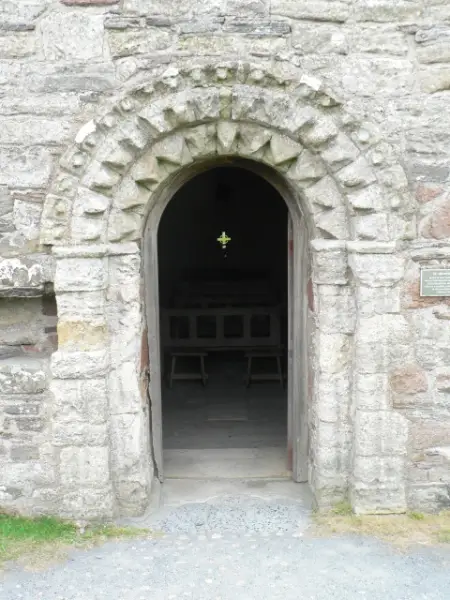
The oldest surviving church on Iona is dedicated to Oran, and the great cemetery around it is called Reilig Odhráin — Odhrán's burial place — in his memory. In Ireland his patronage endured at Silvermines in County Tipperary, and in 1096 the Norse of Waterford chose him as patron of their city, a devotion later extended to the diocese; his Latin name Otteran survives there even in the name of an aircraft. Folklorists have set the burial legend beside ancient beliefs about securing buildings with human victims: George Henderson compared it to the tale of Dinas Emris, where Vortigern was counselled to sacrifice a fatherless child so that his fortress would stand, and argued that the story, though absent from Adomnán's Life of Columcille, points to a deep stratum of folk-belief. Because his name resembles that of Odran, the first Irish Christian martyr, the two have sometimes been identified, each having given himself freely for the work of a better-known saint. The legend continues to find tellers: Neil Gaiman retold it in his poem In Relig Odhrain, and a 2019 animated short and a song by Stephen McDonald have carried the story to new audiences.
§ Legacy
Timeline
- 520
Built a church at Silvermines in County Tipperary, where he had lived for over forty years.
§ Life
- 548
Recorded by tradition as the year of his death, although the Iona account places his burial there after 563.
§ Life
- 563
Sailed with Columba among twelve companions to Iona, where he died and was buried, the first Christian grave on the island.
§ Life
- 1096
Adopted by the Norse as patron of their city of Waterford, and later of the diocese.
§ Legacy
- 2015
Neil Gaiman's poem retelling the story of his death, In Relig Odhrain, was published.
§ In culture
- 2019
A short animated film built on Gaiman's poem, The Grave of St. Oran, reached the screen under Jim Batt's direction.
§ In culture
In Their Own Words
There is no Hell as you suppose, nor Heaven that people talk about
The Record
- Major works
- Church at Silvermines, County Tipperary·Foundation of Lattreagh
- Patron of
- Waterford, Ireland·Silvermines parish, County Tipperary·atheists
- Canonization
- Pre-congregation; venerated since early times in the Catholic, Orthodox, and Anglican churches
Prayer
Bibliography
Show 6 sources
- Farmer, David Hugh (1987). The Oxford Dictionary of Saints. Oxford University Press. 2nd Edition. ISBN 0-19-869149-1
- Finola (9 December 2018). "Patron Saint of Atheists?". roaringwaterjournal.com
- "Silvermines". Killaloe Diocese. Retrieved 25 May 2015.
- MacLeod Banks, M. (1931). "A Hebridean Version of Colum Cille and St. Oran". Folklore. 42 (1): 55–60. JSTOR 1256410.
- Henderson, George (1911). Survivals in Belief Among the Celts. p. 278.
- "Patron Saints of the Diocese". Diocese of Waterford and Lismore. Retrieved 25 May 2015.
Profile text adapted from the Wikipedia article, licensed CC BY-SA 4.0.
Pray with this saint every day
Save St. Oran to your favorites, read the full profile, and get feast-day reminders in the Saints app.
Get the Saints AppFree on the App Store for iPhone and iPad