
1449 – 1505·Feast June 18
St. Osanna of Mantua
Dominican tertiary, mystic, and stigmatic of Mantua
Overview
Osanna Andreasi, called Hosanna, was an Italian Dominican tertiary of the late fifteenth century whose reputation as a mystic and stigmatic drew all Mantua to her door. Born into the nobility — her father Niccolò Andreasi traced his family to Hungary, and her mother was Agnese Gonzaga — she turned from an arranged marriage to consecrated life, secretly receiving the habit of the Third Order of Saint Dominic at fourteen. She waited thirty-seven years to complete her vows, caring for her brothers and sisters after her parents died. At thirty she received the marks of Christ's Passion on her head, side, and feet, and thereafter lived the sufferings of the Passion with special intensity each Wednesday and Friday. She fell into ecstasies when she spoke of God, subsisted on almost no food, and spent her family's fortune on the poor and sick, while serving as spiritual director to nobles and commoners alike. Francesco II Gonzaga and Isabella d'Este sought her as a guide in spiritual and political matters, and her correct forecasts of events won her a name as a seer. She died at Mantua on 18 June 1505, and the whole nobility and clergy walked in her funeral procession.
The Complete Life
A Noble Daughter of the Gonzaga State
Osanna Andreasi entered the world on 17 January 1449 at Carbonara di Po, in the March of Mantua, a child of the city's ruling class: her father Niccolò Andreasi came of a family that had originated in Hungary, and her mother was Agnese Gonzaga, of a name that ruled Mantua. A pious tradition reports that at the age of six she had a vision of angels, the first token of a life that would be marked throughout by heavenly experiences. When her father arranged a marriage for her, she refused it, feeling herself called to a consecrated life she could not explain to him. At fourteen, in the year 1463, she went out secretly and received the habit of the Third Order of St. Dominic, an order she had come to love through the example of Catherine of Siena and of her own contemporary, the friar Girolamo Savonarola, both of whom embodied for her a life of strict self-denial. Returning home, she explained to her father that a vow bound her to wear it until her promise had been discharged, in keeping with an ancient custom — and so, remarkably, she did, for thirty-seven years.
§ Life
A Delayed Vow and a Miraculous Literacy
The vow Osanna had taken could have been completed at once, but she chose to wait nearly four decades before finishing it, so that after the death of her parents she could look after her brothers and sisters; only when that duty was discharged did she fulfill what she had promised. A legend likens her in this to Catherine of Siena: unable to read, she one day saw a piece of paper bearing two words and named them as Jesus and Mary, and from that hour, it is said, everything that concerned the spiritual life lay open to her understanding. Her true initiation into the Passion came in her thirtieth year, when the marks of the wounds showed themselves at her head, at her side, and upon her feet; in that same season a vision showed her heart made new and parted into four. All the rest of her life she experienced the sufferings of Christ actively, above all on Wednesdays and Fridays, though the red marks on her body, unlike some stigmatics', did not bleed. She confided these experiences only to few, chiefly to the Olivetan monk Dom Jerome of Mount Olivet, her biographer and spiritual son, and told him too that for years she had lived on practically no food at all.
§ Life
Mystic of the Passion and Servant of the Poor
Osanna's spiritual life joined extraordinary phenomena to thoroughly practical charity. Ecstasy carried her away whenever her talk turned to God, and visions would show her Christ walking beneath his cross. Yet the same woman spent herself on the poor and the sick of Mantua, drawing on her family's considerable fortune to relieve the unfortunate until little of it remained, and she served as spiritual director to a wide circle of souls. Among the religious of her own order she moved with ease: Columba of Rieti was her friend, and she sought counsel in turn from Stephana de Quinzanis, another Dominican stigmatic of the age. Her letters, preserved by her biographer, express what Father Benedict Ashley has described as an intense and constant suffering, both bodily and inward, borne up only by experiences of union with God that she herself could put into no more than broken and inadequate words. One grief weighed on her above others: the Church's degradation under the abusive Alexander VI, an evil she watched from the middle distance of her ecstatic prayer and mourned as a wound in the body she loved.
§ Relationship with Girolamo de Monte Oliveto
Counsellor of Princes and Voice of Rebuke
The fame of her holiness carried Osanna beyond the almshouses and sickrooms of Mantua into the palace itself. The city's ruling family took notice of the miracles and ecstasies that gathered crowds around her, and none more than Francesco II Gonzaga and his wife, the celebrated Isabella d'Este, who sought her out as a spiritual guide and, remarkably, as a counsellor on matters of state. Time and again her forecasts of coming events proved correct, and she acquired a public reputation as a seer — a role she exercised, by all accounts, without flattery. She spoke out plainly against the decadence of her age and criticized the aristocracy of Mantua for its lack of morality, a daring stance for a woman whose livelihood depended on the goodwill of those same houses. Her correspondence, addressed to fellow Dominicans and to the ruling family alike, moved freely between mystical reflection and hard-headed consideration of the social and political questions of the day, making her one of the rare laywomen of the Italian Renaissance whose judgment on public affairs was sought and recorded by the powerful.
§ Life
Death, Writings, and the Memory of Mantua
Osanna died at Mantua on 18 June 1505, at the age of fifty-six. The city turned out in full for her passing: nobility and clergy alike came to her funeral, and her body went in procession to the church of St. Dominic to be enshrined. Afterwards her remains were moved to the Cathedral of St. Peter — the cathedral of Mantua — where they are venerated still. Her literary legacy is small but unusual for a woman of her station and century: a corpus of letters known as the Lettere, addressed to readers ranging from her fellow Dominicans to the Gonzaga court, and the Colloqui Spirituali, dialogues on spiritual subjects conducted with Girolamo de Monte Oliveto Scolari. Dom Jerome, the monk who had become her spiritual son in her last years, wrote her vita in 1507, barely two years after her death, in the form of a detailed report of their conversations, appending Latin translations of twenty-four of her letters together with documents certifying their authenticity — an intimate portrait that remains the foundation of everything known about her inner life.
§ Relationship with Girolamo de Monte Oliveto
From Local Cult to the Dominican Calendar
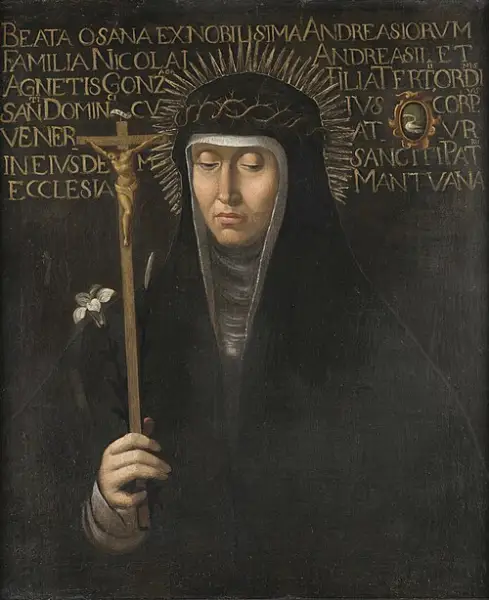
Osanna's veneration began in the city that had known her in the flesh. Within a decade of her death her fame had reached Rome: in response to a request made by the Marchesa Isabella d'Este during a visit to the city, Pope Leo X issued a papal brief on 8 January 1515 allowing her feast day to be kept in the City of Mantua. Formal recognition followed nearly two centuries later, when Pope Innocent XII confirmed her local cultus with a papal bull dated 24 November 1694, the act of beatification conferred at Saint Peter's Basilica in the presence of the Church's rites. Two months after that bull, the privilege was extended beyond Mantua to the whole of the Dominican Order, whose Third Order habit she had worn for so many years and whose great saints — Catherine of Siena foremost among them — had shaped her life from the beginning. Her feast is kept on 18 June, the anniversary of her death, and her imagery gathers the marks of her mysticism: a crown of thorns encircled by rays of light, the devil crushed beneath her feet, a broken heart from which a crucifix rises, a lily, and two angels at her side, one holding a lily and the other a cross.
§ Veneration
Timeline
- 17 Jan 1449
Born at Carbonara di Po in the March of Mantua, daughter of the noble Niccolò Andreasi and Agnese Gonzaga.
§ Life
- 1463
At the age of fourteen, was quietly clothed, in secret, with the habit of the Dominican Third Order.
§ Life
- 18 Jun 1505
Died at Mantua; the entire nobility and clergy followed her body in procession to the Church of St. Dominic.
§ Life
- 1507
Her confidant Dom Jerome of Mount Olivet wrote a vita of her life, recording their conversations and appending twenty-four of her letters.
§ Relationship with Girolamo de Monte Oliveto
- 8 Jan 1515
Pope Leo X, at the request of Marchesa Isabella d'Este, authorized the celebration of her feast in the City of Mantua.
§ Veneration
- 24 Nov 1694
Pope Innocent XII confirmed her local cultus by papal bull at Saint Peter's Basilica.
§ Veneration
- 1695
The confirmation of her cult was extended to the whole Dominican Order two months after the papal bull.
§ Veneration
In Their Own Words
Those words are 'Jesus' and 'Mary.'
The Record
- Major works
- Lettere (correspondence)·Colloqui Spirituali (spiritual dialogues with Girolamo de Monte Oliveto Scolari)
- Symbols
- crown of thorns and rays of light·the devil under her feet·a broken heart with a crucifix springing from it·a lily·two angels, one with a lily, one with a cross
- Canonization
- Beatified by Pope Innocent XII at Saint Peter's Basilica on 24 November 1694; feast in Mantua authorized by Pope Leo X in 1515
Prayer
Bibliography
Show 7 sources
- A. L. Redigonda, 'Andreasi, Osanna', Dizionario biografico degli italiani (DBI).
- Katherine Rabenstein (June 1998). "Blessed Hosanna of Mantua, OP Tert". Saints O' the Day for June 18.
- Terry Jones. "Osanna Andreasi". Patron Saints Index.
- Benedict Ashley. "Osanna d'Andreasi". Blessed Osanna d'Andreasi and Other Renaissance Italian Dominican Women Mystics.
- Plinio Corrêa de Oliveira. "Blessed Osanna of Mantua".
- Short Lives of the Dominican Saints, p. 208, Kegan Paul, Trench, Trubner & Co., Ltd., London, 1901.
- Roberta Ghirardini, Vita della Beata Osanna Andreasi.
Profile text adapted from the Wikipedia article, licensed CC BY-SA 4.0.
Pray with this saint every day
Save St. Osanna of Mantua to your favorites, read the full profile, and get feast-day reminders in the Saints app.
Get the Saints AppFree on the App Store for iPhone and iPad