
1917-1980·Feast March 24
St. Óscar Romero
Archbishop of San Salvador and Martyr
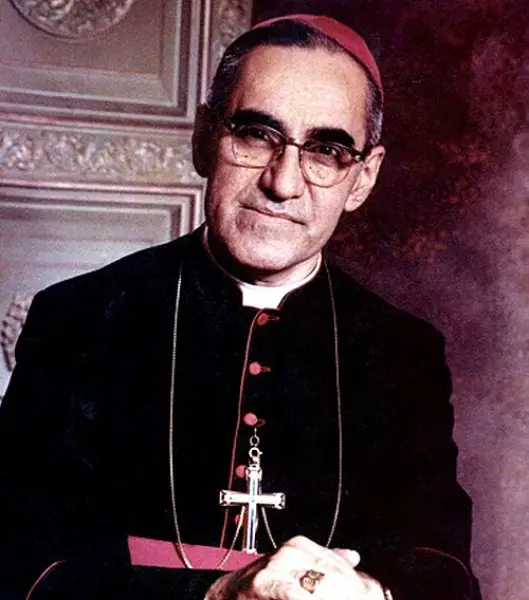
Overview
Óscar Arnulfo Romero y Galdámez, born at Ciudad Barrios in El Salvador's San Miguel department on 15 August 1917, was a carpenter's son whom his father apprenticed to the bench; the boy preferred the seminary. Schooled at San Miguel and San Salvador and then in Rome, he earned a theology licentiate at the Gregorian University with honours and was ordained there on 4 April 1942, his family kept away by wartime travel limits. Detained in Cuba on the journey home, he served more than twenty years as a parish priest of San Miguel, led the inter-diocesan seminary, and edited the archdiocesan paper before becoming auxiliary bishop in 1970 and bishop of the rural diocese of Santiago de María in 1974. Elevated to San Salvador in February 1977 as a supposedly safe conservative, he was changed by the murder of his friend Rutilio Grande a month later; from then on his Sunday radio sermons on YSAX, reciting the week's disappearances, tortures and killings to the largest audience in the country, made him the voice of the poor. He begged Washington in February 1980 not to arm the junta. On 24 March 1980 an assassin shot him dead at the altar while he celebrated Mass in the chapel of the Divina Providencia hospital; the UN Truth Commission concluded that Major Roberto D'Aubuisson had ordered the killing.
The Complete Life
Early Life
Óscar Arnulfo Romero y Galdámez was born at Ciudad Barrios, in El Salvador's San Miguel department, on 15 August 1917, one of the children of Santos Romero, a carpenter, and Guadalupe de Jesús Galdámez. His father apprenticed him to the carpenter's bench; the boy preferred the seminary, entering the minor seminary at San Miguel at thirteen. He continued his studies in San Salvador and then in Rome, where he earned a licentiate in theology at the Gregorian University with honors and was ordained a priest on 4 April 1942, his family kept away by wartime travel restrictions. Returning home — detained in Cuba along the way when the ship was intercepted — he served more than twenty years as a parish priest of San Miguel, then led the inter-diocesan seminary and edited the archdiocesan paper.
§ Introduction
Bishop and Archbishop
Romero was appointed auxiliary bishop of San Salvador in 1970 and bishop of Santiago de María, a poor rural diocese, in 1974. In February 1977 he was elevated to the see of San Salvador, chosen as a supposedly safe conservative pastor. A month later, on 12 March 1977, his friend the Jesuit Rutilio Grande was murdered with companions, and the murder changed him: from then until his death, his Sunday homilies broadcast on radio station YSAX — reciting the week's disappearances, tortures and killings, naming the dead of both sides, and preaching to the largest audience in the country — made him the voice of the poor of El Salvador. He wrote open letters to the government and the death squads; in February 1980 he begged Washington, in a letter to President Carter, not to arm the junta, warning that military aid would sharpen the repression.
§ Bishop and Archbishop
Spirituality and Teaching
Romero's teaching was forged in those three years. Peace, he said, is not the product of terror or fear, and not the silence of cemeteries; peace is the fruit of justice. He taught the Salvadoran poor — his aspire not to have more, but to be more — and he insisted on the Church's option for the poor as the very meaning of the gospel in his country, against a coalition of landowners, security forces and ideology that read the gospel as social order. His homilies, taken down and printed, constitute one of the great bodies of preaching of the century: a running moral record of a country at war with its own people. To feel with the Church — Sentire cum ecclesia — was the motto he took, and in practice he gave it a new reading: feeling with the Church means feeling with the people of God in their suffering.
§ Introduction
Martyrdom
On 24 March 1980, celebrating evening Mass in the chapel of the Hospital de la Divina Providencia, where he lived, Romero was shot through the heart by a sniper from a car outside the door. He had just finished his homily, preached on the text that one who gives his life for his friends gives the greatest love. His funeral, a week later in the cathedral square, was itself attacked by bombs and gunfire, killing dozens of mourners. His murderers were never brought to justice in El Salvador; a UN truth commission later traced the order to a death-squad commander, and a U.S. court found the same man liable in a civil suit in 2004.
§ Introduction
Canonization
Romero's cause was long entangled in politics and in debate over whether he was killed in hatred of the faith or in political conflict. Pope Francis cut the knot: on 3 February 2015 he signed the decree declaring Romero a martyr, killed in odium fidei — the first martyr so recognized for being killed, as Francis put it, while celebrating the Eucharist. He was beatified in San Salvador on 23 May 2015, before a crowd of hundreds of thousands, by Cardinal Angelo Amato representing the pope, and canonized by Francis in Saint Peter's Square on 14 October 2018. His feast is 24 March.
§ Introduction
Legacy
Romero is the emblematic martyr of the late twentieth-century Church of the Americas, honored in the Catholic Church, the Anglican Communion and the Lutheran churches alike. His statue is among the modern martyrs on the west front of Westminster Abbey. For Latin America his name sums the option for the poor; for the universal Church, the conversion of a cautious, pious, bookish man into a prophet — the story of 1977 — is the lesson his life teaches. In El Salvador he is the country's great modern figure, his tomb in the cathedral of San Salvador a place of national pilgrimage. The homilies on YSAX, recorded and preserved, are the primary monument of his voice.
§ Introduction
Timeline
- 15 Aug 1917
Born in Ciudad Barrios, San Miguel, El Salvador, to Santos Romero and Guadalupe de Jesús Galdámez
§ Early life
- 11 May 1919
Baptized as a one-year-old by Father Cecilio Morales
§ Early life
- 1941
Receives a Licentiate in Theology cum laude from the Gregorian University in Rome
§ Priesthood
- 4 Apr 1942
Ordained a priest in Rome; his family cannot attend because of wartime travel restrictions
§ Priesthood
- 1943
Summoned home from Italy by his bishop at age 26; he and a companion are detained for months in Cuban internment camps
§ Priesthood
- 1966
Chosen Secretary of the Bishops Conference for El Salvador and becomes director of the archdiocesan newspaper Orientación
§ Priesthood
- 25 Apr 1970
Appointed auxiliary bishop of San Salvador and titular bishop of Tambeae
§ Bishop and Archbishop
- 21 Jun 1970
Consecrated a bishop by Girolamo Prigione, titular Archbishop of Lauriacum
§ Bishop and Archbishop
- 15 Oct 1974
Appointed Bishop of Santiago de María, a poor rural diocese
§ Bishop and Archbishop
- 3 Feb 1977
Appointed Archbishop of San Salvador, a welcome move for the government but a disappointment to progressive priests
§ Bishop and Archbishop
- 22 Feb 1977
Assumes office as Archbishop of San Salvador
§ Bishop and Archbishop
- 12 Mar 1977
His friend Father Rutilio Grande is assassinated, profoundly changing Romero's ministry into open denunciation of injustice
§ Bishop and Archbishop
- 11 May 1979
Meets Pope John Paul II, but fails to win a Vatican censure of El Salvador's military regime and its death squads
§ Bishop and Archbishop
- Feb 1980
In an open letter he warns President Carter that more American military aid would only deepen injustice and repression
§ Bishop and Archbishop
- 23 Mar 1980
In his last sermon calls on Salvadoran soldiers to stop carrying out government repression and human rights violations
§ Assassination
- 24 Mar 1980
Shot in the heart by a gunman while celebrating Mass at the chapel of the Hospital de la Divina Providencia
§ Assassination
- 1993
His sainthood cause is opened at the Vatican, then delayed for years over debate about whether he died for faith or politics
§ Process for beatification
- 1997
Pope John Paul II bestows the title Servant of God
§ Introduction
- Dec 2012
Pope Benedict XVI decides to unblock the beatification cause, allowing it to move forward
§ Process for beatification
- 3 Feb 2015
Pope Francis authorizes promulgation of the decree of martyrdom, clearing the way for beatification
§ Beatification
- 23 May 2015
Beatified in San Salvador before an estimated 250,000 people, with Cardinal Amato presiding for Francis
§ Beatification
- 6 Mar 2018
Pope Francis approves the miracle needed for canonization; the date is set at a consistory on 19 May
§ Canonization
- 14 Oct 2018
Canonized by Pope Francis in Saint Peter's Square, becoming the first native saint of Central America
§ Canonization
In Their Own Words
We have never preached violence, except the violence of love, which left Christ nailed to a cross, the violence that we must each do to ourselves to overcome our selfishness and such cruel inequalities among us.
You say that you are Christian. If you are really Christian, please stop sending military aid to the military here [El Salvador], because they use it only to kill my people.
The Record
- Major works
- Weekly homilies broadcast on radio station YSAX (collected)·Archdiocesan newspaper Orientación (as editor)·Pastoral letters of the Archdiocese of San Salvador
- Patron of
- Christian communicators·El Salvador·The Americas·Archdiocese of San Salvador·Persecuted Christians·Caritas Internationalis (co-patron)
- Symbols
- Episcopal vestments·Crown of martyrdom·Martyr's palm·Rosary
- Canonization
- Declared a martyr by Pope Francis on 3 February 2015; beatified on 23 May 2015 in San Salvador; canonized by Pope Francis in St. Peter's Square on 14 October 2018
Prayer
Bibliography
Show 12 sources
- ↑ "Oscar Romero, patron of Christian communicators? (in Spanish)" . Aleteia . Retrieved 22 March 2015 .
- ↑ "Romero co-patrono di Caritas Internationalis" . Avvenire. 16 May 2015 . Retrieved 18 May 2015 .
- 1 2 3 4 5 6 "Archbishop St. Oscar Arnulfo Romero y Galdamez †" . Catholic-Hierarchy.org . Retrieved 10 December 2021 .
- ↑ Zraick, Karen (13 October 2018). "Óscar Romero, Archbishop Killed While Saying Mass, Will Be Named a Saint on Sunday" . The New York Times . ISSN 0362-4331 . Retrieved 9 May 2019 .
- ↑ Brockett, Charles D. (21 February 2005). Political Movements and Violence in Central America . Cambridge University Press . ISBN 9780521600552 . Retrieved 19 October 2016 .
- ↑ "Pope Francis sends letter for the beatification of Óscar Romero" . www.archivioradiovaticana.va .
- ↑ Lee, Michael E. (2018). Revolutionary Saint: The Theological Legacy of Oscar Romero . Orbis Books. p. 189. ISBN 9781626982260 .
- 1 2 Lee, Michael E. (2018). Revolutionary Saint: The Theological Legacy of Oscar Romero . Orbis Books. p. 193. ISBN 9781626982260 .
- 1 2 McLaren, Peter; Jandrić, Petar (2017). "From liberation to salvation: Revolutionary critical pedagogy meets liberation theology". Policy Futures in Education . 15 (5). Zagreb : SagePub : 636. doi : 10.1177/1478210317695713 .
- ↑ "Salvadoran archbishop asks pope to make Romero 'doctor of the church' " . 20 March 2019. Archived from the original on 15 October 2018.
- ↑ "Modern Martyrs" . Westminster Abbey . Retrieved 9 December 2025 .
- ↑ Edward S. Mihalkanin; Robert F. Gorman (2009). The A to Z of Human Rights and Humanitarian Organizations . Scarecrow Press . p. 220. ISBN 978-0810868748 – via books.google.com.
Profile text adapted from the Wikipedia article, licensed CC BY-SA 4.0.
Pray with this saint every day
Save St. Óscar Romero to your favorites, read the full profile, and get feast-day reminders in the Saints app.
Get the Saints AppFree on the App Store for iPhone and iPad