
died c. 700·Feast October 7
St. Osgyth
Mercian abbess and cephalophore martyr of Chich
Overview
Osgyth — her name also written Osyth, Sythe, Othith, or Ositha — was a Mercian noblewoman who became a nun, founded a priory near Chich in Essex, and died a martyr's death around the year 700. Quarrendon in Buckinghamshire saw her birth, daughter of Frithuwald, who ruled as a sub-king of Mercia in Surrey, and of Wilburh of the Mercian royal house, she was raised in the household of her saintly aunts Edith of Aylesbury and Edburga of Bicester and longed for the cloister. Politics had other designs: her father forced her into a dynastic marriage with Sighere, King of Essex, to whom she may have borne Offa of Essex. Seizing the days while her husband hunted a white stag, she persuaded two bishops to accept her vows, and Sighere at last relented, granting her land at Chich near Colchester, where she founded a convent and ruled as its first abbess. There, by some raiding pirates, perhaps because she resisted being carried off, she was beheaded. Veneration followed almost at once: she has been honored as a saint since the eighth century, and the village of St Osyth keeps her name to this day. Her feast is 7 October.
The Complete Life
Born to Kings, Raised by Saints
Osgyth was born at Quarrendon in Buckinghamshire, at that time part of the kingdom of Mercia, into the very top of that kingdom's nobility. Her father, Frithuwald, ruled as a sub-king of Mercia in Surrey; her mother, Wilburh, belonged to the royal house of Mercia itself. The family's piety matched its rank: in 675 her parents joined St. Erconwald in founding Chertsey Abbey, one of the great monasteries of the Thames valley. The girl was placed with her mother's sisters, St. Edith of Aylesbury and Edburga of Bicester, to be brought up under their eye, both holy women in their own right, and under their direction her ambition fixed early on the religious life — she meant to become an abbess. A legend told of her childhood shows the wonder that gathered round her name: sent by Edith to carry a book to Modwenna of Northumbria at her nunnery, she fell into a swollen stream while crossing a bridge and drowned, her absence unnoticed for two days because each abbess supposed the girl to be with the other. On the third day the aunts searched, found the child lying near the bank, prayed over her, and commanded her to rise from the water and come to them — and she did. Irish hagiography preserves a tale of much the same shape.
§ Legends
A Queen's Marriage and a Nun's Vows
However strong her desire for the cloister, Osgyth was too important a piece on the political board to be set aside. Her father compelled her into a dynastic marriage with Sighere, King of the East Saxons, and she is likely — though the sources cannot be certain — the mother of Offa of Essex. The marriage, however, ended in an unexpected way. While her husband was away on a long hunt, chasing a beautiful white stag through his own forests, Osgyth won over two bishops of the neighborhood, who received her profession as a nun. Sighere, coming home some days later and found his wife a bride of Christ, he reluctantly consented to her decision, and went further: he granted her land at Chich, near Colchester in Essex, the place now named St Osyth after her. There she established a convent and ruled as its first abbess, the ambition of her childhood fulfilled at last, not in spite of her royal marriage but through its strange unraveling. The story preserves in memorable form the collision between a noblewoman's vocation and the uses her family had for her, and the quiet persistence by which the vocation won.
§ Life
Abbess of Chich and Martyr by the Sea
As abbess of the convent at Chich, Osgyth governed the community she had founded on land given by her former husband, living as ruler and mother of the nuns she had gathered there. Her death came from outside the cloister wall: she was beheaded by raiding pirates who struck the Essex coast, perhaps, the tradition suggests, because she resisted being carried off by them. The manner of her dying made a deep impression. Some accounted it a martyrdom, and the Church of the following centuries received her as a martyr, though Bede, the great historian of the Anglo-Saxon Church, makes no mention of her at all — a silence that reminds how much of early English sanctity rests on foundations later than its age. In the legend that grew up around her end, she joined the company of the cephalophores, the saints who carry their own heads: after the executioner's blow she stood up, took her head in her hands like Saint Denis in Paris, and carried it as far as the door of a convent nearby, and fell there. Matthew Paris, writing in the thirteenth century repeated some of the legends that had gathered around her name.
§ Legends
Legends, Springs, and Pilgrims
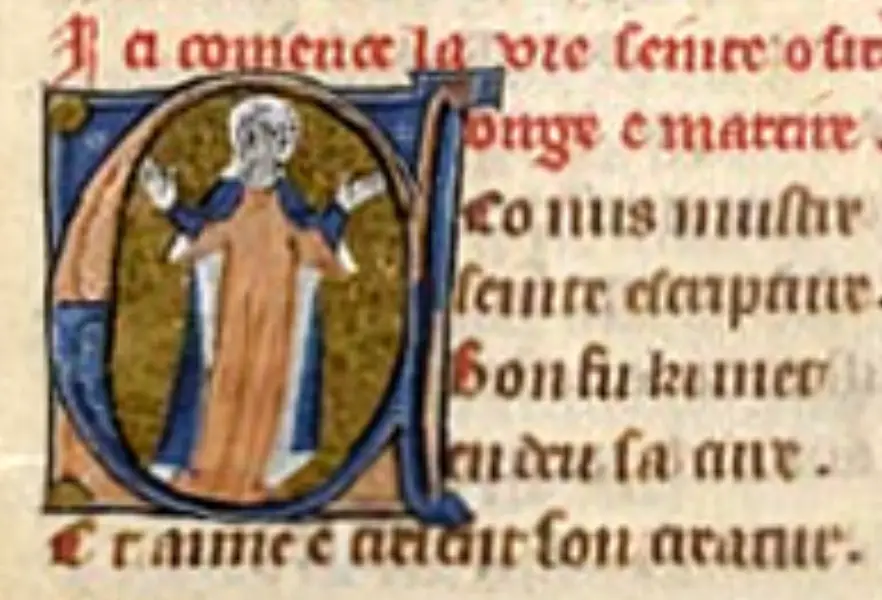
The place of Osgyth's martyrdom was transferred in the telling to the holy spring at Quarrendon, the well already mentioned in the time of her aunts, which now became bound to her legend — the story ran that she rose after her execution and walked to the convent door carrying her head. Some modern authors have linked the tales of such cephalophoric saints to the old Celtic cult of heads, seeing in them a pattern that runs from St. Edmund, St. Kenelm, and St. Sidwell in England to St. Denis in France and St. Melor and St. Winifred in Celtic lands. Devotion to her spread widely across England: in the Middle Ages Norwich Cathedral and St Albans Abbey both had chapels dedicated to her, and an anonymous verse life, La Vie seinte Osith, virge e martire, told her story in Anglo-Norman French. At Aylesbury, where she lay buried in the church of St Mary the Virgin, her grave drew a great though unofficial pilgrimage; a papal decree of 1500 led to the bones being taken up and quietly re-interred, yet the people's prayers went on undeterred, carrying her name into the domestic rituals of English households for generations.
§ Veneration
Shrine, Priory, and the Wealth of Her Cult
Osgyth was never canonized by formal process; she belongs to the pre-congregation saints of the Anglo-Saxon Church, venerated from soon after her death in the eighth century. Her cult was actively promoted by Maurice, bishop of London, in whose cathedral of St Paul's a shrine stood in her honor. Around 1121 his successor Richard de Belmeis I, about that year, established a house of Augustinian canons where her old nunnery had stood, at Chich and obtained the relic of one of her arms for the monastery church; buried in its chancel in 1127, he left the church and its tithes to the canons, who chose as their first prior William de Corbeil, later Archbishop of Canterbury — and Corbeil acquired the other arm for Canterbury. Royal benefactions under Henry II made the canons wealthy, and in 1397 Pope Boniface IX granted their abbot the right to wear a mitre, give the solemn benediction, and ordain priests. At the Dissolution of the monasteries in 1536 the priory's yearly income was reckoned at £758 5s. 8d.; its gatehouse, known as the Abbot's Tower, and some ranges of buildings remain. Her feast is kept on 7 October.
§ Veneration
Timeline
- 675
Her parents, together with St. Erconwald, founded Chertsey Abbey.
§ Life
- 700
Beheaded by raiding pirates at Chich, perhaps for resisting capture, in a death accounted a martyrdom.
§ Life
- 1121
Richard de Belmeis I, bishop of London, founded a priory of Augustinian canons on the site of her former nunnery at Chich.
§ Veneration
- 1127
Richard de Belmeis was buried in the chancel of the monastery church, having bequeathed it and its tithes to the canons.
§ Veneration
- 1397
Pope Boniface IX granted the abbot of St Osgyth the right to wear a mitre, give solemn benediction, and ordain priests.
§ Veneration
- 1500
After a papal decree, her bones were removed from St Mary the Virgin's Church, Aylesbury, and buried in secret.
§ Veneration
- 1536
At the Dissolution of the monasteries, the priory's yearly revenues were reckoned at £758 5s. 8d..
§ Veneration
In Their Own Words
In those days, when they went to bed they did rake up the fire, and make a X on the ashes, and pray to God and Saint Sythe [Saint Osgyth] to deliver them from fire, and from water, and from all misadventure.
The Record
- Major works
- Convent (later priory) at Chich, Essex, now St Osyth
- Symbols
- depicted as a cephalophore, carrying her own head·a stag behind her
- Canonization
- Pre-congregation; venerated as an English saint from the 8th century, soon after her death
Prayer
Bibliography
Show 7 sources
- Drake, Maurice; Drake, Wilfred (1971) [First published 1916]. Saints and Their Emblems. New York: Burt Franklin. pp. 96, 182.
- Wragg, Stefany (2022). Early English Queens, 650–850. Taylor & Francis. p. 89. ISBN 9781-0005-9522-2.
- Butler, Alban (1995). "St. Osyth, martyr". Butler's Lives of the Saints. Vol. 10. Liturgical Press. p. 46. ISBN 9780-8146-2386-2.
- Dunbar, Agnes. "A Dictionary of Saintly Women" (1904).
- White, Beatrice (1972). "A Persistent Paradox". Folklore, vol. 83 no. 2 (Summer 1972), pp. 122–131.
- Burns, Arthur, St. Paul's: The Cathedral Church of London, 604–2004, Yale University Press, 2004, p. 117. ISBN 9780300092769.
- Egerton Beck, "Two Bulls of Boniface IX for the Abbot of St. Osyth", The English Historical Review 26.101 (January 1911): 124-127.
Profile text adapted from the Wikipedia article, licensed CC BY-SA 4.0.
Pray with this saint every day
Save St. Osgyth to your favorites, read the full profile, and get feast-day reminders in the Saints app.
Get the Saints AppFree on the App Store for iPhone and iPad