
died 3 December 1099·Feast July 16 (Church of England); 4 December (historic)
St. Osmund
Bishop of Salisbury and Norman Chancellor
Overview
Saint Osmund, Count of Sées, was a Norman noble and clergyman who followed Duke William to England in the conquest and rose to the two highest offices a churchman could hold in the new realm. He served as Lord Chancellor of England from about 1070 to 1078, taking part in many civil transactions and acting as one of the chief commissioners who compiled the Domesday Book. Consecrated bishop of Salisbury by Archbishop Lanfranc around 3 June 1078, he governed a diocese spanning Dorset, Wiltshire, and Berkshire from the fortress church of Old Sarum. His episcopate joined the administrator's precision to the pastor's zeal: he built the cathedral at Old Sarum and gave it a chapter after the Norman pattern, headed by its dean, precentor, chancellor, and treasurer, gathered a library for his canons, and framed the liturgical books of the Sarum Use, which within a century spread through almost the whole of England, Wales, and Ireland. William of Malmesbury praised his chastity, his freedom from ambition, and his severity to himself alone. He died on 3 December 1099 and, after a canonization cause that began in 1228, was declared a saint by Pope Callixtus III on 1 January 1457.
The Complete Life
From Norman Court to English See
Osmund's career began in Normandy, where he was born at Sées and bore the title of Count. He was a native of the duchy when Duke William assembled his fleet for the invasion of England, and he accompanied the conquest as a trusted follower. His reward was the chancellorship of the realm, which he received about 1070 and held for eight years, a period in which the Norman administration of the conquered kingdom was being built from the ground up. The king kept him busy with civil business of every description, and his methodical mind was set to work on the greatest administrative enterprise of the age: he served as one of the chief commissioners engaged in drawing up the Domesday Book, the great survey of English landholding. At the London council of 1075 the old sees of Sherborne and Ramsbury were merged into one bishopric, and in 1078, by the authority of Pope Gregory VII, Osmund was placed over it, receiving consecration from Archbishop Lanfranc around 3 June. He exchanged the chancery for the cathedral at Old Sarum, a fortress on a high hill which William of Malmesbury described as rather a fortress than a city, ringed by a massive wall, and there he took up the government of Dorset, Wiltshire, and Berkshire.
§ Life
Building the Church of Sarum
As bishop, Osmund's work was threefold. The first undertaking was the cathedral itself, raised at Old Sarum and dedicated on 5 April 1092, crowning the exposed hill where church and castle shared a single enclosure, a juxtaposition that moved Peter of Blois to speak of God's ark confined within a heathen sanctuary. Next he organised the church's clergy as a corporate body after the pattern Norman usage supplied: four officers, dean, precentor, chancellor, and treasurer, each with duties fixed to the smallest detail, supported by some thirty-two canons together with a subdean and a succentor, all bound to residence except the last pair. These secular canons, each dwelling in his own house, were to be the bishop's especial companions and counsellors, to perform the whole cycle of the liturgy with becoming solemnity, and to preach through the country round about; a school for the clergy took shape under the chancellor's direction, and the cathedral stood in every sense as the Mother Church of the diocese. The canons of Sarum won renown alike for the skill of their singing and the hunger of their studies, and the chapter Osmund created shaped the founding of cathedral bodies across England. His third work was the formation of the liturgy for which he is best remembered.
§ Works
The Sarum Use and the Bishop's Scriptorium
The Sarum Use grew from Osmund's selections among the practices he saw around him. He took the old Celtic-Anglo-Saxon rite and the local variants of the Roman use and wrought the two into one, wedding Norman practice to Anglo-Saxon inheritance, and the resemblance of his liturgy to that of Rouen suggests that the practices of northern France inspired his books. The Ordinal of Osmund, ordering the Divine Office, the Mass, and the calendar for his own diocese, proved so fruitful that before a century had passed it had spread over nearly all England, Wales, and Ireland, reaching the churches of Scotland around 1250; it remained the glory of English worship until the Reformation. Alongside the books stood the Register of St. Osmund, a collection of documents gathered after his time, part Consuetudinary and part charters bearing on the cathedral's construction and endowment. The same hand that ordered the liturgy served it in humbler ways: a late-medieval source notes with some disdain that even as a bishop Osmund would scribe, illuminate, and bind books himself, eccentric behaviour by that period but not so in eleventh-century England. He gathered a good library for his canons, and his reverence for learning formed the soul of his spiritual legacy.
§ Works
The Last Reconciliation
Osmund's final decade included one of the sharpest controversies of the Norman church. He once thought the archbishop obstinate beyond necessity and over-scrupulous in the quarrel over investitures, and in 1095 at the Council of Rockingham he favoured the king against him. But after the Lateran Council of 1099 he changed course and boldly sided with Anselm, and tradition preserves a beautiful anecdote of his simple sincerity: as Anselm journeyed towards Windsor, Osmund cast himself at his feet and was pardoned. He had earlier shown the same humility in his devotion to the saints, holding the bishop Aldhelm in great reverence as his predecessor of three centuries before at Sherborne; he presided when Aldhelm's remains were moved to worthier lodging at Malmesbury, helped Lanfranc obtain his canonization, and kept at Sarum a bone of the saint's left arm given him by Abbot Warin, at which miracles were wrought. Death came to Osmund in the night of 3 December 1099. The see remained vacant for eight years before Roger of Salisbury succeeded him, and the bishop was buried at Old Sarum, where his earthly work had been done.
§ Life
Two Centuries to the Altar
Osmund's cause moved at the deliberate pace of the medieval church. In 1228 the Bishop of Sarum and his canons applied to Pope Gregory IX for his canonization, but the papal proceedings that then began did not conclude until almost two hundred and thirty years had passed. Only on 1 January 1457 did Callixtus III at last sign the bull enrolling Osmund among the saints, the one canonization of an English bishop of the middle ages completed so late in the era. His remains, translated from Old Sarum to New Salisbury on 23 July 1457, were deposited in the Lady Chapel, where a sumptuous shrine was raised to him; it was destroyed under Henry VIII, and only a flat slab bearing the simple inscription mxcix remains, shifted about the cathedral over the centuries and now lying beneath the last arch of the south colonnade. Devotion continued nonetheless: in 1472 Pope Sixtus IV granted a special indulgence for visiting the cathedral on his festival, and a convocation at Saint Paul's in 1481 fixed 4 December as his commemoration day. The Church of England remembers him today with a commemoration on 16 July.
§ Works
Memory in Stone and Use
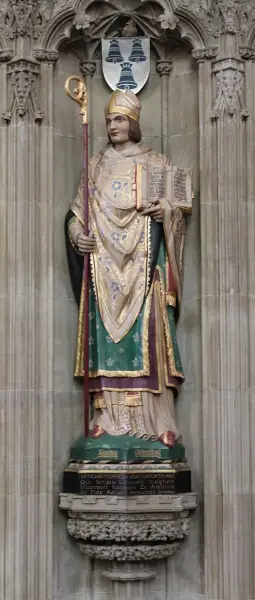
Osmund's influence has outlasted the shrine. The liturgical family he organised, the Sarum Use, shaped worship across the British Isles and left its mark on the English Reformation books themselves, so that his ordering of prayer remains audible in Anglican worship to this day. The cathedral body he constituted became the pattern for other chapters, and the canons he gathered, renowned for musical talent and zeal for learning, set a standard of choral and scholarly excellence for which Salisbury is still known. William of Malmesbury's verdict on his character preserved the saint for posterity: a man whose chastity was so widely credited that rumour itself would have been ashamed to slander his virtue, stern to penitents yet sternest to himself, free from ambition, wasting neither his own substance nor coveting the wealth of others. His memory is kept in many forms: his figure fills one of the carved niches, number 178, along the cathedral's west front, a house at Bishop Wordsworth's School bears his name, and his patronage extends to the afflicted in mind and body, including the mentally ill, the paralysed, and sufferers from toothache, who sought his help at his tomb for centuries.
§ Works
Timeline
- 1070
Is made Chancellor of the realm by William the Conqueror
§ Life
- 1075
The Council of London unites the sees of Sherborne and Ramsbury into the diocese he will govern
§ Life
- 3 Jun 1078
Is consecrated bishop of Salisbury by Archbishop Lanfranc, by authority of Pope Gregory VII
§ Life
- 1086
Attends the Great Gemot at Old Sarum where the Domesday Book is accepted and the landowners swear fealty
§ Life
- 5 Apr 1092
The cathedral he built at Old Sarum is consecrated
§ Works
- 1095
At the Council of Rockingham favours the king against Archbishop Anselm in the investiture dispute
§ Works
- 3 Dec 1099
Dies on the night of 3 December at Salisbury, having sided with Anselm after the Lateran Council
§ Life
- 1228
The bishop and canons of Sarum petition Pope Gregory IX for his canonization
§ Works
- 1 Jan 1457
Pope Callixtus III issues the bull declaring him a saint
§ Works
- 23 Jul 1457
His remains are translated from Old Sarum to New Salisbury and deposited in the Lady Chapel
§ Life
- 1472
Pope Sixtus IV grants a special indulgence for visiting his cathedral on his festival
§ Works
- 1481
An assembly at Saint Paul's chooses 4 December for keeping his memory
§ Works
In Their Own Words
so eminent for chastity that common fame would itself blush to speak otherwise than truthfully concerning his virtue. Stern he might appear to penitents, but not more severe to them than to himself. Free from ambition, he neither imprudently wasted his own substance, nor sought the wealth of others.
the ark of God shut up in the temple of Baal
The Record
- Major works
- Cathedral of Old Sarum, consecrated 1092·Constitution of the Salisbury cathedral chapter·Sarum Use liturgical books (the Ordinal of Osmund)·Register of St. Osmund (Consuetudinary and charters)·Cathedral library gathered for his canons
- Patron of
- Insanity and mental illness·Mentally ill people·Paralysed people and paralysis·Ruptures·Toothache
- Canonization
- Canonized 1 January 1457 by Pope Callixtus III, after a process begun in 1228
Prayer
Bibliography
Show 8 sources
- Fryde, E. B.; Greenway, D. E.; Porter, S.; Roy, I. (1996). Handbook of British Chronology. Third revised edition. Cambridge: Cambridge University Press, pp. 83, 270. ISBN 0-521-56350-X.
- Parker, Anselm. "St. Osmund". The Catholic Encyclopedia. Vol. 11. New York: Robert Appleton Company, 1911.
- William of Malmesbury. Gesta pontificum anglorum, §§183-184.
- Hollister, C. Warren (2001). Henry I. Yale English Monarchs. New Haven: Yale University Press, p. 36f.
- Pfaff, Richard W. (2009). "Old Sarum: the beginnings of Sarum Use". The Liturgy in Medieval England: A History. Cambridge: Cambridge University Press, pp. 350-364. ISBN 978-0-521-80847-7.
- Swanson, R. N. (1995). Religion and Devotion in Europe, c. 1215-c. 1515. Cambridge Medieval Textbooks. Cambridge: Cambridge University Press, pp. 148, 315. ISBN 0-521-37950-4.
- Dodwell, C. R. (1982). Anglo-Saxon Art: A New Perspective. Manchester: Manchester University Press, p. 47. ISBN 071900926X.
- Herbermann, Charles, ed. (1913). "St. Osmund". Catholic Encyclopedia. New York: Robert Appleton Company.
Profile text adapted from the Wikipedia article, licensed CC BY-SA 4.0.
Pray with this saint every day
Save St. Osmund to your favorites, read the full profile, and get feast-day reminders in the Saints app.
Get the Saints AppFree on the App Store for iPhone and iPad