
c. 925 – 992·Feast February 29
St. Oswald of Worcester
Monastic reformer, Bishop of Worcester and Archbishop of York
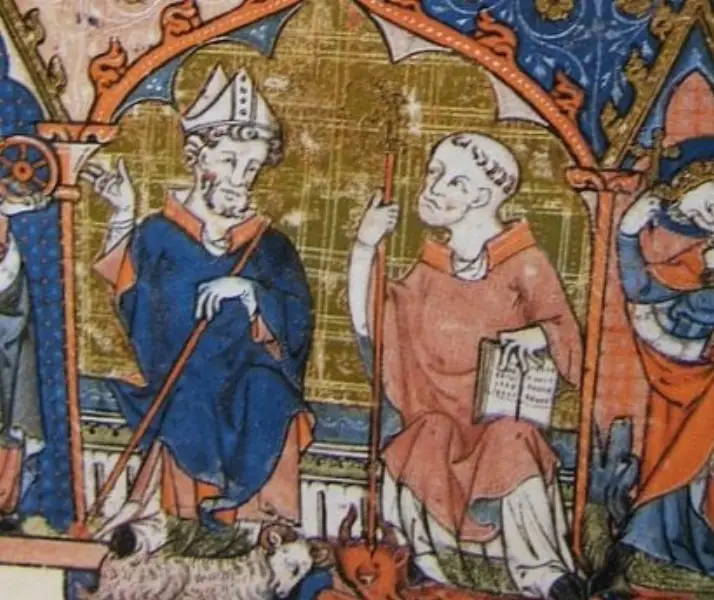
Overview
Oswald of Worcester, archbishop of York from 972 until his death in 992, was one of the architects of the tenth-century English monastic revival. Born around 925 of Danish parentage, he was raised by his uncle Oda, archbishop of Canterbury, who sent him to the abbey of Fleury in France, where he took the monastic habit and was ordained in 959. Recalled to England, he found a new patron in Oskytel, archbishop of York, and came to the notice of Dunstan, who had him consecrated Bishop of Worcester in 961. With Æthelwold of Winchester he promoted Dunstan's reforms, founding Ramsey Abbey and reformed monasteries at Winchcombe, Pershore, Evesham, and Westbury, and replacing the secular cathedral clergy of Worcester with monks while organizing his see's estates into the administrative hundreds of the Oswaldslow. Promoted to York in 972, he held Worcester alongside it, traveled to Rome for his pallium, and brought the scholar Abbo of Fleury to teach in England. He died on 29 February 992, washing the feet of the poor as was his Lenten custom, was buried at Worcester, and was venerated as a saint within days, a hagiographical life following soon after.
The Complete Life
A Dane of Fleury
Oswald was born around 925 into a family of Danish descent, in an England where Scandinavian settlers were being drawn into the English church. His upbringing fell to his uncle Oda, Archbishop of Canterbury, a kinsman through the Danish connection, and under Oda's roof he received the schooling of a career cleric, instructed by the Frankish scholar Frithegod and holding the office of dean of Winchester. The decisive choice of his youth came when his uncle sent him to France, to the great monastery of Fleury on the Loire, where the Benedictine tradition was kept with particular fidelity; there he entered as a monk around 950 and was ordained priest in 959. At Fleury he formed friendships with Osgar of Abingdon and Germanus of Winchester, fellow Englishmen who would stand with him in the reform movement, and he absorbed the continental monastic discipline that would mark all his later work. The influence of those years outlasted him: when the English church agreed a common code of monastic conduct, the Regularis Concordia of 970, Fleury's practice stood among its inspirations, carried home in no small measure by Oswald himself.
§ Early life
Return and Consecration
Oswald came back to England in 958 at his uncle's summons, but Oda died before the monk arrived, leaving him without a patron in a church still dominated by secular clergy. He turned to another kinsman, Oskytel, lately elevated to the archbishopric of York, and served him in ecclesiastical affairs; a later Ramsey chronicle even claims the two traveled together to Rome for Oskytel's pallium, a tale that may owe more to the abbey's pride than to fact. His diligence brought him to the attention of Archbishop Dunstan, the leading statesman of the English church, who secured his appointment to the bishopric of Worcester, and he was consecrated there in 961. The young bishop at once began gathering men of his own spirit, persuading Germanus, his friend from the Fleury years, to come back to England and take charge of a little religious settlement gathered by Westbury-on-Trym about 962, a house of prayer in the new style he had learned across the Channel. But the site lay on lands belonging to the see of Worcester, and Oswald, fearing a successor might dissolve what he had built, began to look for ground the monastery could call its own.
§ Return to England
Ramsey and the Reform of Worcester
The answer came from Æthelwine, son of Æthelstan Half-King, who offered Oswald a site in the fens of Huntingdonshire. There, about 971, he planted a monastery that drew most of the Westbury community to itself and grew into Ramsey Abbey, his most famous foundation; its church was dedicated in 974, the bishop gave it a magnificent Bible noted in his Life along with wall hangings and other textiles, and he directed its affairs until his death, when his dean Eadnoth became its first abbot. As bishop, and from 972 as archbishop of York holding Worcester with it, Oswald stood with Dunstan and Æthelwold at the heart of the monastic reform, backed by King Edgar and the Rule of St. Benedict. His temper differed from Æthelwold's harsher hand: where Winchester ejected secular clergy by force, Oswald moved by persuasion, and one tradition has him patiently raising a monastic church beside the cathedral until the monks could take it over, while another credits him with expelling the married clergy outright. He also organized his see's estates into the hundreds of the Oswaldslow, steadying the church's revenues, and never ceased visiting the houses he had founded, remembered long after as the father of his people.
§ Return to England
Archbishop in Two Sees
In 972 Oswald was raised to the archbishopric of York and traveled to Rome for his pallium from Pope John XIII, perhaps combining the journey with an embassy for King Edgar to the court of the emperor Otto I. He kept Worcester in his hands alongside the northern see, an uncanonical arrangement that nonetheless became customary for half a century, adding a richer and more peaceful diocese to York's endowment. His archiepiscopate joined scholarship to government. In 985 he brought Abbo of Fleury, the foremost scholar of his old monastery, to Ramsey, where for two years Abbo taught computus, the reckoning of Easter's date and, in the speculations of the age, of the Last Judgment. Oswald promoted the education of the clergy and kept drawing learned men from Fleury to teach in England. A surviving manuscript preserves his list of estates that had been stripped from the diocese of York, evidence of an administrator keeping accounts against the day of recovery; two books, a psalter now in the British Library and a pontifical at Cambridge, are believed to have served his own daily devotions. When Edgar died in 975 and Ealdorman Ælfhere broke up monastic communities across Mercia, Ramsey alone of Oswald's foundations stood unharmed under Æthelwine's protection, while the archbishop backed Edgar's son Edward in the succession dispute.
§ Archbishop of York
Death at the Poor's Feet
Oswald died on 29 February 992 at Worcester, in the very act that summed up his episcopate: the washing of the feet of the poor, which during Lent he performed as a daily custom. He was buried in the Church of St Mary at Worcester, and the signs of sanctity began at once, with miracles reported at his funeral and then at his tomb. Within a few years a hagiographical Life was in circulation, probably written by Byrhtferth, a monk of Ramsey, the house that owed him its existence. Ten years after his death his remains were translated to a new resting place in Worcester Cathedral, where his cult continued. His memory was kept on 28 February in common years and on 29 February in leap years, the day of his death, and the Personal Ordinariate of the Chair of Saint Peter later kept his feast on 19 May. He is venerated in the Catholic Church, the Eastern Orthodox Church, and the Anglican Communion alike, honored as a hierarch who joined the strictest monastic ideals to a lifetime of pastoral care and died among the poor he served.
§ Death and sainthood
Father of His People
Oswald's achievement was to plant continental monasticism in the English midlands and north. Ramsey Abbey, born from his worry over a borrowed plot of land, became one of the great fenland houses, a school for scholars and a source of chronicles that preserved his memory; its first abbot had been his own dean. The reformed houses at Winchcombe, Pershore, Evesham, and Westbury carried the Benedictine rule through Worcestershire and Gloucestershire, and his conversion of the Worcester cathedral chapter from priests to monks made the see a monastic bishopric in the continental style. The Oswaldslow, the estate hundreds he organized, kept the revenues of his church stable for generations and left his name attached to the administration of his diocese. The holding of Worcester together with York, begun as his personal arrangement, became the custom of the northern province for almost fifty years after his death. Later ages remembered him as a bishop who constantly visited the monasteries he had founded and was long celebrated as the father of his people in both of his sees, the reformer whose gentle methods proved as effective as his colleagues' severity and whose sanctity was recognized before his body was cold.
§ Death and sainthood
Timeline
- 950
Entered the monastery of Fleury in France, sent there by his uncle Oda, Archbishop of Canterbury.
§ Early life
- 959
Was ordained priest while a monk of Fleury, where he met Osgar of Abingdon and Germanus of Winchester.
§ Early life
- 961
Was consecrated Bishop of Worcester through the influence of Archbishop Dunstan.
§ Return to England
- 962
Placed Germanus at the head of a little religious settlement by Westbury-on-Trym not long after his consecration.
§ Return to England
- 971
Founded a monastery on land offered by Æthelwine at Ramsey in Huntingdonshire, which became Ramsey Abbey.
§ Return to England
- 972
Was made Archbishop of York and journeyed to Rome to receive his pallium from Pope John XIII.
§ Archbishop of York
- 974
The church of Ramsey Abbey, his most famous foundation, was dedicated.
§ Return to England
- 985
Invited Abbo of Fleury to Ramsey, where the scholar taught computus until 987.
§ Archbishop of York
- 29 Feb 992
Died at Worcester while washing the feet of the poor, his daily custom in Lent, and was buried in the Church of St Mary.
§ Death and sainthood
- 1002
His remains were translated to a new burial place in Worcester Cathedral ten years after his death.
§ Death and sainthood
The Record
- Major works
- Foundation of Ramsey Abbey·Reform of the monasteries of Winchcombe, Pershore, Evesham, and Westbury·Replacement of Worcester cathedral clergy with monks·Organization of the Oswaldslow estate hundreds·The Regularis Concordia, the English monastic code his Fleury training helped inspire
- Patron of
- Invoked by monastic reformers·Patron of the poor, whose feet he washed at his death
- Symbols
- Archbishop's vestments·Basin and towel for the washing of feet
- Canonization
- Pre-congregation; hailed as a saint almost immediately after his death in 992
Prayer
Bibliography
Show 6 sources
- Brooks, N. P. (2004). "Oswald (St Oswald) (d. 992)", Oxford Dictionary of National Biography, Oxford University Press. doi:10.1093/ref:odnb/20917.
- Dodwell, C. R. (1985). Anglo-Saxon Art: A New Perspective. Ithaca, NY: Cornell University Press. ISBN 0-8014-9300-5.
- Fryde, E. B.; Greenway, D. E.; Porter, S.; Roy, I. (1996). Handbook of British Chronology (Third revised ed.). Cambridge University Press. ISBN 0-521-56350-X.
- Knowles, David (1976). The Monastic Order in England: A History of its Development from the Times of St. Dunstan to the Fourth Lateran Council, 940–1216 (Second reprint ed.). Cambridge University Press. ISBN 0-521-05479-6.
- Lawrence, C. H. (2001). Medieval Monasticism: Forms of Religious Life in Western Europe in the Middle Ages (Third ed.). New York: Longman. ISBN 0-582-40427-4.
- Stenton, F. M. (1971). Anglo-Saxon England (Third ed.). Oxford University Press. ISBN 978-0-19-280139-5.
Profile text adapted from the Wikipedia article, licensed CC BY-SA 4.0.
Pray with this saint every day
Save St. Oswald of Worcester to your favorites, read the full profile, and get feast-day reminders in the Saints app.
Get the Saints AppFree on the App Store for iPhone and iPad