
died 20 August 651·Feast August 20
St. Oswine of Deira
King of Deira betrayed and put to death
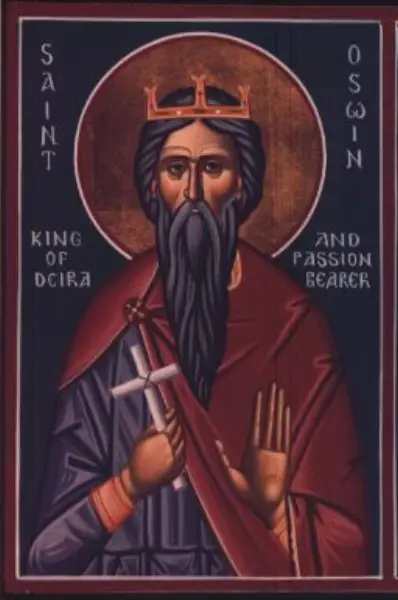
Overview
Oswine, sometimes written Oswin or Osuine, was king of Deira in northern England, the son of Osric, who succeeded to the throne around 644 after the death of King Oswald of Northumbria at the Battle of Maserfield. His accession, perhaps by the choice of the Deiran people themselves, split the kingdom of Northumbria once more, for Oswiu reigned over Bernicia to the north. Seven years or so of quiet governance followed, at whose end Oswiu proclaimed war against him. Unwilling to spend his people's blood in battle, Oswine disbanded his army and withdrew to the house of Earl Humwald at Gilling, whom he trusted as a friend, accompanied by a single faithful soldier named Tonhere. The earl betrayed him, delivering him into the hands of Oswiu's soldiers, and he was killed by Oswiu's commander Ethilwin on 20 August 651, probably at Diddersley Hill in North Yorkshire. To satisfy the justice owed for the murder, Oswiu founded Gilling Abbey, where monks from both families prayed for the souls of killer and victim alike. From that monastery, years later, came the claim that Oswine was a saint; his relics rested at Tynemouth and were translated with honor in 1065.
The Complete Life
King of the Deirans
Oswine was the son of Osric, king of Deira, and belonged to the Deiran royal line displaced when the Bernician house of Æthelfrith and Edwin held both northern kingdoms together. His chance came with the death of King Oswald of Northumbria at the Battle of Maserfield, after which the united Northumbria of Oswald's reign broke apart: around 644, probably in that year, Oswine succeeded to the throne of Deira, while Oswald's brother Oswiu took Bernicia to the north. The article of his succession is uncertain in its details, but the sources suggest that the choice may have belonged to the Deiran people themselves, who set their own king over them. For about seven years he ruled in peace, the last native king of the Deiran line to hold the throne, while the Bernician king who would destroy him consolidated power across the border. Of his character in these years the record of Bede preserves the decisive trait: a king who set the peace of his people above any triumph of arms, a disposition that would cost him his crown and his life when war finally came.
§ Life
Betrayal at Gilling
Once seven quiet years of government had passed, war came against the Deiran king from the Bernician side. Oswine raised an army, but refused to give battle, and sent the men he had gathered home again. With only one trusted soldier, Tonhere, he withdrew to seek concealment in the house of Earl Humwald at Gilling, a man he believed to be his most loyal friend. Bede, who tells the story, places the retreat at a hill called Wilfaresdun, Wilfar's Hill, lying about ten miles northwest of the village of Cataract, modern Catterick, a description that points modern seekers to Diddersley Hill in North Yorkshire as the scene of the king's death. There the trust was broken: Humwald betrayed his guest, delivering him into the hands of Oswiu's soldiers, and the king was slain in a treacherous manner by Ethilwin, Oswiu's commander. Bede dates the deed to the thirteenth day before the Kalends of September, in the ninth year of Oswiu's reign, at the place called Ingetlingum, the Gilling of the English annals: 20 August 651, the day kept ever since as Oswine's feast. A gentle king died because he would not make his people die for him.
§ Life
Blood Debt and Abbey of Prayer
Anglo-Saxon custom required that the nearest kinsmen of a murdered man avenge him or take compensation, the wergild paid to the family of the slain. Oswine's killing placed Oswiu in an impossible position: the slain king's nearest kinswoman was Oswiu's own queen, and the killer was related to his victim besides. The blood debt could not be paid in the ordinary ways, and Oswiu sought another satisfaction. He founded Gilling Abbey, a monastery at the very place of the murder, staffed in part by the relatives of both royal houses, and charged it with offering prayers alike for his own salvation and for the soul of the cousin his soldiers had killed. From that house of twin intercession, many years afterward, came the claim that Oswine was a saint, one of the Anglo-Saxon royals whose cults grew in the monasteries that honored their memory, as with Edward the Martyr. A twelfth-century homilist gave the cult its rationale: the king's blood had been shed, if not in confession of the faith, then in the cause of the justice of Christ, and a death like that deserved a martyr's crown. His main shrine was at Tynemouth, where the faithful venerated him on 20 August.
§ Veneration
Tynemouth and Wylam
Oswine was buried at Tynemouth on the Northumbrian coast, but in time the site of his grave passed out of memory. Tradition holds that the burial place was made known again through an apparition to a monk named Edmund, and in 1065, on the very eve of the Conquest, his relics were carried in honor to a worthy resting place inside Tynemouth Priory, the monastery rising above the Tyne near the scene of his ancient kingdom. In 1103, when the chapel that housed the remains had fallen into disrepair, Ranulf Flambard, Bishop of Durham, carried them away to St Alban's Abbey in Hertfordshire, according to the account of Alban Butler, spreading the cult to one of the great abbeys of the south. In his old kingdom his memory endured in parishes: the Church of England church at Wylam in Northumberland, built in 1886 with a peal of six bells and a congregation of about a hundred and fifty, bears his dedication, and in Tynemouth itself St Oswin shares the patronage of the Tynemouth Catholic parish with the Mother of God herself; the parish church on Front Street faces the ruins of the priory where the martyr king was first honored.
§ Veneration
Timeline
- 644
Succeeded King Oswald as ruler of Deira, splitting the kingdom of Northumbria from Bernicia under Oswiu.
§ Life
- 20 Aug 651
Was betrayed by Earl Humwald, delivered to Oswiu's soldiers, and put to death at Gilling, probably on Diddersley Hill.
§ Life
- 1065
His relics, whose resting place had been revealed to a monk named Edmund in an apparition, were carried in honor to a fitting resting place inside Tynemouth Priory.
§ Veneration
- 1103
Ranulf Flambard, Bishop of Durham, translated the remains from the decayed chapel at Tynemouth to St Alban's Abbey in Hertfordshire.
§ Veneration
- 1886
The Church of England parish church of Wylam in Northumberland was built and dedicated to Saint Oswin.
§ Veneration
In Their Own Words
If not for the faith of Christ, at least for the justice of Christ.
The Record
- Patron of
- Invoked for those betrayed by friends·Co-patron, with Our Lady, of the Catholic parish of Tynemouth
- Symbols
- Crown and sword of a king·Palm of martyrdom
- Canonization
- Pre-congregation; claimed as a saint from Gilling Abbey many years after his death
Prayer
Bibliography
Show 6 sources
- Bede. Ecclesiastical History of the English People, Book III, Chapter 14, ed. and tr. B. Colgrave and R.A.B. Mynors, Oxford, 1969.
- Anonymous, Vita Oswini (twelfth century), ed. James Raine, Miscellanea Biographica, Publications of the Surtees Society 8, London, 1858, pp. 1-59.
- Parker, Anselm. "St. Oswin", The Catholic Encyclopedia, Vol. 11, New York: Robert Appleton Company, 1911.
- Butler, Alban. "Saint Oswin, King and Martyr", Lives of the Fathers, Martyrs, and Principal Saints, 1866, CatholicSaints.Info.
- Farmer, David Hugh (2011). The Oxford Dictionary of Saints (5th rev. ed.), Oxford University Press, p. 405. ISBN 9780191727764.
- Monks of Ramsgate. "Oswin", Book of Saints, 1921, CatholicSaints.Info, 19 May 2016.
Profile text adapted from the Wikipedia article, licensed CC BY-SA 4.0.
Pray with this saint every day
Save St. Oswine of Deira to your favorites, read the full profile, and get feast-day reminders in the Saints app.
Get the Saints AppFree on the App Store for iPhone and iPad