
c. 689 – c. 759·Feast November 16
St. Othmar
First Abbot of Saint Gall and friend of the poor
Overview
Saint Othmar, also called Audomar, was a monk and priest of Alemannic descent who became the first abbot of the Abbey of Saint Gall, the Benedictine monastery from which the Swiss city of Saint Gallen grew. Educated at the cathedral school of Chur in Rhaetia and ordained priest, he served for a time a church of Saint Florinus before being appointed in 720 by Waltram of Thurgau as superior over the cell of Saint Gall and custodian of the wandering missionary's relics. There he united the monks who lived about the holy place into a monastery under the Rule of Saint Columban and became their first abbot, adding a hospital and a school on whose foundations the famous monastery library would one day rise. In 747 he introduced the Benedictine Rule as part of the reform of church institutions in Alamannia, and he provided for the surrounding population with an almshouse and a leprosarium, the earliest known in the Swiss lands. His fearless defence of the abbey's property against two grasping counts led to his arrest and imprisonment on the Rhine island of Werd, where he died around 759 after six months of captivity.
The Complete Life
An Alemannic Youth in Rhaetia
Othmar was born around 689, according to tradition near the place where the city of Saint Gallen now stands, and he belonged by descent to the Alemannic people whose lands the monastery he would govern lay within. For his education he was sent to the cathedral school at Chur, in Rhaetia, one of the centres of Christian learning in the upper Rhine country, where he was formed in the scriptures and in the discipline of the church. He advanced to holy orders and was ordained priest, after which he was placed for a time in charge of a church dedicated to Saint Florinus in Rhaetia, an Irish missionary of the preceding generation. This was likely the same building as Saint Peter's at Remus, where Florinus once served as priest and found his burial, so that Othmar's first pastoral charge already connected him to the heritage of the wandering monks who had carried the Gospel into the Alpine valleys. In these years he acquired the reputation for piety and competence that would bring him, in the prime of life, the appointment that defined his life: the care of a holy man's tomb and the souls who gathered beside it.
§ Life
The Cell of Saint Gall
In 720 the Thurgauish lord Waltram placed Othmar in charge of the cell of Saint Gall, with custody of the dead missionary's relics; the Irishman Gall's hermitage in the Steinach valley had by then become a place of pilgrimage and quiet settlement. Others had lived and prayed there since Gall's death, and around the little church a loose company of monks had gathered. Othmar's vocation was to give this settlement form: he united the monks who lived about the cell into a single monastery, following the Rule of Saint Columban, and became their first abbot. Under his direction the community acquired not only a rule but works of mercy, for he added a hospital and a school to the foundation, institutions that would become the seed from which the celebrated Stiftsbibliothek, the monastery library of Saint Gallen, eventually grew. In 747, when the reforming spirit reached the church establishments of Alamannia, he adopted the Rule of Saint Benedict in place of the Columbanian observance, and that rule remained in effect at Saint Gall until the monastery's secularization and closure in 1805. In the same year the Frankish prince Carloman laid down his throne and came to Saint Gall, entrusting to the abbot a letter for his brother Pepin that commended monastery and abbot alike to the king's liberality; Othmar bore it to Pepin in person and was graciously received.
§ Life
Mercy Beyond the Monastery Walls
Othmar's vision of the monastic life reached past the cloister to the whole surrounding population. He provided for the needs of the people who lived near the abbey by building an almshouse for the destitute, and he founded a leprosarium, the earliest known in the Swiss lands, an institution of peculiar courage in an age when lepers were driven to the margins of every settlement; he established other such houses in France and Germany as well. These foundations made the abbey of Saint Gall from its beginnings a centre of charity and not merely of prayer and study, and they set the pattern by which the great monasteries of the Alemannic lands served the societies around them. His courage matched his charity. When Counts Warin and Ruodhart tried to gain possession of property belonging to Saint Gall in 759, Othmar fearlessly resisted their demands, refusing to surrender the patrimony that supported his monks and his poor. The counts answered his resistance with violence: they seized him while he was journeying to Constance and held him prisoner, first in the castle of Bodmann and afterwards on Werd, a little island of the Rhine, where after six months of captivity the old abbot died and was buried.
§ Life
Prisoner on the Island of Werd
The last months of Othmar's life were spent in captivity, taken from the abbey he had built by the very men whose greed he had resisted. Arrested on the road to Constance, he was confined at the castle of Bodmann above the Rhine and afterwards removed to the island of Werd, a small river island where the waters flow towards Lake Constance. There, after an imprisonment of six months, he died around the year 759, far from Saint Gall and from the monks whose father he had been for nearly four decades, and there his body was laid to rest. The injustice of his end did not dim the memory of his life. The community he had gathered endured the attack on its property and grew into one of the chief monasteries of the German-speaking world, keeping his rule, his school, and his works of mercy intact for more than a thousand years. The island chapel that later rose on Werd in his memory made the place of his imprisonment a place of prayer, so that the river bank where the abbot breathed his last became, for the faithful of the region, a station of quiet pilgrimage in his honour.
§ Veneration
The Saint of the Never-Empty Barrel
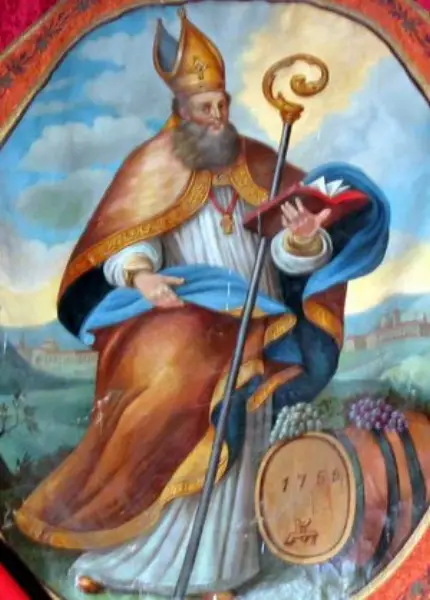
Devotion to Othmar was on the move within a few years of his burial, and he ranks beside Maurice and Gall among the most popular saints of Switzerland. In 769, ten years after his burial on Werd, his remains were carried up to the abbey of Saint Gall, and the journey gave rise to the miracle for which he is best loved: as the men rowed his coffin across the lake in hot weather they grew desperately thirsty, and the single barrel of wine remaining to them never became empty, however much they drank. The wine barrel became one of his two attributes in art, together with the crozier, and he is habitually shown in abbot's habit with a small cask in his grasp, recalling the further legend that one of Othmar's casks never ran dry, however much he drew from it for the poor. Solomon I, the bishop of Constance, gave the cult official recognition in 864, and in 867 the relics were solemnly entombed in the new church of Saint Othmar at Saint Gall. His feast is celebrated on 16 November, and the collegiate church of Saint Gall and Othmar above the abbey keeps the two founding saints side by side.
§ Veneration
A Name Across Europe
The memory of Othmar has spread far from the Rhine island where he died. The cathedral of Saint Gallen is dedicated jointly to Gall and Othmar, honouring the hermit and the abbot who made the valley holy, and in the tenth century a chapel of Saint Othmar was erected on the island of Werd itself, in memory of his imprisonment and death. Beyond Switzerland, a church named for him stands at Mödling in Austria, testimony to the reach of his cult through the German-speaking lands, and in the United States the Pro-Cathedral of Saint Mary in Bismarck, North Dakota, preserves a reliquary containing some of his relics, carrying the first abbot of Saint Gall to the northern plains. Even popular sport keeps his name: the handballers of TSV St. Otmar Saint Gallen take their very name from him, a curious but telling sign of how deeply the abbot is woven into the identity of the city that grew from his monastery. The school and hospital he founded, the leprosarium that was the first in the Swiss lands, and the rule that governed his community for more than a millennium remain the lasting substance of a life given to prayer, learning, and the poor.
§ Legacy
Timeline
- 689
Is born, supposedly near Saint Gallen in what is now Switzerland
§ Introduction
- 720
Waltram of Thurgau appoints him superior over the cell of Saint Gall and custodian of Gall's relics
§ Life
- 747
Introduces the Benedictine Rule at Saint Gall as part of the church reform in Alamannia
§ Life
- 747
Receives Carloman, who gives him a letter of recommendation to his brother Pepin, and delivers it to the king
§ Life
- 759
Dies in captivity on Werd island in the Rhine after six months at the hands of Counts Warin and Ruodhart
§ Life
- 769
His body is transferred to the monastery of Saint Gall, and the wine that never failed becomes his emblem
§ Veneration
- 864
His cult is officially recognized by Solomon I, Bishop of Constance
§ Veneration
- 867
His relics are solemnly entombed in the new church of Saint Othmar at Saint Gall
§ Veneration
- 1805
The Benedictine Rule he introduced remains in force at Saint Gall until the monastery's secularization in this year
§ Life
The Record
- Major works
- Abbey of Saint Gall, organized as a monastery under his abbacy·Hospital and school at Saint Gall·Almshouse and the first leprosarium in what is now Switzerland
- Patron of
- City of Saint Gall, together with Saint Gallus
- Symbols
- Crozier·Wine barrel
- Canonization
- Canonized 864 at Constance by Solomon I, Bishop of Constance
Prayer
Bibliography
Show 7 sources
- Schärer, Deacon Dani. "Synaxis of All the Saints of Switzerland". pravoslavie.ch. Russian Orthodox Church of the Resurrection, Zurich.
- The Swiss Monthly, Volume 4, October 1926, p. 260.
- Ott, Michael. "St. Othmar". The Catholic Encyclopedia. Vol. 11. New York: Robert Appleton Company, 1911.
- Strong, James and McClintock, John, eds. (1880). The Cyclopedia of Biblical, Theological, and Ecclesiastical Literature. Harper and Brothers, New York.
- Saint Louis Medical and Surgical Journal, Volume 83, 1902, p. 315.
- "St. Othmar's Chapel - Werd Island". Schaffhauserland Tourismus.
- "Saints in our Reliquary". Pro-Cathedral of St. Mary, Bismarck, North Dakota.
Profile text adapted from the Wikipedia article, licensed CC BY-SA 4.0.
Pray with this saint every day
Save St. Othmar to your favorites, read the full profile, and get feast-day reminders in the Saints app.
Get the Saints AppFree on the App Store for iPhone and iPad