
c. 1060 – 1139·Feast July 2
St. Otto of Bamberg
Bishop of Bamberg and Apostle of Pomerania
Overview
Otto of Bamberg was a German missionary, papal legate, and bishop who won the Pomeranian peoples for the Christian faith and came to be called the Apostle of Pomerania. Born into a noble family around 1060, he prepared for an ecclesiastical career, followed the Salian princess Judith of Swabia to the Polish court as her chaplain in 1082, and entered the service of Emperor Henry IV in 1091, rising to imperial chancellor in 1101 and supervising the construction of Speyer Cathedral. In 1102 the emperor raised him to the see of Bamberg, and with it to the first rank of Germany's princely prelates. He founded more than thirty monasteries and hospitals between Carinthia and Saxony, rebuilt his fire-damaged cathedral and the earthquake-destroyed monastery of St. Michael, and helped his people from his own purse. A celebrated diplomat in the Investiture Controversy, he negotiated the peace sealed in the Concordat of Worms in 1122. Sent by Duke Bolesław III Wrymouth of Poland, he led peaceful missions to the Pomeranians in 1124 and 1128, baptizing more than 22,000 people and founding eleven churches. He died at Bamberg on 30 June 1139 and was canonized in 1189.
The Complete Life
A Nobleman's Younger Son
Otto was born around 1060 or 1061 into a noble, edelfrei family whose estates lay in the Swabian Jura; his mother was related to the Staufers, and a descent from the Franconian house of Mistelbach has been proposed without conclusive proof. As the elder brother inherited the paternal property, the younger son was destined for the church and sent to school, probably at Hirsau Abbey or one of its filial monasteries, where the reforming spirit of that great house helped shape him. His abilities brought him into the world of high politics early: in 1082, when the Salian princess Judith of Swabia, sister of Emperor Henry IV, married the Piast duke Władysław I Herman, Otto followed her north as chaplain to the Polish court, gaining his first knowledge of the Slavic lands he would one day evangelize. In 1091 he entered the emperor's own service, and his rise was steady: by 1101 he stood as imperial chancellor, and in that office he supervised the construction of Speyer Cathedral, the great burial church of the Salian dynasty. Courtier, diplomat, and churchman, he had learned every skill his later career would demand.
§ Early life
Bishop of Bamberg
In 1102 Emperor Henry IV appointed and invested Otto as Bishop of Bamberg in Franconia, and with the investiture the onetime chancellor took his place among the foremost princes of the German realm. The pallium reached him in 1106 from Pope Paschal II, binding his see closely to Rome even while he remained loyal to the imperial court through the storms of the Investiture Controversy. His fidelity carried a price: at the Synod of Fritzlar in 1118 a papal party led by Cuno of Praeneste suspended him. Yet Otto's standing with both sides made him the indispensable mediator, and at the Congress of Würzburg in 1121 he successfully negotiated the peace that was signed as the Concordat of Worms in 1122, ending the great quarrel between emperor and papacy; Emperor Henry V rewarded his part in it with gifts for his cathedral. Through the 1130s he went on arbitrating between Emperor Lothair of Supplinburg and the rising Hohenstaufens. In the midst of politics he clothed Hildegard of Bingen as a Benedictine nun at Disibodenberg around 1112, standing in for the imprisoned Archbishop Adalbert of Mainz.
§ Bishop
The Apostle of Pomerania
Otto's most enduring fame rests on the peaceful conversion of the Pomeranians, achieved where earlier forcible attempts by the Polish rulers and by the Spanish bishop Bernard had failed. In 1124 the Polish duke Bolesław III Wrymouth sent him on his first mission to the Baltic coast. His method was Bernard's reverse: where the Spaniard had traveled alone as a poor and unknown priest, Otto came as a wealthy and famous man, attended by twenty clergy of his own diocese, numerous servants, sixty warriors supplied by Bolesław, and rich supplies and gifts. His evident wealth reassured the Pomeranians that he sought their souls, not their substance. Bearing the rank of official papal legate, he won over vast multitudes at Pyrzyce, Kamień, Szczecin, and Jomsborg, and is credited with more than 22,000 baptisms, and founded eleven churches, earning the title Apostle of Pomerania. After he returned to Bamberg in 1125 pagan customs began to creep back, and in 1128 he journeyed to Pomerania again, this time with the support of Duke Wartislaw I, and sent Bamberg priests to serve the young church. His plan to consecrate a bishop for the new converts was blocked by the metropolitans of Magdeburg and Gniezno, and only after his death did his companion Adalbert take the see of Wolin in 1140.
§ Missionary
A Simple and Frugal Prelate
For all his princely power Otto led a simple and frugal personal life, and his wealth flowed outward rather than inward. As bishop he did much to improve both his ecclesiastical and his temporal realms: he took in hand the repair and completion of Bamberg Cathedral, wrecked by the fire of 1081, raised the standard of its cathedral school, established numerous monasteries, and built churches throughout his territory. Between Carinthia and Saxony upward of thirty monasteries and hospitals owed their existence to him, while strongholds rose at his command for the safeguarding of his lands. When his people were in need he helped them out of his own pocket, and he greatly expanded the town of Bamberg itself, rebuilding the Monastery of St. Michael after an earthquake had destroyed it around 1117. The founders of three contemporary biographies, Wolfger of Prüfening, Ebo of Michelsberg, and Herbord of Michelsberg, all writing within three decades of his death, present a bishop who joined the courtier's polish to the pastor's care, a man at home in the emperor's council and in the hospital alike, whose holiness was visible in administration as much as in prayer.
§ Bishop
Death at Bamberg
Otto's last years were spent between his episcopal city and the arbitration of the empire's quarrels. In the 1130s he continued to mediate between Emperor Lothair of Supplinburg and the rising Hohenstaufen house, the same diplomatic service that had made him famous at Würzburg two decades earlier. His unfinished concern remained the church of his Pomeranian converts: his plan to give them a bishop of their own had been thwarted by the claims of Magdeburg and Gniezno, and he could only send priests from Bamberg to keep the mission supplied. His death came at Bamberg on 30 June 1139, and Michaelsberg Abbey received his body, the community of St. Michael he had rebuilt after the earthquake gathering around his grave. Within a year his intention was fulfilled: in 1140 his former companion Adalbert was consecrated Bishop of Wolin, securing for Pomerania the episcopal succession Otto had worked for. The Christianization he had set in motion spread further along the Baltic, the eastern Pomeranian lands around Gdańsk receiving the faith through Pomerania, and the monastery of Oliwa was founded in that movement's wake.
§ Veneration
Canonized in Rome
Devotion to Otto followed swiftly upon his burial at Michaelsberg. In 1189, fifty years after his death, Pope Clement III canonized him in Rome, enrolling the diplomat-bishop among the saints of the Catholic Church. His tomb in the Michaelsberg Abbey church became the center of his cult and remains the principal shrine of the saint of Bamberg. The calendar of his feast carries the marks of his double memory: his death fell on 30 June, yet the Roman martyrology inscribes him on 2 July, and the Archdiocese of Bamberg keeps its own solemnity for him on September 30, a local observance flourishing beside the universal one. Three medieval biographies secured his fame for later centuries, those of Wolfger of Prüfening, Ebo of Michelsberg, and Herbord of Michelsberg, and a modern English edition of two of them has carried the story of the Apostle of Pomerania to readers far beyond Franconia. He is honored as bishop and confessor, the saint whose patience, learning, and charity converted a Baltic nation without the shedding of blood, and whose memory binds the two halves of his career, the imperial court and the Pomeranian mission field, into one achievement.
§ Veneration
Patron of Bamberg and Berlin
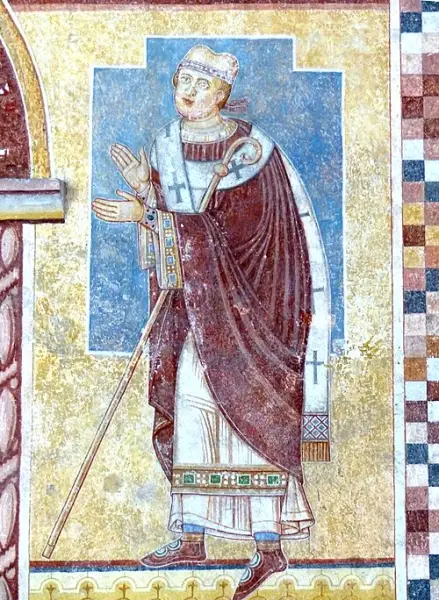
Otto's legacy endures in the geography and devotion of Germany and Poland alike. He is the patron saint of the Archdiocese of Bamberg, whose cathedral city he enlarged and whose abbey church holds his tomb, and co-patron of the Archdiocese of Berlin and of the Diocese of Stettin-Kammin, the sees that stand on the ground of his Pomeranian mission. The faithful have invoked him for help against fever and rabies, diseases against which his intercession was specially sought. In Pomerania his memory was fixed in stone: eleven churches stood from his missions, and the Christianization of the coast he began reached onward to the lands around Gdańsk, where the abbey of Oliwa arose in his era. His statue watches from the Pomeranian Ducal Castle at Szczecin, and a Romanesque fresco of about 1130 at Prüfening Abbey, painted close to his own lifetime, preserves his likeness among the earliest we possess of any German bishop. Historians remember him equally as the negotiator of the Concordat of Worms, the churchman who proved that the quarrel of empire and papacy could be settled by a man trusted on both sides.
§ Veneration
Timeline
- 1060
Was born into a noble family with estates in the Swabian Jura, possibly of the Franconian house of Mistelbach.
§ Early life
- 1082
Followed Judith of Swabia to the Polish court as her chaplain when she married Duke Władysław I Herman.
§ Early life
- 1091
Entered the service of Emperor Henry IV.
§ Early life
- 1101
Was appointed the emperor's chancellor and supervised the construction of Speyer Cathedral.
§ Early life
- 1102
Was appointed and invested as Bishop of Bamberg by Emperor Henry IV.
§ Bishop
- 1106
Received the pallium from Pope Paschal II.
§ Bishop
- 1112
Clothed Hildegard of Bingen as a Benedictine nun at Disibodenberg Abbey, substituting for the imprisoned Archbishop Adalbert of Mainz.
§ Bishop
- 1118
A papal party under Cuno of Praeneste had him suspended at the Synod of Fritzlar because he stood by the imperial court.
§ Bishop
- 1121
Negotiated the peace treaty at the Congress of Würzburg that led to the Concordat of Worms.
§ Bishop
- 1124
Set out on his first missionary journey to Pomerania, sent by the Polish duke Bolesław III Wrymouth.
§ Missionary
- 1128
Journeyed to Pomerania a second time, supported by Duke Wartislaw I, after pagan customs began to reassert themselves.
§ Missionary
- 30 Jun 1139
Died at Bamberg and was buried in Michaelsberg Abbey.
§ Veneration
- 1140
His former companion Adalbert was consecrated Bishop of Wolin, fulfilling Otto's thwarted intent to give Pomerania its own bishop.
§ Missionary
- 1189
Was canonized by Pope Clement III in Rome.
§ Veneration
The Record
- Major works
- Foundation of more than 30 monasteries and hospitals between Carinthia and Saxony·Restoration and completion of Bamberg Cathedral·Rebuilding of the Monastery of St. Michael, Bamberg·Christianization of Pomerania: over 22,000 baptisms and eleven churches founded·Negotiation of the Concordat of Worms
- Patron of
- Patron saint of the Archdiocese of Bamberg·Co-patron of the Archdiocese of Berlin·Co-patron of the Diocese of Stettin-Kammin·Invoked for help against fever and rabies
- Symbols
- Episcopal vestments and crozier·Model of a church
- Canonization
- Canonized in 1189 in Rome by Pope Clement III
Prayer
Bibliography
Show 6 sources
- Jaeger, C. S. (1983). "The Courtier Bishop in Vitae from the Tenth to the Twelfth Century", Speculum 58(2), pp. 291-325. doi:10.2307/2848256.
- Löffler, Klemens. "St. Otto", The Catholic Encyclopedia, Vol. 11, New York: Robert Appleton Company, 1911.
- Robinson, Charles Henry (ed.), "The Life of Otto, Apostle of Pomerania, 1060-1139", New York: The Macmillan Company, 1920. Two contemporary biographies by Ebbo and Herbordus.
- Medley, D. J., The Church and the Empire, Kessinger Publishing, 2004, p. 152. ISBN 1-4191-5673-X.
- Buchholz, Werner. Pommern, Siedler, 1999, p. 25. ISBN 3-88680-272-8.
- Benedict XVI, General Audience, 1 September 2010, Vatican News Service.
Profile text adapted from the Wikipedia article, licensed CC BY-SA 4.0.
Pray with this saint every day
Save St. Otto of Bamberg to your favorites, read the full profile, and get feast-day reminders in the Saints app.
Get the Saints AppFree on the App Store for iPhone and iPad