
1040 – 1127·Feast March 23
St. Ottone Frangipane
Benedictine monk and hermit, patron of Ariano Irpino
Overview
Ottone Frangipane, whom devotion honors as Saint Ottone or Saint Otho, took the Benedictine habit and ended his days a hermit; Rome was his birthplace in 1040, believed to have belonged to the powerful baronial Frangipani family. A knight in his youth, he took part in 1058 in the armed defense of the Pope against rebel lords near Frascati, was captured and chained in a tower, and escaped after a night in which Saint Leonard of Limoges, patron of prisoners, appeared to him and freed his chains. He made his way to the Abbey of Cava de' Tirreni, where under Abbot Pietro he embraced the Rule of St. Benedict in prayer and manual labor, and went on to Montevergine Abbey, where he came to know Saint William of Vercelli and deepened his vocation to asceticism. About 1117 he settled at Ariano Irpino, a staging town for pilgrims bound for the Holy Land, and founded for them the hospital of San Giacomo. In 1120 he withdrew into seclusion beside the church of Saint Peter; in the cell he raised there he gave himself to prayer, vigil, penance, and fasting, and he dug his own tomb as a memento of death. He died there on 23 March 1127, and his reputation for sanctity and miracles made him the patron saint of Ariano Irpino and its diocese.
The Complete Life
A Son of the Frangipani
Ottone was born in Rome in 1040, and tradition believes him a son of the Frangipani, the powerful baronial family that occupied a commanding position in the city from the eleventh century onward. The Frangipani maneuvered cleverly between the Empire and the Papacy, and their maneuvering ran so far that the elevation of two popes at least, Honorius II and Innocent II, owed much to their hands. Birth in such a house was to be born into wealth, arms, and politics, and Ottone's youth followed the knightly course expected of him. In about 1058 he rode out with the forces defending the Pope against rebel lords in the region of Frascati, taking his place in the armed service of the Roman church as his class understood it. The campaign, however, became the hinge of his life: he was captured by the enemy and cast into a cell in a tower, put in chains like any common prisoner. There, stripped of family and freedom, the young knight learned dependence on God alone, in a prison that would prove the antechamber of his monastic vocation.
§ Life
From Prison to the Cloister
In his tower cell Ottone besought the intercession of Saint Leonard of Limoges, the patron saint of the imprisoned, who came to him in the darkness of his cell and struck off his fetters. Freed by so plain a wonder, the knight laid aside the ambitions of baronial Rome and set out as a pilgrim for the Abbey of Cava de' Tirreni, the great Benedictine house of the Italian south. Under the abbot Pietro's direction he embraced the Rule of St. Benedict, giving himself to the twofold discipline of prayer and manual labor, the sword of the nobleman exchanged for the tools of the monk. He did not rest even in the cloister: from Cava he moved on to Montevergine Abbey, where he came to know Saint William of Vercelli, the rugged founder of that mountain community, and under William's influence developed his vocation toward the stricter life of asceticism. The arc of his conversion ran from chains to freedom, from freedom to discipline, and from discipline to the desire for solitude, a progression completed only decades later when he was past seventy.
§ Life
Hospitalier of Ariano
In about 1117 Ottone came to Ariano Irpino, the hilltop city of inland Campania. The place had a particular apostolate waiting for him: at that time Ariano stood on the route of pilgrims traveling from Naples and Benevento toward Bari, there to take ship for the Holy Land, and the stream of poor travelers passing through the city had no sure place of shelter. Ottone consecrated himself to their care and founded the hospital of San Giacomo, named for the patron of pilgrims, to accommodate them on their way to the crusading ports. The monastery's discipline he had learned at Cava was thus turned outward into works of mercy: the monk became a hospitalier, serving Christ in the road-worn strangers who filled his city's streets. For years he directed this work of charity, until the time came when even active service was to be left behind. In him the old knightly instinct for escort and protection found its true object at last, guarding not a lord's banner but the poorest wayfarer on the road. The hospital remained his enduring monument in Ariano, the foundation that bound the old Roman noble to the mountain town that would one day claim him as its own saint and patron.
§ Life
The Hermit of San Pietro
In 1120, at about eighty years of age, Ottone resolved to embrace the solitary state of a hermit. His retreat lay in a secluded spot beside the church of Saint Peter at Ariano, the place afterward called San Pietro dei Reclusi, and built with his own hands a small cell in which to pray, keep vigil, do penance, and fast. The knight who had once worn the arms of his family now mortified the body with a harsher discipline, and his scourge passed into his very iconography. One act above all marked the spirit of his final years: he dug out a tomb for himself, keeping the open grave beside his cell so that the nearness of death would remain continually before his eyes. The paradox of his sanctity was complete before his death, for the reputation of holiness spread quickly around the secluded cell, and many miraculous events were reported in connection with the old man who had fled the world to pray for it. On 23 March 1127 he died in his hermitage, having spent his last seven years in the silence he had sought since his youth.
§ Life
Burial and Translation
Ottone died on 23 March 1127 in the hermitage beside San Pietro, and Ariano claimed her saint without delay. Within days of his death the body was borne in solemn procession to the cathedral of Ariano Irpino and laid to rest there, the hermit of the town's outskirts becoming its treasure within the walls. There the remains rested for nearly a century, until the insecurity of the age intervened: in 1220, during the reign of Frederick II, fear of Saracen raids led to the translation of the relics to Benevento, carried away from the exposed hilltop city to stronger walls. Later records trace their further history: a document of 1686, the Synodicon Diocesanum Sanctae Beneventanae Ecclesiae, records the relics of Saint Ottone Frangipane as then kept in the parish church of San Pietro at Montemiletto. His feast is kept in the Roman Martyrology on 23 March, the day of his death, while Ariano adds a second commemoration on the octave of the Assumption, joining the hermit's memory to the great feast of the Mother of God and giving the city two solemn days for its patron every year.
§ Legacy and veneration
Miracles of the Patron of Ariano
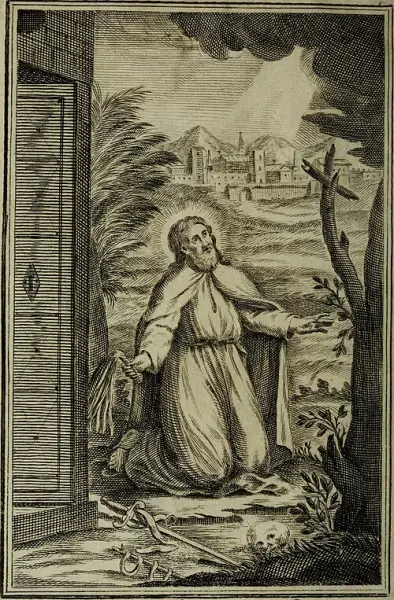
The veneration of Ottone as a saint grew from the wonders recorded around his life and his grave. The most celebrated came around 1180, half a century after his death, when the Saracens of Lucera laid siege to Ariano: the saint appeared among the clouds, and a rain of pebbles struck down the besiegers, delivering the city. The Arianese answered with thanksgiving, raising the church of Santa Maria della Ferma in memory of the deliverance. Other favors followed through his intercession: among those who received wonders at his intercession was Saint Elzéar of Sabran, later Count of Ariano and now honored as the city's patron alongside him. When plague gripped Ariano in 1528, the inhabitants bound themselves in a solemn vow to their protector, and tradition tells that he preserved the city then as at other times from plague and earthquake. In art he is shown in the monastic habit, with a sword recalling his knightly past and a scourge recalling his penance. He is patron saint of Ariano Irpino and of its diocese, of the cathedral he is buried beside, and of the Molise village of Castelbottaccio.
§ Legacy and veneration
The Saint of Two Lives
Ottone Frangipane left his city a double inheritance: the memory of a nobleman who renounced everything, and a tradition of protection in calamity that has never faded. The hospital of San Giacomo stood on the pilgrim road of the Mezzogiorno as the monument of his charity, serving travelers to the Holy Land in an age when the crusader ports drew the poor of Europe southward. His cult took root in the institutions of Ariano, where the cathedral shares his dedication and the joint patronage with Saint Elzéar of Sabran, and it spread to Castelbottaccio in the Molise, which keeps him as its own patron. The vow of 1528 passed into the civic identity of the Arianese, renewed in memory whenever plague or earthquake threatened, and the church of Santa Maria della Ferma still marked the spot where the besieging army had melted away. Historians of southern Italian sanctity, from the studies of D'Agostino and Grasso onward, have seen in him the type of the twelfth-century penitent noble, the baron's son who passed through prison, cloister, hospital, and hermitage to the altar of his adopted city, honored there on 23 March in every generation since.
§ Legacy and veneration
Timeline
- 1040
Was born in Rome, believed to be of the baronial Frangipani family.
§ Life
- 1058
Fought in defense of the Pope near Frascati, was captured and imprisoned, and escaped his chains after an apparition of Saint Leonard of Limoges.
§ Life
- 1117
Went to Ariano Irpino and founded the hospital of San Giacomo to shelter pilgrims traveling toward the Holy Land.
§ Life
- 1120
Withdrew into the life of a hermit beside the church of Saint Peter at Ariano, building a cell and digging his own tomb.
§ Life
- 23 Mar 1127
Died at Ariano; his body was soon carried in procession to Ariano Cathedral and buried there.
§ Legacy and veneration
- 1180
A rain of pebbles from the clouds scattered the Saracens of Lucera besieging Ariano through his intercession; Santa Maria della Ferma commemorates the marvel.
§ Legacy and veneration
- 1220
During the reign of Frederick II, his remains were translated from Ariano Cathedral to Benevento for fear of Saracen raids.
§ Legacy and veneration
- 1528
The Arianese made a vow to Saint Ottone during a plague that gripped their city, crediting him with its deliverance.
§ Legacy and veneration
The Record
- Major works
- Foundation of the hospital of San Giacomo at Ariano Irpino
- Patron of
- Patron saint of Ariano Irpino·Patron saint of the Diocese of Ariano Irpino-Lacedonia·Patron saint of Castelbottaccio·Invoked against plague and earthquakes
- Symbols
- Monastic habit·Sword·Scourge
- Canonization
- Pre-congregation; his feast is set in the Roman Martyrology on 23 March
Prayer
Bibliography
Show 5 sources
- "Sant'Ottone Frangipane", Santi e Beati.
- Guérin, Paul (ed.), Vie des Saints des Petits Bollandistes, Paris, Bloud et Barral, 1876, vol. III, p. 607.
- D'Agostino, A., Sant'Ottone Frangipane, Ariano, Stab. Tip. Appulo Irpino, 1892.
- Grasso, B. A., Sant'Ottone Frangipane nella storia e nella leggenda, Ariano, Stab. Tip. Appulo Irpino, 1901.
- De Stasio, F.; Minelli, D., I Santi Patroni di Ariano e le Sante Spine, Marigliano, 1982.
Profile text adapted from the Wikipedia article, licensed CC BY-SA 4.0.
Pray with this saint every day
Save St. Ottone Frangipane to your favorites, read the full profile, and get feast-day reminders in the Saints app.
Get the Saints AppFree on the App Store for iPhone and iPad