
c. 536 – c. 615·Feast July 2
St. Oudoceus
Early Welsh bishop and patron of Llandaff
Overview
Saint Oudoceus, in Welsh Euddogwy, is generally known as the third Bishop of Llandaff in South Wales, though modern scholars think he was probably a seventh-century bishop based at Llandeilo Fawr rather than at Llandaff itself. Tradition, preserved in the twelfth-century Book of Llandaff, makes him the son of Buddig or Budic, a king of Brittany, and of Anawfedd, the sister of Saint Teilo. Ismael, Bishop of Rhos, and Tyfei the martyr, both of them saints, were reckoned his brothers. His father promised him to the church, he came to Wales to train under his uncle Teilo and in time succeeded him as bishop. He stood as an early patron of the church at Llandaff, where tradition says he placed the relics of Saint Teilo, and legend tells how a hunted stag, laying its head on his cloak, was saved from the hounds of King Einion, who then granted him land. Llandogo near Tintern received him in retirement, and there his life closed on 2 July, the day of his feast. He was buried at Llandaff, where a shrine stood to him until 1547, and Llandaff Cathedral numbers him among its three patron saints.
The Complete Life
A King's Son of Brittany
The story of Oudoceus reaches us mainly through the twelfth-century Book of Llandaff, a compilation whose purpose was to magnify a see of Llandaff newly reorganized by its Norman masters, and every detail of his life must be weighed against that design. The hagiographic life there tells how he was the son of King Budic of Brittany, born in that country soon after his father returned from exile in Dyfed, in south Wales. His mother, named Anawfedd or Anawed in the sources, was accounted a sister of Saint Teilo, among the greatest figures of the Welsh church; Budic accordingly promised that the boy would be trained for God's service at his uncle's side. Holiness marked the whole family, for Ismael, Bishop of Rhos, and Tyfei the martyr were numbered among his brothers. The genealogy follows the pattern beloved of Celtic saint lore, joining Brittany to Wales in the figure of a princely exile's son who crosses the sea to serve God among his mother's people. Whatever history underlies the claims, they set Oudoceus before us as a man born to rank and reared in a household already distinguished by the church's honor.
§ Hagiography
From Brittany to Wales
Oudoceus came to Wales in fulfillment of his father's promise and trained for the church under Saint Teilo, his mother's brother and the founding bishop of the see he would one day be said to head. The Book of Llandaff presents him as eventually succeeding Teilo as Bishop of Llandaff, and asserts that he was consecrated by the Archbishop of Canterbury — the first mention in any written source of the Welsh diocese being subservient to Canterbury, a claim that served the Norman reorganization's purposes exactly. Modern scholarship has redrawn the picture from other evidence. Land grants preserved in the Book of Llandaff make Oudoceus a contemporary of the late seventh-century kings of South Wales, and the historian Wendy Davies sets his episcopal tenure between roughly 650 and 700, concluding that he was in fact a seventh-century bishop whose seat lay most likely at Llandeilo Fawr rather than Llandaff, since nothing attests a bishopric at Llandaff before at least the early eleventh century. Read this way, the cult of Euddogwy at Llandaff may have revived an older saint's memory, borrowing standing from the ambitions of the reorganized diocese whose records carried his name.
§ Hagiography
Patron of Llandaff
Whatever the precise seat of his ministry, Oudoceus's associations with Llandaff are very strong, and he seems to have been an early patron of the church there, which may have been an early monastic foundation. Tradition says that he placed there the relics of Saint Teilo, his uncle and predecessor in the bishopric, binding the new foundation to the memory of the old saint. The life in the Book of Llandaff preserves a charming legend of his authority: Einion, King of Glywysing, ran a stag to earth among the rocks and woodlands of the Wye; the exhausted creature came to the cloak of Oudoceus and laid itself down upon it, and there not one of the royal hounds could touch it. Einion, seeing heaven's shelter in the beast's deliverance, answered with a grant of land to the man of God. The tale, though its chronology is impossible — this Einion was the son of Morgan Hen ab Owain, who died in 974, and so no contemporary — preserves the memory of a bishop whose sanctity gave sanctuary and whose person was a shelter for the hunted.
§ Life
Llandogo and Death
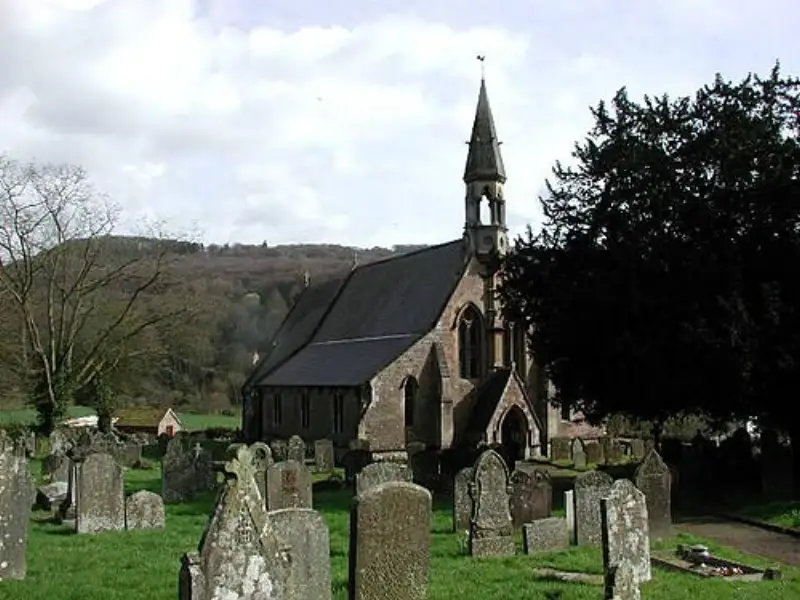
In his last years Oudoceus retired to Llandogo, the small Wye-side settlement near Tintern, and it was there that he died, on 2 July — the date that became and remains his feast day. Llandogo preserved the memory of its bishop, and modern scholars allow it a place among the possible seats of his ministry, since tradition makes him a bishop there around 580 by the old reckoning. His burial was said to be at the church in Llandaff, on the ground where the present cathedral stands, and a shrine honored him there down to 1547, surviving to the eve of the Reformation's dissolution. The church of St Oudoceus at Llandogo still bears his name above the Wye he knew in life. His cult joined him to the greater saints of his house and land: he stands among the three patrons to whom Llandaff Cathedral is dedicated, sharing that dignity with the founders of the Welsh church whose inheritance he was believed to have carried forward. Pilgrims and parishioners alike kept 2 July for him, and his name endures in Welsh form as Euddogwy among the early bishops of the southern realm.
§ Life
Euddogwy of Llandaff
Oudoceus's memory lives on above all in the dedication of Llandaff Cathedral, where he stands as one of the three patron saints of the Welsh church's principal see of the southeast. The twelfth-century compilers of the Book of Llandaff made him a link in their chain of legitimacy, the successor of Teilo consecrated by Canterbury, and though historians have dismantled the chronology, the cult they fostered proved durable enough to keep his shrine at Llandaff standing until 1547. The distinction between the legendary saint and the historical figure is itself part of his story: the Book of Llandaff's Oudoceus, son of a Breton king, nephew of Teilo, benefactor of the stag at the Wye; the scholar's Oudoceus, a seventh-century bishop of Llandeilo Fawr whose cult may have been transferred to Llandaff by ambitious Norman clerics; and the village saint of Llandogo, whose church on the riverbank and feast of 2 July keep his name among the living parishes of Wales. In the Orthodox and Catholic churches alike he is honored as an early bishop of the Welsh land, and the parish calendar of Wales keeps his name and his July feast without interruption.
§ Hagiography
Timeline
- 536
Was said to have been born in Brittany, shortly after his father Budic's return there from exile in Dyfed.
§ Hagiography
- 580
Was said to have been a bishop at Llandogo around this date, one of several suggested centers of his ministry.
§ Hagiography
- 615
Died at Llandogo, his retreat near Tintern, on 2 July, the date observed as his feast.
§ Life
- 1547
Llandaff, on whose church ground the present cathedral rises, kept a shrine in his honor until this date.
§ Life
The Record
- Patron of
- One of the three patron saints of Llandaff Cathedral
- Canonization
- Pre-congregation; shrine at Llandaff until 1547
Prayer
Bibliography
Show 5 sources
- Nedelec, Louis. Cambria Sacra: Or, The History of the Early Cambro-British Christians, Chapter XI, Burns and Oates, 1879.
- Farmer, David Hugh (2011). The Oxford Dictionary of Saints, Fifth Edition Revised, OUP Oxford, pp. 338-. ISBN 978-0-19-959660-7.
- Emanuel, Hywel David. "Oudoceus (Euddogwy), saint, fl. late 6th century", Dictionary of Welsh Biography, National Library of Wales.
- Davies, John Reuben (2003). The Book of Llandaf and the Norman Church in Wales, Boydell Press, pp. 90-92. ISBN 978-1-84383-024-5.
- Monks of Ramsgate. "Oudaceus", Book of Saints, 1921, CatholicSaints.Info, 21 May 2016.
Profile text adapted from the Wikipedia article, licensed CC BY-SA 4.0.
Pray with this saint every day
Save St. Oudoceus to your favorites, read the full profile, and get feast-day reminders in the Saints app.
Get the Saints AppFree on the App Store for iPhone and iPad