
d. 1555 and 1556·Feast October 16
The Oxford Martyrs
Bishops burnt at the stake in Oxford
Overview
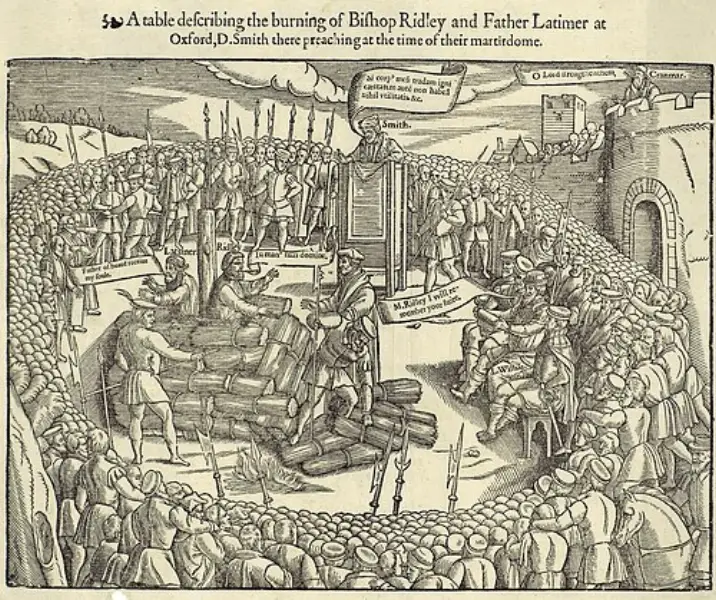
The Oxford Martyrs were three bishops of the Church of England who died for their reformed convictions in Oxford during the Marian persecutions: Hugh Latimer, Nicholas Ridley, and Thomas Cranmer, Archbishop of Canterbury. Tried for heresy in 1555, each refused to abandon the teaching of the English Reformation, and the denial of transubstantiation proved the decisive point of condemnation. Latimer and Ridley were burnt together on 16 October 1555; Cranmer, who wavered through recantations before standing firm, suffered five months later on 21 March 1556. The executions took place just beyond the northern walls of the city, on ground now occupied by Broad Street. The three men were held in the Bocardo Prison, whose cell door survives today in the tower of St Michael's by the North Gate. Their deaths became among the most famous martyrdoms of the English Reformation, retold in John Foxe's Book of Martyrs and honored in granite and stone: a cross set into Broad Street outside Balliol College, and the Victorian Martyrs' Memorial on St Giles'. The Anglican Communion keeps their witness on 16 October.
The Complete Life
Trial for the Faith
When Queen Mary I moved to restore the old religion, the leading voices of the English Reformation were gathered up and charged with heresy. The three bishops were tried in Oxford's University Church of St Mary the Virgin, the university's own church on the High Street. For Latimer, Ridley, and Cranmer the issue crystallized around the Roman Catholic dogma of transubstantiation, which all three refused to affirm. Their episcopal rank and their years of teaching made their condemnations a public demonstration that the Marian regime intended to uproot the reformed faith by force where persuasion had failed. The proceedings in Oxford were part of a wider persecution in England, yet these three deaths carried a weight far beyond their number: one had been Archbishop of Canterbury, and the others had shaped and defended the doctrine of the Church of England through its formative years. Condemned, they passed from the courtroom to the prison and from the prison to the fire, their persistence fixing in the Protestant memory an image of learned, patient courage in the face of a death they might have escaped by a single spoken concession.
§ History
Prison and Fire
After their trial the men were confined in the Bocardo Prison, which stood near the church of St Michael at the North Gate by the northern gate in the city walls, on Cornmarket Street. The door of their cell has never been lost: it is preserved and displayed in the tower of St Michael's, where visitors may still see it. The executions were carried out just outside the walls to the north, on ground where Broad Street now runs. There, on 16 October 1555, Latimer and Ridley were burnt together for denying the dogma of transubstantiation, dying in one another's company before a crowd of onlookers. Cranmer's end came five months later, on 21 March 1556, after he had passed through recantations that tormented his conscience and then withdrew them to die in the faith he had taught. A small area paved with granite setts in the shape of a cross now marks the spot in the roadway before Balliol College, so that the traffic of the modern city passes daily over the place where the three bishops died. Neither the prison nor the fire was permitted to fade from the city's memory, for the preserved cell door and the painted cross in the roadway alike were kept on as silent witnesses to what had happened there.
§ History
Memory in Stone and Verse
The deaths of Latimer, Ridley, and Cranmer entered English memory chiefly through John Foxe's Book of Martyrs, first printed in 1563, whose woodcuts of the burning of Latimer and Ridley fixed the scene for generations of readers. In 1827 the American poet Lydia Sigourney published her poem Latimer and Ridley in a collection of verse, carrying the story across the Atlantic. The city itself took longer to raise its monuments. In 1843 the Martyrs' Memorial was completed at the south end of St Giles', a Victorian spire-like structure that still anchors the street where it stands, near the site of the burnings. A cross of granite setts in Broad Street marks the precise place of execution outside Balliol College, and a plaque there recalls the three men to passers-by. In 2008 a further memorial plaque was fixed to the north wall of the University Church, recalling Reformation martyrs of both allegiances, Catholic and Protestant, men and women who dwelt in Oxfordshire, taught at Oxford, or were conveyed to the city for execution. Stained-glass windows as far away as Christ Church in Little Rock, Arkansas, depict their witness.
§ In literature
Timeline
- 1555
Tried for heresy at the University Church of St Mary the Virgin in Oxford during the Marian persecution.
§ History
- 16 Oct 1555
Hugh Latimer and Nicholas Ridley burnt at the stake outside the northern walls for denying transubstantiation.
§ History
- 21 Mar 1556
Thomas Cranmer, Archbishop of Canterbury, burnt at the stake five months after his fellow bishops.
§ History
- 1827
Lydia Sigourney's poem Latimer and Ridley published in her collection of poetry.
§ In literature
- 1843
The Martyrs' Memorial, a Victorian spire-like monument at the south end of St Giles', completed.
§ History
- 2008
Memorial plaque installed on the northern wall of the University Church, honoring Reformation martyrs of Oxfordshire.
§ Gallery
The Record
- Canonization
- Commemorated as martyrs in the Anglican Communion; no formal canonization process
Prayer
Bibliography
Show 3 sources
- "The Oxford Martyrs". Britain Express. Retrieved 18 May 2023.
- "The martyrs' cross". Broad Street, Oxford. Oxford History. Retrieved 18 May 2023.
- "Martyrs' Cross". Morris Oxford. 17 April 2019. Retrieved 18 May 2023.
Profile text adapted from the Wikipedia article, licensed CC BY-SA 4.0.
Pray with this saint every day
Save The Oxford Martyrs to your favorites, read the full profile, and get feast-day reminders in the Saints app.
Get the Saints AppFree on the App Store for iPhone and iPad