
c. 292 – 348·Feast May 15
St. Pachomius the Great
Father of cenobitic communal monastic life
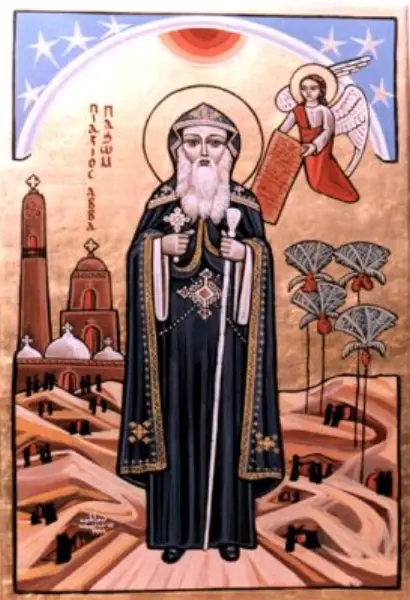
Overview
Pachomius the Great, born around 292 in the Thebaid of Roman Egypt near modern Luxor, is honored as the founder of Christian cenobitic monasticism, the form of religious life in which monks live together, pray together, and hold all property in common. Raised by pagan parents, he was conscripted into the Roman army at twenty-one and, while held at Thebes, met Christians whose daily charity to the impressed soldiers converted his heart. Baptized in 314, he trained for seven years under the hermit Palaemon and then, at Tabennisi, answered what he understood as a divine command to build a dwelling for those who would come to him. Between 318 and 323 he established his first monastery there, organizing community life under a written rule, and later founded a second house at Pbow, which became the center of a growing network along the Nile. He led the movement for some thirty years, refused ordination, and died on 9 May 348 during an epidemic. At his death eight monasteries looked to his rule and the brothers under his guidance numbered several hundred; within a generation his manner of monastic life had spread out of Egypt into Palestine, Syria, North Africa, and Western Europe.
The Complete Life
A Pagan Boy on the Nile
Pachomius came into the world around 292 in the Thebaid, the stretch of Upper Egypt near modern Luxor, to parents who worshipped the old gods. His name is Coptic, drawn from a word for the eagle or falcon, ultimately from an Egyptian term for the divine image, though Greek speakers folk-etymologized it as broad-shouldered. His path changed abruptly at the age of twenty-one, when a Roman army recruitment drive swept him up against his will, a common hazard in an era of turmoil and civil war. With other young men he was put aboard a vessel drifting down the Nile, which reached Thebes in the evening. There he encountered local Christians for the first time, and their custom struck him deeply: day after day they came to the conscripted troops, bringing food and comfort to men who had been seized from their homes. The kindness he witnessed became the seed of a vow, made before his release, that he would investigate this faith further. He managed to leave military service without ever fighting, settled in the village of Sheneset, also called Chenoboskion, in Upper Egypt, and there was converted and baptized in 314.
§ Life
Apprentice of the Desert
After his baptism Pachomius sought out the recognized ascetics of Egypt and resolved to follow their way under the direction of a hermit named Palaemon, beginning around 317. Among the devotions he practiced was one popular in that age: praying with the arms stretched outward in the shape of a cross. For seven years he remained Palaemon's disciple, mastering the disciplines of prayer, fasting, and simplicity before he was ready to stand on his own. He then withdrew to live as a hermit near St. Anthony of Egypt, imitating the practices of the great father of monasticism. Yet Pachomius's vocation was pointing beyond the solitary cell. While at prayer in the abandoned village of Tabennisi, a voice came to him, summoning him to settle there and raise a monastery, promising that many would come to become monks alongside him. Later, following a day spent harvesting reeds beside his brother on a little island, he received a night vision in which an angel, three times over, declared the Lord's will: that he minister to the human race and unite humanity to God. Earlier ascetics such as Macarius had grouped holy men into loose settlements of cells; Pachomius was being called to gather them into something more deliberate.
§ Life
Building the Common Life
Between 318 and 323 Pachomius established his first monastery at Tabennisi. His elder brother John joined him, and within a short time more than a hundred monks were living nearby. What set his work apart was organization: until then Christian asceticism had been essentially solitary, with monks in separate huts or caves meeting only for occasional worship. Pachomius created the cenobitic form, in which monastics lived together, held property in common, and obeyed an abbot or abbess, knowing that men accustomed only to eremitical freedom might recoil if the burdens of community were thrust upon them too abruptly. He therefore absorbed the administration himself, leaving others free for spiritual exercise, and the brothers hailed him as Abba, father, the word from which abbot descends. Tabennisi, repeatedly enlarged, soon proved too small, and a second monastery rose at Pbow, which became the hub of houses spreading along the Nile in Upper Egypt; from 336 onward Pachomius made it his base. He never sought priesthood for himself or his monks. When Athanasius visited in 333 and wished to ordain him, Pachomius fled, likely a fruit of his zealous defense of orthodoxy against Arianism. Basil of Caesarea later visited, absorbed his ideas, and carried them into his own rule.
§ Life
The First Written Rule
Pachomius was the first to set a monastic rule down in writing. His initial legislation built on prayers already in general use, above all the Lord's Prayer, appointed for the monks each day; as the communities grew, the precepts were elaborated with material drawn from the Bible. The rule he composed eased the way for the less proficient while leaving room for the severest asceticism among the strongest. Its guiding principle was balance: prayer joined to work, the communal life to solitude, with the day organized around the liturgy, manual labor, and devotional reading. Fasts and tasks were matched to each monk's strength, and every brother received the same food and clothing. Common meals were provided, yet a monk who wished to abstain from them was encouraged in his choice, with bread, salt, and water set in his cell, so that the ordering of meals and fasting rested largely with the individual. To Pachomian tradition is also credited the first Christian use and recommendation of the prayer rope. Among the many miracles reported of him is that, though he never learned Greek or Latin, he sometimes spoke both tongues miraculously.
§ Rule of St. Pachomius
The Last Epidemic
Pachomius continued to govern the cenobitic federation for roughly thirty years, holding together a network of houses that stretched along the Nile. His death came in the shadow of sickness. During an epidemic, probably plague, he gathered the monks, strengthened their faith in the face of the scourge, and, whether by oversight or by humble design, did not appoint a successor before the end came. He died on 14 Pashons in the year 64 of the Coptic era, corresponding to 9 May 348, at Pbow, the monastery he had raised into the center of his movement. The Coptic church marks that departure each year on 9 May, while Orthodox and Catholic calendars keep him a few days later. He left behind not a single great foundation but a living institution: eight monasteries and several hundred brothers who had learned to pray, work, and hold all things in common under his guidance. The man who had fled episcopal ordination died as one of the most consequential organizers of Christian life in the ancient world, his community prepared to carry his manner of discipleship far beyond the Egyptian desert that had formed it.
§ Death and legacy
A Way of Life for the Whole Church
Within a generation of his death, cenobitic practice spread out of Egypt into Palestine and the Judean desert, onward to Syria and North Africa, and in time to Western Europe; the number of monks shaped by his movement may have reached seven thousand. His written rule was translated into Latin by Jerome, followed by Honoratus of Lérins, and adapted by both Basil the Great and Benedict of Nursia in their own legislation. The Ascetica descended from his way of life remains in use in the Eastern Orthodox Church today, the eastern counterpart to the Benedictine rule of the West. His reputation for holiness has endured across traditions: Coptic churches keep his feast on 9 May, Eastern Orthodox and Catholic communities on 15 May, and Lutheranism remembers him as a renewer of the church, alongside his fellow desert saint Anthony, on 17 January. The major shrine of Monastery of Saint Pachomius stands at Luxor, near his birthplace, and iconography depicts him as a hermit in monastic garb or riding a crocodile over the Nile, an image of the miraculous authority the desert fathers ascribed to him.
§ Death and legacy
Timeline
- 292
Born in the Thebaid of Roman Egypt, near modern-day Luxor, to pagan parents.
§ Life
- 314
Converted to Christianity and baptized at Sheneset (Chenoboskion) in Upper Egypt after leaving the army.
§ Life
- 317
Placed himself under the guidance of the hermit Palaemon to pursue the ascetic life.
§ Life
- 318
Established his first monastery at Tabennisi, an undertaking dated between 318 and 323.
§ Life
- 333
Visited by Athanasius of Alexandria, who wished to ordain him; Pachomius fled to remain a simple monk.
§ Life
- 336
From this year onward spent most of his time at the monastery of Pbow, the center of his federation.
§ Life
- 9 May 348
Died at Pbow during an epidemic, on 14 Pashons in the Coptic calendar, after some thirty years as abbot.
§ Death and legacy
In Their Own Words
Pachomius, Pachomius, struggle, dwell in this place and build a monastery; for many will come to you to become monks with you, and they will profit their souls.
Pachomius, Pachomius, the Lord's will is [for you] to minister to the race of men and to unite them to himself.
The Record
- Major works
- Rule of St. Pachomius·Foundation of the Monastery of Tabennisi·Foundation of the Monastery of Pbow
- Symbols
- Hermit in a monastic garb·Hermit crossing the Nile on the back of a crocodile
- Canonization
- Pre-congregation; venerated from antiquity across the Catholic, Eastern Orthodox, Oriental Orthodox, Anglican, and Lutheran traditions
Prayer
Bibliography
Show 6 sources
- Gawdat Gabra; Hany N. Takla (2010). Christianity and Monasticism in Upper Egypt. American Univ in Cairo Press. p. 33. ISBN 978-977-416-311-1.
- Veilleux, Armand (1980). Pachomian Koinonia: The life of Saint Pachomius and his disciples (volume 1). Cistercian Studies Series. Vol. 45. Kalamazoo, Mich: Cistercian Publications. ISBN 0-87907-845-6.
- Goehring, J. E. (1999). Ascetics, Society, and the Desert: Studies in Early Egyptian Monasticism. Trinity Press International. pp. 27–28. ISBN 9781563382697.
- Hedstrom, D. L. B. (2021). The Monastic Landscape of Late Antique Egypt: an Archaeological Reconstruction. Cambridge University Press. p. 161. ISBN 9781316614082.
- Crum, Walter Ewing (1939). A Coptic Dictionary. Oxford: Clarendon Press. p. 25.
- Philip Rousseau (University of California Press, Berkeley 1985), Pachomius: the Making of a Community in Fourth-Century Egypt, pp. 74–75. ISBN 0-52005048-7.
Profile text adapted from the Wikipedia article, licensed CC BY-SA 4.0.
Pray with this saint every day
Save St. Pachomius the Great to your favorites, read the full profile, and get feast-day reminders in the Saints app.
Get the Saints AppFree on the App Store for iPhone and iPad