
c. 310 – 391·Feast March 9
St. Pacian
Fourth-century Bishop of Barcelona and Church Father
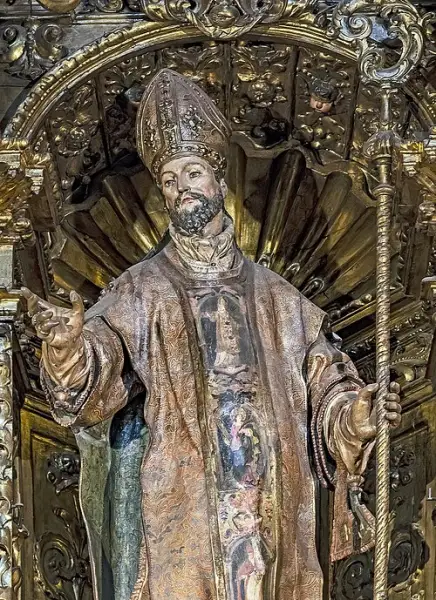
Overview
Pacian, born around 310, was an early Spanish Christian prelate who held the see of Barcelona from roughly 365 until his death there around 391, succeeding Bishop Praetextatus in that Catalan city. He ranks among the Fathers of the Church, a distinction secured in his own lifetime's aftermath by Jerome, who eulogized him in De viris illustribus and commended his eloquence, learning, chastity, and the holiness of his life. Of his literary output only a portion survives: three letters and a short treatise, the Paraenesis ad Poenitentiam, an exhortation on repentance. In these works he took up ecclesiastical discipline, baptism, papal primacy, and the teaching on penance, writing against Novatianism, the rigorist movement then flourishing in Spain. To posterity he is remembered above all for one sentence from his correspondence: Christianus mihi nomen est, catholicus vero cognomen — in his own rendering, Christian is my name and Catholic my surname. Unusually among the great bishops of his age, he was a married man; his son Nummius Aemilianus Dexter rose to serve the emperor Theodosius I as proconsul and praetorian prefect. In 2023, scholars identified in his Latin writings some of the earliest traces of the Catalan language.
The Complete Life
A Married Man Called to the Episcopate
Pacian's road to the see of Barcelona ran through family life rather than around it. He was a married man, and his household produced a son of remarkable distinction: Nummius Aemilianus Dexter, who would serve under the emperor Theodosius I as proconsul and as praetorian prefect, among the highest offices of the late Roman administration. This domestic circumstance did not hinder his advancement in the church of fourth-century Spain. Around the year 365 he was raised to the episcopate of Barcelona, succeeding Praetextatus, and he governed that important Mediterranean port city for roughly twenty-six years, until his death around 391. The fact that Jerome, writing the first great biographical dictionary of Christian authors, dedicated De viris illustribus to Pacian's son shows how closely the bishop's family was woven into the learned circles of the age; Jerome himself never knew Pacian personally, but he knew and honored Dexter. The picture that emerges is of a bishop whose authority rested on character and culture rather than on renunciation, a family man whose chastity and holiness of life drew praise even from a distant admirer who had never met him in the flesh.
§ Personal life
Teacher of Penance and Catholic Unity
Pacian's literary remains are fragmentary but weighty: three letters and a brief treatise, the Paraenesis ad Poenitentiam, an appeal urging the faithful toward repentance. Through these texts he enters the theological controversies of late fourth-century Spain. Novatianism, the rigorist movement that denied reconciliation to those who had fallen into grave sin, was then flourishing on the Iberian peninsula, and against it Pacian defended the church's power to bind and to loose through the ministry of penance. His writings range across ecclesiastical discipline, the meaning of baptism, and papal primacy, presenting the bishop of Rome's authority as part of the ordered structure by which unity is preserved. The sentence by which he is best remembered — Christianus mihi nomen est, catholicus vero cognomen — declares in his own idiom that Christian is his name and Catholic his surname. In it he answered those who disdained the Catholic name while claiming the Christian one, arguing that the two belong together as personal name and family name. The formulation became one of the classic patristic definitions of the church's identity, quoted wherever Christians have had to explain why communion with the whole church matters more than private perfection.
§ Biography
From Jerome's Pages to the Origins of Catalan
Jerome's verdict secured Pacian's standing for every later generation. In De viris illustribus the great scholar eulogized the bishop of Barcelona, praising his eloquence, his learning, his chastity, and the holiness of his life — a fourfold commendation from a man who did not know him personally but judged him through his writings and through his son. The church accordingly numbers Pacian among the Fathers, and his memory is kept on 9 March by Catholics and honored in both the Eastern Orthodox and Oriental Orthodox churches. In the twenty-first century his words gained an unexpected second life. A 2023 study — the work of Jesús Alturo i Perucho together with Tània Alaix i Gimbert — discerned the first hunches of the Catalan language in his Latin, pointing to forms such as ceruulus for cèrvol and subinde for sovint, and to the expression si te placet standing where a Catalan writer would one day put si us plau, among many other traces. By this account, the language spoken today in Barcelona, the very city Pacian governed, may have its earliest written stirrings in the correspondence of its fourth-century bishop.
§ Legacy
Timeline
- 310
Born around this year into the Christian community of Roman Spain.
§ Biography
- 365
Became Bishop of Barcelona around this year, succeeding Praetextatus in the see.
§ Biography
- 391
Died in Barcelona around this year, after roughly a quarter century as bishop.
§ Biography
- 2023
Study by Alturo and Alaix identified first hunches of the Catalan language in his writings.
§ Legacy
In Their Own Words
Christianus mihi nomen est, catholicus vero cognomen
The Record
- Major works
- Three extant letters·Paraenesis ad Poenitentiam
- Canonization
- Pre-congregation; venerated as a saint and Church Father from antiquity
Prayer
Bibliography
Show 7 sources
- Craig L., Hanson (1999). Iberian Fathers, Volume 3. CUA Press. pp. ii. ISBN 978-0-8132-0099-6.
- St. Pacian – Catholic Online.
- Patron Saints Index: Saint Pacian of Barcelona.
- A. H. M. Jones; J. R. Martindale; J. Morris (1971). "Nummius Aemilianus Dexter 3". Prosopography of the Later Roman Empire. Vol. 1. Cambridge University Press. p. 251. ISBN 978-0-521-20159-9.
- Irondequoit Catholic Communities – Pacian. Archived October 28, 2007, at the Wayback Machine.
- Alturo, Jesús; Alaix, Tània (2023). Lletres que parlen: viatge als orígens del català. Barcelona: La Magrana. pp. 55–56. ISBN 9788419334053.
- Camps, Magí (February 27, 2023). "El catalán escrito, dos siglos más antiguo de lo que se creía". La Vanguardia. Retrieved May 27, 2023.
Profile text adapted from the Wikipedia article, licensed CC BY-SA 4.0.
Pray with this saint every day
Save St. Pacian to your favorites, read the full profile, and get feast-day reminders in the Saints app.
Get the Saints AppFree on the App Store for iPhone and iPad