
1653 – 1721·Feast September 24
St. Pacificus of San Severino
Franciscan friar, suffering missionary and miracle-worker
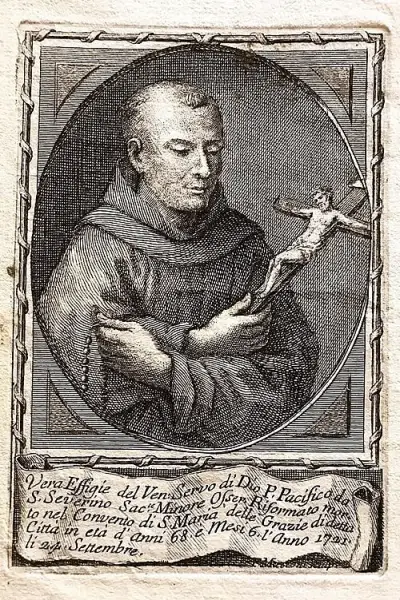
Overview
Pacificus of San Severino, born Carlo Antonio Divini on 1 March 1653 at San Severino in the March of Ancona, was an Italian Franciscan priest celebrated as a miracle-worker and for a lifetime of unrelieved bodily suffering endured with serenity. Orphaned of his noble parents around the age of three, he was raised by a maternal uncle, the archdeacon of the cathedral, and in December 1670 received the Franciscan habit among the Reformati at Forano, taking the religious name Pacificus. Ordained a priest on 4 June 1678, he taught philosophy to the order's junior members at Fossombrone for six years and then gave four or five years to preaching missions through the surrounding countryside. Though chronically frail, he walked a great part of central and northern Italy to preach, until failing health — lameness, deafness, and encroaching blindness — ended the itinerant apostolate and turned him wholly to the contemplative life. He governed the Santa Maria delle Grazie convent at San Severino as Guardian from 1692 to 1693 and died there on 24 September 1721. Crowds flocked to his funeral; the process toward his canonization opened in 1740, and he was declared a saint in 1839.
The Complete Life
An Orphan of the Marches
Carlo Antonio Divini entered the world on 1 March 1653 at San Severino, in the March of Ancona within the Papal States, the youngest of the thirteen children of Antonio Maria and Mariangela Bruni Divini, nobles of the town. Fortune gave him little time beneath their roof: his mother and father died within a short span of his Confirmation, when the boy was only three years old. His upbringing passed to his mother's brother, Luzizio Bruni, archdeacon of the cathedral at San Severino, remembered as a good and cultured man, though far too strict in temper to care easily for a small child. From such a childhood — noble birth, early bereavement, a severe but educated guardian in the shadow of the cathedral — came the boy who would choose the strictest branch of the Franciscan family. In December 1670, still in his teens, he received the habit among the Reformati, the order's reformed branch, at Forano in the Ancona march and took the name by which the world would know him: Pacificus. The choice of the strictest observance set the pattern of rigor and interior freedom that would mark the rest of his life.
§ Life
Priest, Professor, Preacher
Priestly ordination came to Pacificus on 4 June 1678, and he was at once given work of the mind: for the next six years he taught philosophy to the order's junior members at Fossombrone, forming young Franciscans in the study that undergirded their ministry. Teaching, however, was a preparation rather than a terminus. Leaving the lecture room, he devoted four to five years to missionary work in the region around his houses, preaching to the people of the Marches in the popular mission style of the age. A contemporary description preserves the image he presented: a man tall and thin, pale of complexion, with an aquiline nose, a clear preaching voice, and a modest, friendly air. Though his health was never robust, he walked a good part of central and northern Italy to preach, carrying the missions from town to town on foot. The vocation that began in an orphan's choice of the strictest Franciscan observance thus matured into a life spent forming his brethren and evangelizing the countryside, until bodily collapse finally redirected rather than extinguished it. Preaching of this kind demanded not learning alone but endurance, and to the mission he brought both, until the body could no longer answer the call.
§ Life
Apostle on Foot
The missionary apostolate of Pacificus belonged to the great Franciscan tradition of itinerant preaching, pursued at extraordinary physical cost. In an era when travel meant walking, and when his body gave him no reserves of strength, he covered a good part of central and northern Italy to bring the missions to towns and villages. The work demanded not only stamina but voice and presence, and contemporaries noted both — the clear voice that carried the sermon and the modest, friendly manner that drew hearers in. When in 1684 his health began to fail, the loss was progressive and total: lameness deprived him of the road, deafness of easy contact with the people, and blindness of the written page. Unable to continue giving missions, he did not retire into bitterness but cultivated the contemplative life, turning the energies of the apostolate inward. Even so he was not set aside by his brethren: though his health was chronically poor, he served in turn at the San Severino and Forano houses, holding posts of responsibility in each, and from 1692 to 1693 governed the Santa Maria delle Grazie convent in San Severino as Guardian, the house in which he would one day die.
§ Life
Suffering Offered in Silence
The spirituality of Pacificus was forged in the fire of unremitting physical pain. Bodily torment of an intense kind pursued him all his days, and he sought comfort and relief in God alone; those who wrote his earliest lives were convinced that this total recourse was rewarded, for he was endowed with remarkable supernatural graces and a gift for working miracles. His chroniclers record that his patience under suffering was angelic, that several wonders were worked at his intercession, and that God favored him with ecstasies — prayers so absorbed that they carried him beyond the senses. The gifts that clustered around his later years bore the same stamp of a soul disciplined by affliction: he is said to have foretold the dreadful earthquake that laid waste the Abruzzo in 1703, and the marvels reported at his tomb after death were regarded as the continuation of graces begun in his lifetime. When lameness, deafness, and blindness ended his public preaching, he received the change as a call to the contemplative life, finding in illness not the end of apostolate but its transfiguration. His was a spirituality of the broken body made fruitful, and the church's recognition of him as patron of those with chronic pain honors exactly this.
§ Life
The Last Years at Santa Maria delle Grazie
Pacificus's final decades were spent shuttling between the two houses that had framed his religious life, the San Severino and Forano monasteries, holding responsible offices in each despite a body that had long since ceased to serve him. From 1692 to 1693 he carried the burden of leadership as Guardian of the convent of Santa Maria delle Grazie in San Severino, the administrative superior of a community while himself lame, growing deaf, and losing his sight. There, in that same convent, his long pilgrimage closed: he died on 24 September 1721 at the age of sixty-eight, having lived more than half a century under the Franciscan habit. The people of the town did not treat his passing as an ordinary death. The funeral drew great crowds, and marvels were soon reported at his tomb, the first public signs of the devotion that would carry his cause to Rome. In 1725, four years after his death, his remains were translated to the abbey church, giving the growing stream of pilgrims a proper place to pray at his side. Those who knelt at the abbey altar were convinced that the wonder-working friar had only changed the place of his intercession, not ceased to make it.
§ Life
From Servant of God to Saint
The road to the altars began formally in 1740, when the canonization process commenced under Pope Benedict XIV and Pacificus received the first title in the church's process, Servant of God. Nearly half a century later, on 4 August 1786, Pope Pius VI beatified him at Saint Peter's Basilica in the Papal States. The year following that beatification his cult received splendid expression: his relics, clothed over with a wax effigy, were set in a glass coffin and translated to a chapel raised in his honor, where the faithful could see the saint's likeness sheltering his mortal remains. A final half-century of awaited confirmation ended on 26 May 1839, when Pope Gregory XVI canonized him at Saint Peter's Basilica, enrolling the Franciscan of the Marches among the saints of the universal church. His feast is celebrated on 24 September, the anniversary of his death, the traditional day of a saint's heavenly birth. From confinement to confession of the altar, his cause ran for almost exactly a century, a slow and steady verdict on a life of hidden suffering. Each stage was weighed on the testimony of a life already scrutinized by physicians, prelates, and hostile critics, and each examination found the same quiet constancy beneath the famous wounds.
§ Veneration
Patron of the Chronically Ill
Pacificus left no writings and founded no congregation; his legacy is a reputation for holiness written in pain and mercy, and a devotion that found him peculiarly close to those who suffer as he suffered. Those living with chronic pain claim him as their patron, an intercession drawn directly from his own long endurance of lameness, deafness, blindness, and daily bodily torment, and he is likewise honored as patron of San Severino Marche, the town of his birth and death. Devotion to him has crossed borders in modest but telling ways. A chapel in Humphrey, New York, is the one North American church that bears his name, and in Istanbul the Latin Catholic church on the island of Büyükada, ancient Prinkipo, is called San Pacifico in his honor, carrying his memory to the shores of the Bosporus. For the Franciscan order he stands among the confessors — saints renowned not for martyrdom but for heroic virtue in ordinary, if arduous, obedience. His glass coffin in the chapel at San Severino remains the focal point of a cult that has never depended on monuments, only on answered prayers.
§ Veneration
Timeline
- 1 Mar 1653
Born Carlo Antonio Divini at San Severino in the March of Ancona, youngest of thirteen children.
§ Life
- Dec 1670
Received the Franciscan habit among the Reformati at Forano, taking the name Pacificus.
§ Life
- 4 Jun 1678
Ordained to the priesthood.
§ Life
- 1684
Health began to fail; lameness, deafness, and blindness forced him to abandon preaching missions.
§ Life
- 1692
Became Guardian of the Santa Maria delle Grazie convent at San Severino, serving through 1693.
§ Life
- 1703
Credited with predicting the terrible earthquake that devastated the Abruzzo in this year.
§ Life
- 24 Sep 1721
Died at the convent of Santa Maria delle Grazie in San Severino, aged sixty-eight.
§ Life
- 1725
Mortal remains placed in the abbey church after crowds and reported miracles at his grave.
§ Veneration
- 1740
Canonization process commenced under Pope Benedict XIV, granting him the title Servant of God.
§ Veneration
- 4 Aug 1786
Beatified by Pope Pius VI at Saint Peter's Basilica.
§ Veneration
- 1787
Relics clothed in a wax effigy, set in a glass coffin, and translated to a chapel raised in his honor.
§ Veneration
- 26 May 1839
Canonized by Pope Gregory XVI at Saint Peter's Basilica.
§ Veneration
In Their Own Words
he sought for comfort and relief in God alone, and was by him favoured with marvellous supernatural graces and with the gift of working miracles
tall, thin man with pale skin, an eagle nose, a clear voice and a modest and friendly appearance
The Record
- Patron of
- San Severino Marche·those with chronic pain
- Symbols
- Franciscan habit
- Canonization
- Beatified 4 August 1786 by Pope Pius VI at Saint Peter's Basilica; canonized 26 May 1839 by Pope Gregory XVI at Saint Peter's Basilica
Prayer
Bibliography
Show 9 sources
- "St.Pacific of San Severino, Franciscan friar - Information on the Saint of the Day - Vatican News". www.vaticannews.va. Retrieved 2026-09-24.
- "Saint Pacificus", Daily Compass.
- Bihl, Michael. "St. Pacificus of San Severino." The Catholic Encyclopedia Vol. 11. New York: Robert Appleton Company, 1911. 15 May 2018.
- "St. Pacifico dari San Severino" OFM-Indonesia.
- Odden, Per Einar. "Den hellige Pacificus av San Severino (1653-1721)", Den katolske kirke, December 24, 2005.
- Monks of Ramsgate. "Pacificus". Book of Saints, 1921. CatholicSaints.Info. 3 May 2017.
- "Saint Pacifico of San Severino (1653-1721)", St. Mary's Press.
- "Büyükada - the Roman Catholic Church of San Pacifico - Princes' Islands Tourism Development Center".
- Herbermann, Charles, ed. (1913). "St. Pacificus of San Severino". Catholic Encyclopedia. New York: Robert Appleton Company. Public domain.
Profile text adapted from the Wikipedia article, licensed CC BY-SA 4.0.
Pray with this saint every day
Save St. Pacificus of San Severino to your favorites, read the full profile, and get feast-day reminders in the Saints app.
Get the Saints AppFree on the App Store for iPhone and iPad