
died c. 550·Feast April 15
St. Padarn
Abbot-bishop of Llanbadarn and founding saint of Brittany
Overview
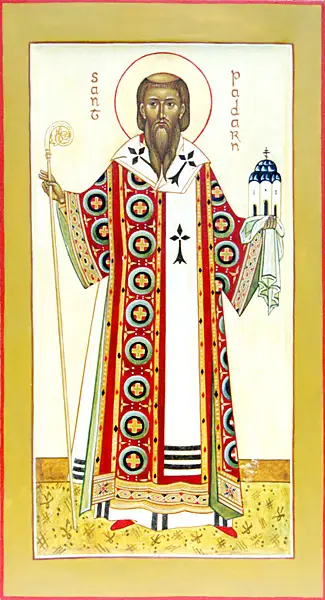
Padarn, whose name appears in Latin as Paternus or Padarnus and in Breton as Padern, was a sixth-century British abbot-bishop who stands among the founding figures of Welsh and Breton Christianity. His medieval Life, the Vita Sancti Paterni, makes him Armorican by race, the son of Petran and Guean, though modern scholars such as Canon G. H. Doble favor a Welsh origin. Around the year 524 he traveled to Ireland to join his father, threw in his lot with a fellowship of monks under his cousin St. Cadvan, and studied at the great school of Illtud, Cor Tewdws. He founded the monastery of Llanbadarn Fawr beside Aberystwyth, from which grew a new diocese whose first bishop he became, and later crossed to Brittany, where he raised a monastery at Vannes and was numbered the seventh of the region's seven founding saints after making peace with its six bishops. His name is also attached to Saint Paternus of Avranches in Normandy, and perhaps to the first bishop of Braga. Unusually for a Celtic saint, his early vita is one of a small handful of independent witnesses to King Arthur, whose attempted theft of Padarn's tunic became the saint's most celebrated legend.
The Complete Life
From Armorica to the Schools of the Saints
The Vita Sancti Paterni, the chief source for Padarn's story, tells of a birth into a family already given over to God: his parents, Petran and Guean, dedicated themselves to Christ, and his father quit Letavia — Brittany of today — for Ireland. Thomas Wakeman reckons Padarn a nephew of Hoel of Cornouaille, though the claim of Breton descent has its doubters; Canon G. H. Doble judged that the supposed Armorican origin could no longer be maintained, and E. G. Bowen thought Padarn was later mixed up with Breton saints bearing that name. Whatever his birthplace, the pattern of his formation is clear. Around the year 524 he traveled to Ireland to join his father, and there attached himself to a monkish fellowship under the lead of his cousin, St. Cadvan, bound for Britannia. The company carried a worldly as well as a spiritual air, for among the travellers were cousins who appointed Padarn the fourth leader of the troop with the charge that he should rule over people by the example of his life. He went on to study at Cor Tewdws, Illtud's school, the great nursery of Welsh saints, and there completed the education of a monk, a scholar, and a leader of men.
§ Life
Bishop of Llanbadarn and Seventh Saint of Brittany
Padarn's enduring monument in Wales is the monastery he founded at Llanbadarn Fawr, near Aberystwyth — the church of Padarn, as the place-name declares — from which grew a new diocese over which he presided as first bishop. Leaving the house in the charge of a trusted steward, he journeyed onward, and his presence was said to carry such spiritual weight that it sufficed to calm the armies of the kings of two provinces. On his return to Llanbadarn Fawr he contended with Maelgwn Gwynedd, who tried to cheat the monastery of its property; the king's two heralds were defeated in the ordeal of boiling water, and Maelgwn himself, first cursed and then cured of sickness and blindness, came on bended knee to ask pardon and to bestow lands on the community, boundaries drawn with the precision of a title deed from the mouth of the river Rheidiol to the river Clarach. The Vita records a pilgrimage to Jerusalem with St. David and St. Teilo, where the patriarch ordained all three bishops and presented Padarn with a crozier and a tunic finely woven; on the journey the three acquired the gift of tongues, and on their return they divided Britannia amicably into three bishoprics. At last Padarn returned to Letavia, made peace with Bishop Samson at Vannes, built a monastery there, and joined peace with the six bishops of Armorica as their seventh.
§ Life
The Tunic, the King, and the Three Feasts
Padarn's name reached the wider world through legend. In the vita's most celebrated episode, King Arthur, traversing the country, came to the saint's cell and, seized with avarice, tried to make off with the tunic brought from Jerusalem. Padarn answered that the garment belonged to the clerical office, not to any malign person; when Arthur returned in wrath to take it by force, the saint spoke — may the earth swallow him — and the ground opened to Arthur's chin. The humbled king begged forgiveness on his knees, received it, and took Padarn as his continual patron. Modern commentators see the tale as a bid to magnify the saint by attaching him to the Christianizing of the semi-historical Arthur, and note that the author confused this Padarn with Padarn Redcoat, whose coat ranked among the Thirteen Treasures kept of the Island of Britain. The Vita Sancti Paterni itself, composed at Cemis in Pembrokeshire during the twelfth century, remains one of the rare insular saints' lives to mention Arthur independently of Geoffrey of Monmouth. In Armorica three days were kept in his honor: the November Kalends, marking the perpetual unity he formed with the six chief saints; his obit day; and the day of his ordination to the episcopate. Churches at Llanbadarn Fawr, Llanberis, and three in Radnorshire bear his dedication, and St Padarn's Institute in Llandaff now trains ministers for the Church in Wales.
§ Padarn and Arthur
Timeline
- 512
By the tradition identifying him with Paternus of Avranches, ordained priest by the Bishop of Coutances.
§ Paternus of Avranches
- 524
Traveled to Ireland to join his father and attached himself to a fellowship of monks under his cousin St. Cadvan.
§ Life
- 550
Died at Vannes in Brittany around this year, having built a monastery in the city.
§ Life
In Their Own Words
you should rule over people for example of life
The Record
- Major works
- Foundation of the monastery and church of Llanbadarn Fawr·Foundation of a monastery at Vannes
- Canonization
- Pre-congregation; venerated in the Anglican Communion, Eastern Orthodox Church, and Roman Catholic Church
Prayer
Bibliography
Show 9 sources
- "St. Padarn of Wales", Parish of Oystermouth, Swansea.
- Llanbadarn, "Padarn's church".
- J. S. P. Tatlock, "The Dates of the Arthurian Saints' Legends", Speculum 14.3 (July 1939:345–365) pp. 349ff.
- Wakeman, tho, as. Lives of the Cambro British Saints, Chap X, W. Rees, 1853.
- Bowen, Emrys George. "Padarn (c. 560), a Celtic saint", Dictionary of Welsh Biography, 1959.
- Maddem, Eric. Snowdonia Folk Tales, The History Press, 2015. ISBN 9780750966429.
- A. W. Wade-Evans, ed. (1944). Vitae Sanctorum Britanniae et Genealogia. University of Wales Press, p. 259.
- Over, Kristen Lee., Kingship, Conquest, and Patria, Routledge, 2014. ISBN 9781135474164.
- "Lives of the Saints, For Every Day of the Year" edited by Rev. Hugo Hoever, S.O.Cist, Ph.D., New York: Catholic Book Publishing Co., 1955, p. 151.
Profile text adapted from the Wikipedia article, licensed CC BY-SA 4.0.
Pray with this saint every day
Save St. Padarn to your favorites, read the full profile, and get feast-day reminders in the Saints app.
Get the Saints AppFree on the App Store for iPhone and iPad