
1887 – 1968·Feast September 23
St. Padre Pio
Capuchin stigmatist and confessor of Pietrelcina
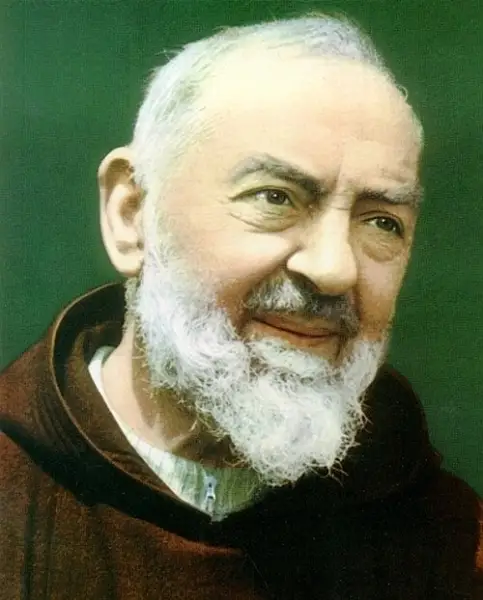
Overview
Pio of Pietrelcina, born Francesco Forgione on 25 May 1887 and known throughout the world as Padre Pio, was an Italian Capuchin friar, priest, stigmatist, and mystic whose reputation for sanctity grew to extraordinary dimensions within his own lifetime. He entered the Capuchin novitiate at Morcone at fifteen, was ordained a priest in 1910, and from 1916 until his death lived at the Our Lady of Grace friary up in the Gargano mountains of San Giovanni Rotondo. In September 1918, while hearing confessions, he received the stigmata — wounds like those of the crucified Christ on his hands, feet, and side — which he bore for fifty years. Reports of healing, bilocation, prophecy, and the reading of hearts drew hundreds of pilgrims daily, and also drew decades of Vatican scrutiny: public restrictions were imposed from the early 1920s until Pius XI lifted the ban on public Mass in 1933, and successive investigations by visiting prelates ended in his vindication. To his spiritual children he gave his famous counsel — pray, hope, and don't worry — and five rules for spiritual growth centered on weekly confession and daily Communion. His earthly work, the hospital Casa Sollievo della Sofferenza, opened in 1956. He died at San Giovanni Rotondo on 23 September 1968, aged eighty-one, and an estimated hundred thousand mourners attended his funeral.
The Complete Life
A Peasant Boy of Pietrelcina
The future friar, Francesco Forgione, first saw light on 25 May 1887 at Pietrelcina, a small town in the province of Benevento in the southern region of Campania, born to Grazio Mario Forgione and Maria Giuseppa Di Nunzio, peasant farmers holding land in the Piana Romana. His siblings were one elder brother, Michele, and three sisters younger than he — Felicita, Pellegrina, and Grazia, the last of whom in time took vows as a Bridgettine nun; two other children of the couple died in infancy. Baptized in the nearby Santa Anna Chapel, built upon the walls of a castle and later the scene of his own service as an altar boy, he was christened Francesco in honor of Saint Francis of Assisi. The household was intensely religious: daily Mass, the Rosary each night, and abstinence from meat three days a week in honor of Our Lady of Mount Carmel, while illiterate parents and grandparents narrated the stories of the Bible to their children. By his own account he had decided to give his life to God by the age of five, and until he was ten he worked the land, tending the family's small flock of sheep. Childhood was shadowed by illness — severe gastroenteritis at six, typhoid fever at ten — and brightened by heavenly visions and ecstasies that he reported from boyhood onward.
§ Early life
Friar Pius of the Capuchins
In 1897, having completed three years at a public school, the boy heard a Capuchin friar out from Sant'Elia a Pianisi collecting donations in the countryside and felt himself drawn to the friar's life. When he told his parents, they walked the road to Morcone to ask whether their son could enter the order; the friars were willing, but he needed more schooling. His father accordingly emigrated to America to earn the cost of private tutoring, and Francesco passed the required examinations while preparing for Confirmation, which he received on 27 September 1899. On 6 January 1903, at fifteen, he entered the Capuchin novitiate at Morcone, and a little over two weeks later took the habit and the name Fra Pio, after Pope Pius I whose relic rested in the Santa Anna Chapel of his home town, professing vows of poverty, chastity, and obedience in their simple form. The seven years of study that followed were crossed by constant sickness — loss of appetite, insomnia, exhaustion, fainting spells, migraines — yet it was in this weakened condition that devotees date the first strange phenomena: during prayer he seemed absent from his body, and a fellow friar claimed to have seen him in ecstasy, levitating above the ground. He made his solemn profession on 27 January 1907 and was ordained a priest on 10 August 1910 at the Cathedral of Benevento, celebrating his first Mass four days later at Santa Maria degli Angeli.
§ Priesthood
San Giovanni Rotondo and the Fifty Wounded Years
Because his health remained precarious, Padre Pio was allowed to stay with his family in Pietrelcina while retaining the habit, writing letters of extraordinary literary beauty to his spiritual directors about the mystical experiences that visited him. On 4 September 1916 he was recalled to community life at San Giovanni Rotondo's Convento dei Cappuccini di Santa Maria delle Grazie, a Capuchin house of seven friars in the Gargano mountains, and apart from military service he never left it again. The war years brought drafting, discharge, and recall until March 1918, when he was declared permanently unfit. That August came the transverberation, a piercing felt spiritually and physically that left a wound on his side; on 20 September 1918, while hearing confessions, the five wounds of Christ appeared on his body and remained for fifty years. News spread by early 1919, and hundreds of believers came each day. The church's response was severe: sanctions in the 1920s forbade him to celebrate Mass in public, hear confessions, or display the wounds; the Holy Office declared in 1923 that nothing supernatural had been proven; a plan to move him was cancelled only when the townspeople threatened to riot. Rehabilitation came slowly — Pius XI restored public Mass in 1933, confessions followed in 1934, Pius XII encouraged pilgrims, and in the mid-1960s Paul VI dismissed all accusations against him.
§ Arrival at San Giovanni Rotondo
Pray, Hope, and Don't Worry
Padre Pio's spiritual teaching was strikingly practical. He urged confession each week, likening it to the dusting of a room or, as he put it, the soul's bath; he counseled a twice-daily round of meditation and self-examination — morning, to ready the soul for the day; evening, to look back over it. His five rules for spiritual growth gathered the essentials: confession each week, Communion each day, spiritual reading, meditation, and examination of conscience. To worried souls he offered the counsel that became his motto: pray, hope, and don't worry. He bade Christians find God within all things, wanting nothing so much as the doing of God's will, and he presented suffering as a special token of God's love, since it made souls resemble the divine Son amid his desert anguish and on Calvary's hill. The Rosary never left his hands, even at the hour of death. Around 1913 his directors asked him to take up the spiritual direction of men and women seeking progress in holiness, and the guidance he gave through decades of correspondence, published as Letters in five volumes, led his examiners to call him an enlightened guide of souls sustained by enviable theological, ascetic-mystical, and biblical training. In the confessional he was severe with the insincere and gentle with the contrite, and his own jovial, sometimes abrupt manner hid a heart that wept easily at the sight of suffering.
§ Personal views
The Last Mass
The physical strength that had carried Padre Pio through decades of confessional labor ebbed in the 1960s, but he continued his spiritual works to the end. On 22 September 1968 he celebrated the Mass marking fifty years since his receiving the stigmata, before a crowd of pilgrims so great that the superior decided the celebration should be a Solemn Mass, far more demanding than a Low one. He fulfilled every duty but appeared extremely frail; his voice was weak, and at the conclusion he nearly collapsed on the altar steps, saved by the supporting arms of his Capuchin brothers. It was his last Mass. Early the next morning, 23 September, he made his final confession and renewed his Franciscan vows. As was his lifelong custom he held the Rosary in his hands, but lacking the strength to voice the Hail Marys he repeated instead the two words Gesù, Maria — Jesus, Mary. He died in his cell shortly after half past two in the morning, eighty-one years old. A few days earlier his stigmata had vanished: the doctor at his deathbed found the wounds completely healed, without trace or scar, as if the sign he had carried for fifty years were being returned. His body lay in the monastery church for pilgrims to venerate, and on 26 September an estimated hundred thousand people attended the funeral before his burial in the crypt of Our Lady of Grace.
§ Death
From Inquiry to Altar
The church moved slowly and publicly toward the altar for its most scrutinized friar. In 1982 the Holy See authorized Manfredonia's archbishop to open an investigation into his life; after seven years, in 1990 came the declaration of Padre Pio as a Servant of God. The Congregation for the Causes of Saints weighed how he had lived, and in 1997 John Paul II pronounced him venerable. The examination then turned to the effects of his intercession, including the reported cure of Consiglia de Martino, an Italian woman. On 2 May 1999, before a crowd of more than 300,000 in St. Peter's Square, John Paul II beatified him, preaching that the stigmata-marked body made visible the paschal mystery's intimate bond joining death and resurrection, and recalling Pio's own conviction about Calvary as the hill where saints are made. A further healing, that of the boy Matteo Pio Colella, recovered from a coma, was examined, and on 28 February 2002 the decree of canonization was promulgated. On 16 June of that year the pope proclaimed him a saint in St. Peter's Square before an estimated 300,000 people, fixing his feast on 23 September, the day of his death.
§ Canonisation
The Poor Friar Who Prays, Remembered Worldwide
Padre Pio's earthly work survived him in the Casa Sollievo della Sofferenza, the Home for the Relief of Suffering that opened in 1956 and remains coordinated with the prayer groups he fostered. Those groups, begun in the 1950s in response to Pope Pius XII's call for monthly gatherings of prayer, numbered about 700 groups and 68,000 members in fifteen countries at his death; by 2013 there were some 3,300 registered groups in sixty countries with roughly three million members. Devotion to him has made him among the most beloved and popular saints in the world today. The Sanctuary of Saint Pio of Pietrelcina, begun in 1991 and dedicated by John Paul II on 1 July 2004, holds his relics in its crypt; Pietrelcina draws around two million pilgrims a year to his birthplace; and shrines rise from Barto, Pennsylvania, to Santo Tomas, Batangas. A 2006 survey found more Italian Catholics praying for his intercession than for that of any other saint. Popes have honored him in person — John Paul II, Benedict XVI, and Francis all visited San Giovanni Rotondo, and Francis designated him a saint-confessor for the Jubilee of Mercy, exposing his relics in St. Peter's Basilica. Named patron of civil defence volunteers in 2004, and affectionately invoked against stress and the January blues, he remains what he asked to be: a poor friar who prays.
§ Worldwide devotion
Timeline
- 25 May 1887
Born Francesco Forgione at Pietrelcina in the province of Benevento, to peasant farmer parents.
§ Early life
- 27 Sep 1899
Received the sacrament of Confirmation while preparing under private tutoring for the Capuchins.
§ Early life
- 6 Jan 1903
Entered the Capuchin novitiate at Morcone at the age of fifteen.
§ Early life
- 22 Jan 1903
Took the Franciscan habit and the name Fra Pio, professing simple vows of poverty, chastity, and obedience.
§ Early life
- 27 Jan 1907
Made his solemn religious profession despite failing health.
§ Priesthood
- 10 Aug 1910
Archbishop Paolo Schinosi ordained him a priest at the Benevento cathedral.
§ Priesthood
- 14 Aug 1910
Celebrated his first Mass at Santa Maria degli Angeli, his parish church, four days after ordination.
§ Priesthood
- 15 Nov 1915
Drafted into the Italian army during World War I, then assigned on 6 December to the 10th Medical Corps in Naples.
§ World War I and aftermath
- 4 Sep 1916
Ordered back to community life and moved to the Capuchin friary of Our Lady of Grace at San Giovanni Rotondo.
§ Arrival at San Giovanni Rotondo
- 5 Aug 1918
Experienced a mystical piercing felt spiritually and physically, interpreted by his director as a transverberation, lasting until 7 August.
§ Transverberation
- 20 Sep 1918
Received the visible stigmata while hearing confessions, wounds he would bear for fifty years.
§ World War I and aftermath
- May 1923
The Holy Office issued a formal statement that nothing supernatural had been proven about him, warning the public against his claims.
§ Vatican investigations and declarations
- 1933
Pius XI ordered the ban lifted on his public celebration of Mass.
§ Rehabilitation (1930s to mid-1960s)
- 1934
Again permitted to hear confessions, and given honorary permission to preach.
§ Rehabilitation (1930s to mid-1960s)
- 9 Jan 1940
Committee formed to realize his dream of a hospital for poor and affluent alike, the Casa Sollievo della Sofferenza.
§ La Casa Sollievo della Sofferenza hospital
- 1947
Construction of the hospital began, the same year a young Father Karol Wojtyła traveled to San Giovanni Rotondo to confess to him.
§ La Casa Sollievo della Sofferenza hospital
- 1956
The Casa Sollievo della Sofferenza, the Home for the Relief of Suffering, opened near the friary.
§ La Casa Sollievo della Sofferenza hospital
- 22 Sep 1968
Celebrated his last Mass, a Solemn Mass marking the fiftieth anniversary of the stigmata, before a vast crowd.
§ Death
- 23 Sep 1968
Died in his San Giovanni Rotondo cell shortly after 2:30 a.m., aged eighty-one, his stigmata healed without trace.
§ Death
- 1990
Declared a Servant of God after the Holy See authorized the opening of his cause in 1982.
§ Canonisation
- 1997
Declared venerable by Pope John Paul II.
§ Canonisation
- 2 May 1999
Beatified by Pope John Paul II at St. Peter's Square before more than 300,000 faithful.
§ Canonisation
- 16 Jun 2002
Canonized by Pope John Paul II at St. Peter's Square before an estimated 300,000 people.
§ Canonisation
- 1 Jul 2004
Pope John Paul II dedicated the new Sanctuary of Saint Pio of Pietrelcina, begun in 1991, at San Giovanni Rotondo.
§ Pilgrimage sites
- 3 Mar 2008
Body exhumed from the crypt forty years after his death and prepared for public display.
§ Exhumation
In Their Own Words
Pray, hope, and don't worry
This evening my earthly work has begun. I bless you and all those who will contribute to this work...
I don't know how it is or the nature of this phenomenon—and I certainly don't give it much thought—but it did happen to me to be in the presence of this or that person, to be in this or that place; I do not know whether my mind was transported there, or what I saw was some sort of representation of the place or the person; I do not know whether I was there with my body or without it.
It's not necessary. He's already in Paradise.
I want to be a poor friar who prays
The Record
- Major works
- Letters, Volumes I–V (correspondence with his spiritual directors)·Casa Sollievo della Sofferenza hospital·Padre Pio Prayer Groups
- Patron of
- civil defence volunteers·adolescents·Pietrelcina·stress relief·January blues
- Symbols
- Stigmata·Franciscan habit·sacerdotal vestments
- Canonization
- Beatified 2 May 1999 by Pope John Paul II at St. Peter's Square; canonized 16 June 2002 by Pope John Paul II at St. Peter's Square
Prayer
Bibliography
Show 8 sources
- Allegri, Renzo (2000). Padre Pio: a man of hope. Ann Arbor. ISBN 9781569551387.
- Castelli, Francesco (2011). Padre Pio under investigation: the secret Vatican files. San Francisco: Ignatius Press. ISBN 978-1-58617-405-7.
- Ceci, Lucia (2016). The Vatican and Mussolini's Italy. Boston: Brill Publishers. ISBN 978-90-04-32879-2.
- Kalvelage, Bro. Francis Mary (1999). Padre Pio: the wonder worker. New Bedford, MA: Franciscan Friars of the Immaculate. ISBN 0-89870-770-6.
- Luzzatto, Sergio (2011). Padre Pio: Miracles and politics in a secular age (1st ed.). New York: Picador. ISBN 978-0312611668.
- Ruffin, C. Bernard (1991) [1982]. Padre Pio, the true story. Huntington, Ind.: Our Sunday Visitor. ISBN 0-87973-673-9.
- Schug, John A. (1987) [1976]. Padre Pio. Huntington, Ind.: Our Sunday Visitor. ISBN 0-87973-856-1.
- Rega, Frank (2005). Padre Pio and America. Rockford. ISBN 9780895558206.
Profile text adapted from the Wikipedia article, licensed CC BY-SA 4.0.
Pray with this saint every day
Save St. Padre Pio to your favorites, read the full profile, and get feast-day reminders in the Saints app.
Get the Saints AppFree on the App Store for iPhone and iPad