
1924 – 1994·Feast July 12
St. Paisios of Mount Athos
Athonite elder, ascetic and God's radio operator
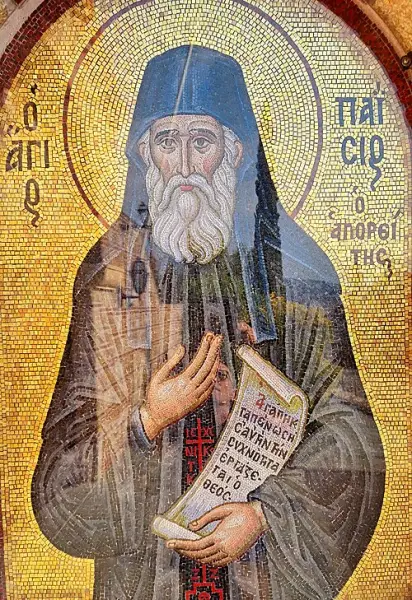
Overview
Saint Paisios of Mount Athos, born Arsenios Eznepidis on 7 August 1924 in Pharasa, Cappadocia, was a Greek Orthodox ascetic and elder who became one of the most beloved figures of contemporary Orthodoxy. Baptized by Arsenios the Cappadocian, who foretold his monastic future, he grew up in Konitsa, Epirus after his family was displaced in the population exchange between Greece and Turkey. He served as a radio operator in the Hellenic Army during the Greek civil war, volunteering for the front line in place of family men, and in 1950 went to Mount Athos, where he progressed through every degree of monastic life — Rassophore in 1954 as Averkios, Small Schema in 1957 as Paisios, Great and Angelic Schema in 1966. He served the faithful near his ancestral village, spent two years at Saint Catherine's Monastery on Sinai among the Bedouins, and settled in 1979 at the hermitage of Panagouda, where his renown as a spiritual father grew while he slept only two or three hours a night. In 1993 cancer forced him to leave the Holy Mountain for the last time; he died on 12 July 1994 at Souroti's Monastery of St. John the Theologian, near Thessaloniki, and was buried beside Arsenios the Cappadocian. The Ecumenical Patriarchate canonized him on 13 January 2015.
The Complete Life
The Last Child of Pharasa
Arsenios Eznepidis first saw light on 7 August 1924 at Pharasa, a village of Cappadocia, only weeks before the Greek–Turkish population exchange emptied such places of their Orthodox inhabitants. His baptism was entrusted to Arsenios the Cappadocian, the holy man of the same village, who gave the child his own name and is said to have foretold that he would become a monk. The church of Pharasa itself was dedicated to the Martyrs Barachisius and Jonah, saints whose memory would later be woven into churches raised in the two villagers' honor. After the exchange the Eznepides family settled in Konitsa, in Epirus, where the boy spent his childhood among refugees rebuilding their lives. There he completed intermediate public school, learned the carpenter's trade, and developed a love of Byzantine chant tutored by his uncle Prodromos. The formation was humble and practical — hands trained to craft wood, a voice trained to the ancient tones of Greek prayer — yet the prophecy of his baptism hung over it all, waiting for the moment when the young veteran of a brutal civil war would turn his back on the world and climb toward the Holy Mountain.
§ Early life
Radio Operator of the Army, Signalman of God
Greece's civil war found Arsenios serving in the Hellenic Army, to which he enlisted in 1945, as a radio operator. His service was marked by a self-sacrifice that foreshadowed everything after: he asked to take the front line in place of family men, so that their wives and children would not suffer the loss of a loved one. The imagery of that soldier's trade — dials, frequencies, signals sent and received — became the lasting language of his teaching. Extolling monasticism to skeptics, he said there are monks who possess spiritual television and serve as God's radio operators, a description his biographer applied to himself. His fundamental counsel took the same form: whoever wishes to catch God so that He hears prayer must set the dial of the soul to humility, the one frequency on which God listens. In 2017 the Greek Church's Holy Synod, by its own decision, proclaimed him patron of the military communications corps, the unit he had once served in. In 1950, his military duty completed, he made his way to Mount Athos, beginning under Fr. Kyril, the future abbot of Koutloumousiou, and continuing at Esphigmenou Monastery, where four years of novitiate led to the tonsure of the Rassophore under the name Averkios on 27 March 1954.
§ Military service
From Sinai to Panagouda
The mature monk's life unfolded across the whole geography of Orthodox asceticism. At Philotheou monastery's then-idiorrhythmic brotherhood, in which his uncle lived the monastic life, he was under the obedience of Symeon, who on 12 March 1957 tonsured him to the Small Schema with the name Paisios, honoring Paisios II, the indefatigable Metropolitan of Caesarea, a fellow son of Pharasa. In 1958 obedience called him back toward his own people: he spent time in and around his ancestral village, strengthening the faithful against Protestant proselytizing and helping many. In 1962 he set out for Saint Catherine's Monastery on Sinai, remaining two years in the desert; there he became beloved of the Bedouins, buying them food with the money earned from his carved wooden handicrafts. Returning to the Holy Mountain in 1964, he stayed at the Skete of Iviron and then at Katounakia, the wilderness at Athos's southernmost tip. On 11 January 1966 he received the Great and Angelic Schema from Tikhon at Stavronikita's Hermitage of the Holy Cross, and after that elder's death in 1968 he kept the hermitage. In 1979 he made his final move, to Panagouda, a hermitage of Koutloumousiou, where pilgrims found him and his fame spread through Greece and beyond.
§ Monastic life
Two Hours of Sleep and a Door Always Open
The spirituality of Elder Paisios joined the rigors of the desert to an inexhaustible charity toward ordinary people. At Panagouda, prayer and visitors between them left him a mere two or three hours of sleep nightly, as he received the endless stream of pilgrims who climbed to his door with burdens of family, illness, and doubt. His counsel was plain-spoken and mechanical where the age required it — turn the dial of the soul to humility, the frequency on which God operates — yet it rested on the deepest ascetic tradition: among his listed influences stand Arsenios the Cappadocian, the Russian elder Tikhon, and Isaac the Syrian, the great writer on tears and mercy. He was a worker with his hands, supporting Bedouin families from the sale of his carved wood, and a biographer of the saints, writing the life of Arsenios the Cappadocian whose relics he later placed at Souroti. The liturgical tradition that grew up around him carries his own conviction, voiced in the kontakion composed for his veneration: that hosts of saints would have wished to live in days like ours, and that those struggling valiantly now for salvation would gain a martyr's wage. For the dispirited and the sinful he became, in the words of one bishop, a saint for those whom others had given up on.
§ Monastic life
Exile to Souroti
The body that had endured soldiering, fasting, and the wilderness at last gave way. On 5 October 1993 the elder came down from Athos to seek medical treatment, intending to be gone only a few days; the diagnosis was cancer requiring immediate surgery. After recovering from the operation he was moved to Souroti's Monastery of St. John the Theologian, outside Thessaloniki, the sisterhood whose novices had donated blood to save him during his lung surgery in 1966 and whose monastery he had helped establish. His health forbade any return to the Holy Mountain; he therefore entrusted to Philothei of Souroti his final wish, that he be buried there, and the metropolitan consented. He died on 12 July 1994 at eleven in the morning, having received Holy Communion the previous day, and was buried behind Arsenios the Cappadocian's church at the monastery, beside the saint whose life he had written — the baptizer of Pharasa and the last child of Pharasa keeping one another's company in Greek Macedonia. Even in his last illness he remained a father to the sisters who had given their blood for him, a patient guest whose dying wish bound his memory to their monastery forever.
§ Death and burial
A Swift Glorification
By the standards of the Orthodox Church, Elder Paisios traveled to sainthood with unusual speed. On 13 January 2015 the Holy Synod of the Ecumenical Patriarchate of Constantinople, with the Patriarch presiding, unanimously approved its Canonical Committee's proposal that the monk Paisios of the Holy Mountain be entered in the register of the church's saints — the second-fastest canonization in recent church history. Pilgrims responded immediately: on Sunday 17 January 2015 faithful from across the Balkans made their way to the monastery at Souroti, and the celebration culminated in five nights of continuous prayer. Archbishop Damianos of Sinai, abbot of Saint Catherine's monastery since 1973 — the community that remembered Paisios's two years among them — was present at the ceremonies. The commemorations spread outward through the Orthodox world: on 5 May 2015 the Russian Orthodox Church's Holy Synod added his name to its Menology, establishing his feast on June 29 / July 12 in alignment with Constantinople, and the Romanian calendar followed in June of the same year. The first church in the world dedicated to the new saint had already been consecrated in Limassol, Cyprus, on 25 January 2015, weeks after his glorification.
§ Canonization
Churches, Books, and a Continent's Patron
Paisios left the church a library and a cult that spans continents. His written works, gathered and translated by the Souroti monastery, include Saint Arsenios the Cappadocian, Elder Hadji-Georgis the Athonite, Athonite Fathers and Athonite Matters, the Epistles, and the six volumes of Spiritual Counsels, running from With Pain and Love for Contemporary Man to On Prayer. His attributed prophecies, published by Hieromonk Makarios in 1990, have made him a figure of fascination and controversy alike: some claim fulfillments in the changing Greek political landscape and beyond, while critics note that specific geopolitical predictions rest on word of mouth, and associates insist the largely apolitical elder never said them — a caution the Esphigmenou monastery itself has voiced. Rod Dreher has compared his standing among Orthodox Christians to Padre Pio's among Catholics. Churches dedicated to him rose swiftly: in Limassol in 2015, at Nea Efesos in Pieria — the first in Greece — on 11 July 2015, and on Mount Athos itself at Kapsala in 2019. Bishops have honored him as a saint for the dispirited and the sinful, and as an answer for whoever doubts that God is present. On 2 October 2023, Archbishop Makarios formally proclaimed him Protector of Australia and patron of that land's Greek Orthodox Archdiocese, extending the elder of Panagouda's open door to the ends of the earth.
§ Legacy and veneration
Timeline
- 7 Aug 1924
Born Arsenios Eznepidis in Pharasa, Cappadocia, and baptized by Arsenios the Cappadocian, who foretold his monastic calling.
§ Early life
- 1945
Enlisted in the Hellenic Army as a radio operator during the Greek civil war, requesting duty on the front line in place of family men.
§ Military service
- 1950
Went to Athos after completing his service, first to Fr. Kyril, then on to Esphigmenou Monastery.
§ Monastic life
- 27 Mar 1954
Tonsured a Rassophore monk after four years as a novice, receiving the name Averkios.
§ Monastic life
- 12 Mar 1957
Tonsured to the Small Schema by Symeon at Philotheou monastery, receiving the name Paisios.
§ Monastic life
- 1958
Asked to spend time in his home region to steady the faithful against Protestant proselytism.
§ Monastic life
- 1962
Set out for Saint Catherine's Monastery on Sinai; two years there made him beloved of the Bedouins.
§ Monastic life
- 1964
Returned to Mount Athos, residing at the Skete of Iviron and then at Katounakia at the mountain's southern tip.
§ Monastic life
- 11 Jan 1966
Received the Great and Angelic Schema from Tikhon, at the Holy Cross hermitage of Stavronikita.
§ Monastic life
- 1966
Underwent lung surgery, beginning his long friendship with the sisterhood of St. John the Theologian at Souroti, whose novices donated blood to save him.
§ Monastic life
- 1967
Helped found the monastery at Souroti, whose sisterhood he would later entrust with the relics of Arsenios the Cappadocian.
§ Canonization
- 1968
After the death of his elder Tikhon on 10 September, took up residence in the hermitage and spent time at the Monastery of Stavronikita.
§ Monastic life
- 1979
Moved to Panagouda, the hermitage of Koutloumousiou Monastery, where his renown grew as he rested only two or three hours nightly.
§ Monastic life
- 1990
Hieromonk Makarios published the elder's recorded prophecies in a 1990 volume rendering their title as Words of Wisdom and Grace of Elder Paisios the Hagiorite.
§ Attributed prophecies
- 5 Oct 1993
Left Mount Athos for medical treatment and was diagnosed with cancer requiring immediate surgery.
§ Death and burial
- 12 Jul 1994
Died at the Monastery of St. John the Theologian in Souroti, having received Holy Communion the previous day.
§ Death and burial
- 13 Jan 2015
The Ecumenical Patriarchate's Holy Synod canonized him, in the second-fastest such process in recent church history.
§ Canonization
- 5 May 2015
The Holy Synod of the Russian Orthodox Church added his name to its Menology, fixing his feast on June 29 / July 12.
§ Legacy and veneration
- 2 Oct 2023
Archbishop Makarios formally proclaimed him Protector of Australia and patron of that land's Greek Orthodox Archdiocese.
§ Patronages
In Their Own Words
There are monks who have spiritual television and are God's radio operators.
If you want to 'catch' God so He can hear you when you pray, turn the dial to humility, for this is the frequency on which God operates.
The Record
- Major works
- Saint Arsenios the Cappadocian·Elder Hadji-Georgis the Athonite·Athonite Fathers and Athonite Matters·Epistles·Spiritual Counsels, Vols. 1–6
- Patron of
- Australia·signalmen·military communications corps
- Symbols
- Skufia·vest·prayer rope·walking stick
- Canonization
- Canonized 13 January 2015 by the Holy Synod of the Ecumenical Patriarchate of Constantinople
Prayer
Bibliography
Show 7 sources
- Hieromonk Isaac. Saint Paisios of Mount Athos. Translated by Hieromonk Alexis (Trader) PhD, and Fr. Peter Heers. 2nd Edition. Holy Monastery of "Saint Arsenios the Cappadocian", Chalkidiki, Greece, 2016. ISBN 978-960-89764-5-0.
- Hieromonk Isaac. Elder Paisios of Mount Athos. Transl. Hieromonk Alexis (Trader) PhD, and Fr. Peter Heers. Holy Monastery of "Saint Arsenios the Cappadocian", Chalkidiki, Greece, 2012. ISBN 978-960-89764-3-6.
- Middleton, Herman A. "Elder Paisios the Athonite". In: Precious Vessels of the Holy Spirit: The Lives & Counsels of Contemporary Elders of Greece. 2nd Ed. Protecting Veil Press, Thessalonica, Greece, 2004.
- Athanasios Rakovalis. Talks with Father Paisios. Published in Thessaloniki in 2000.
- Και επίσημα άγιος ο Γέροντας Παΐσιος. ΣΚΑΪ.gr. 13/01/2015. Retrieved: 20 January 2015.
- "The Russian Church Adds the Name of the Venerable Paisios of Mount Athos to its Menology". PRAVMIR.COM. 11 May 2015.
- Λόγοι σοφίας και χάριτος Α' Γέροντος Παϊσίου του Αγιορείτου, Μακάριος Ιερομόναχος, Ιερόν Κελλίον Κοιμήσεως της Θεοτόκου, Αγία Άννα - Άγιον Όρος. 1990.
Profile text adapted from the Wikipedia article, licensed CC BY-SA 4.0.
Pray with this saint every day
Save St. Paisios of Mount Athos to your favorites, read the full profile, and get feast-day reminders in the Saints app.
Get the Saints AppFree on the App Store for iPhone and iPad