
c. 1722 – 1773·Feast June 19
St. Paisius of Hilendar
Monk-historian of the Bulgarian National Revival
Overview
Saint Paisius of Hilendar was a Bulgarian Orthodox clergyman and a leading figure of the Bulgarian National Revival, honored as its forefather. Born around 1722 in the Samokov eparchy, most likely in the town of Bansko, he settled at the Hilandar Monastery on Mount Athos in 1745 and eventually served there as a hieromonk and deputy abbot. After two years of gathering materials, including a journey into the Habsburg monarchy, he completed his Slaveno-Bulgarian History at the Zograf Monastery in 1762, the first significant modern history of Bulgaria. The book sought to awaken and strengthen Bulgarian national consciousness at a time when Greek clergy of the Rum Millet threatened to absorb Bulgarian identity through Hellenization. Paisius carried the work with him as he toured the Bulgarian lands as a mendicant friar, and handwritten copies spread everywhere among the people. He is thought to have died around 1773 on the road to Mount Athos, near Ampelino, the modern Asenovgrad. Glorified by the Bulgarian Orthodox Church in 1962, he keeps his feast on June 19, together with his namesake Paisius the Great.
The Complete Life
A Son of the Samokov Eparchy
Paisius was born around 1722 in the Samokov eparchy of the Ottoman Empire, in lands that now belong to Bulgaria. Scholars have long argued over the exact village of his birth, but most scholars settle on the town of Bansko, and monuments around the country, including one in Silistra, honor it as his home. He came into the world at a low ebb of Bulgarian public life: the medieval kingdom was long gone, the Church was administered largely by Greek clergy under the Ottoman Rum Millet, and written Bulgarian culture had grown faint. Into that silence a generation of monks and scholars began to gather whatever memory of nationhood survived in monasteries like Hilandar and Zograf on Mount Athos. Paisius's early formation drew him toward that Athonite world, where Slavic monks kept the liturgy and the chronicles of their peoples alive. His later burning concern that Bulgarians should not be ashamed of their native tongue, nor trade it for Greek, was the concern of a man who had seen how easily a people's memory dies when its books go silent.
§ Introduction
Hilandar and the Athonite Calling
In 1745 Paisius established himself at the Hilandar Monastery, the great Serbian imperial foundation on Mount Athos that had long sheltered Bulgarian monks as well. There he advanced in the monastic life and was eventually ordained a hieromonk, serving also as deputy abbot of the community. Hilandar's libraries and its tradition of Slavic commemoration gave him both the tools and the motive for his later scholarship: a monk charged with the welfare of his monastery needed to know the history of the peoples who prayed there. Athos in the eighteenth century was a crossroads where Greek, Serbian, Bulgarian, and Russian monks met, and where the question of language and identity was never abstract. Paisius's choice of the monastic name and his attachment to Hilandar gave him the epithet by which history knows him. From that secure Athonite base he would make the journeys to the Bulgarian lands and to the Habsburg monarchy that supplied the raw material of his history, gathering charters, chronicles, and traditions wherever Bulgarian memory had been preserved. The monastery gave him the name by which Bulgaria would remember him.
§ Introduction
The Slaveno-Bulgarian History
The work for which Paisius is remembered cost him two years of hard collecting, including a visit to the Habsburg monarchy in search of sources, and was finished in 1762 at the Zograf Monastery. His Istoriya Slavyanobolgarskaya was the first significant modern history of the Bulgarians, the third modern work on the subject after the histories of Petar Bogdan Bakshev of 1667 and Blasius Kleiner of 1761. It was the first attempt at a complete account of Bulgaria's past, and its declared aim was to awaken and strengthen Bulgarian national consciousness. The book opens with two introductions, proceeds through chapters on historic events, includes a chapter on the pupils of Cyril and Methodius who taught the Slavs, and a chapter on Bulgaria's own saints, and an epilogue. Its most famous passage rebukes the Bulgarian who is ashamed of his own name and language, recalling the emperors and patriarchs of the nation's past and warning against turning themselves into Greeks. Paisius toured his homeland as a mendicant friar, carrying the work with him, and copies spread among the people until the little history became the seed of a national rebirth.
§ Introduction
The Road to Athos
The details of Paisius's last years are few, as befits a mendicant who owned nothing and left no tomb with an inscription. What tradition preserves is fitting: he is thought to have died around 1773 while traveling back toward Mount Athos, near Ampelino in the Rhodope region, the town known today as Asenovgrad. He had spent his strength in exactly the way his book demanded, walking between the monasteries that guarded Bulgarian memory and the villages that needed to hear of it, carrying his manuscript and seeing it copied by willing hands. The first of those copies had been made as early as 1765 by Sophronius of Vratsa, himself destined for honor in Bulgarian letters, and from that manuscript a chain of copies carried the History through the Bulgarian lands. Paisius did not live to see the revival he ignited, but the movement he began gathered force through the nineteenth century, and the town where he died stands today as a quiet station on the itinerary of his last journey. His death on a journey, unattended by any community, suited a man who had asked the faithful for nothing.
§ Introduction
Venerable Paisius
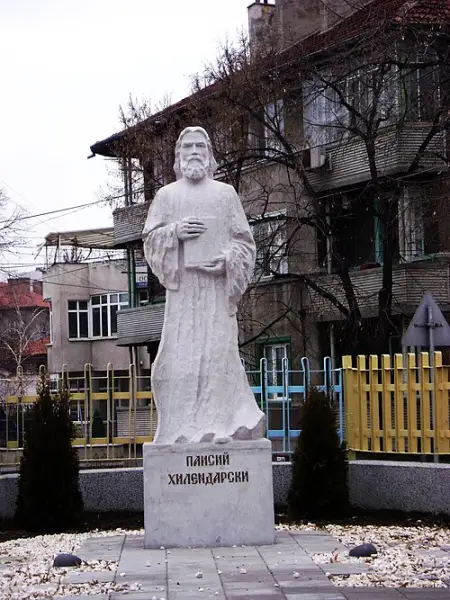
On June 26, 1962, the Bulgarian Orthodox Church canonized Paisius with the title of Venerable, enrolling the monk-historian among its saints two centuries after his death. He is venerated within the Eastern Orthodox Church as a whole and with particular devotion in his Bulgarian homeland. His feast falls on June 19, a day he shares with his ancient namesake Paisius the Great, so that the desert father and the national historian are commemorated side by side in one liturgical memory. The canonization of 1962 recognized what Bulgarian readers had long understood: that the man who gave the nation back its history had performed a work of spiritual as well as patriotic renewal. Monuments across the country, from Silistra to Sofia, bear his image, and his name is invoked as the forefather of the National Revival. In the calendar of a Church that suffered long centuries without a state of its own, his glorification stands as a declaration that the written word, kept alive by monks, is among the instruments of providence. The honor paid to him belongs to the whole people whose voice he first raised.
§ Veneration and legacy
From Manuscript to Mountain Peak
The legacy of Paisius of Hilendar extends from historiography to geography to currency. As the acknowledged forefather of the Bulgarian National Revival, he stands at the head of the movement that restored Bulgarian schools, printing, and eventually an independent Bulgarian Church and state. His Slaveno-Bulgarian History survives in dozens of copies made by successive hands, beginning with Sophronius of Vratsa in 1765, each copy a witness to the hunger of Bulgarian readers for their own past. Science has carried his name to the southern hemisphere: Paisiy Peak on Livingston Island in the South Shetland Islands, Antarctica, commemorates the Athonite monk. At home he has been honored on the money of the modern state, portrayed on the obverse of the two-lev banknote issued in 1999 and again in 2005, on the two-lev coins of 2015, and on the first Bulgarian two-euro coin of 2026. Few national awakeners have been so visibly woven into the daily life of their people, and fewer still by means of a single copied book. Bulgaria has never forgotten the monk who told it not to be ashamed.
§ Veneration and legacy
Timeline
- 1745
Established himself at the Hilandar Monastery on Mount Athos, where he later served as hieromonk and deputy abbot.
§ Introduction
- 1762
Completed the Slaveno-Bulgarian History at the Zograf Monastery after two years of collecting materials.
§ Introduction
- 1765
Sophronius of Vratsa made the first handwritten copy of the History.
§ Introduction
- 1773
Died around this year on the way to Mount Athos, near Ampelino, the modern Asenovgrad.
§ Introduction
- 26 Jun 1962
The Bulgarian Orthodox Church glorifies him as Venerable.
§ Veneration and legacy
In Their Own Words
Why are you ashamed to call yourself a Bulgarian and why don't you read and speak in your native language? Weren't Bulgarians powerful and glorious once? Didn't they take taxes from strong Romans and wise Greeks? Out of all the Slavic nations they were the bravest one.
The Record
- Major works
- Istoriya Slavyanobolgarskaya (Slaveno-Bulgarian History, 1762)
- Patron of
- Bulgaria
- Canonization
- Canonized June 26, 1962 by the Bulgarian Orthodox Church with the title Venerable.
Prayer
Bibliography
Show 9 sources
- Bourchier, James David (1911). "Bulgaria/History". In Chisholm, Hugh (ed.). Encyclopædia Britannica. Vol. 04 (11th ed.). Cambridge University Press. pp. 779–784.
- Daskalov, Rumen (2004). The Making of a Nation in the Balkans: Historiography of the Bulgarian Revival. Central European University Press. ISBN 963-9241-83-0.
- MacDermott, Mercia (1962). A History of Bulgaria 1395–1885. New York: Frederick A. Praeger. p. 91.
- The Encyclopedia of Eastern Orthodox Christianity, John Anthony McGuckin, John Wiley & Sons, 2011, ISBN 1405185392, p. 85.
- Berend, Tibor Iván (2003). History Derailed: Central and Eastern Europe in the Long Nineteenth Century. University of California Press. ISBN 0-520-23299-2.
- Meininger, Thomas A. The Formation of a Nationalist Bulgarian Intelligentsia, 1835-1878. Garland Pub., 1987, ISBN 0824080289, p. 75.
- Frucht, Richard C. Eastern Europe: An Introduction to the People, Lands, and Culture. Vol. 2. ABC-CLIO, 2004, ISBN 1576078000, pp. 821–822.
- "Venerable Paisius of Hilandar, Bulgaria". Orthodox Church in America (www.oca.org).
- "Paisiy Peak". SCAR Composite Gazetteer of Antarctica.
Profile text adapted from the Wikipedia article, licensed CC BY-SA 4.0.
Pray with this saint every day
Save St. Paisius of Hilendar to your favorites, read the full profile, and get feast-day reminders in the Saints app.
Get the Saints AppFree on the App Store for iPhone and iPad