
1722 – 1794·Feast November 15
St. Paisius Velichkovsky
Hesychast elder and translator of the Philokalia
Overview
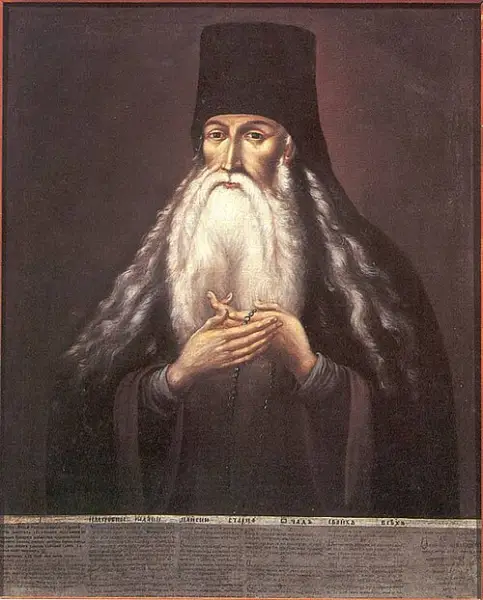
Saint Paisius Velichkovsky was an Eastern Orthodox monk and theologian who carried the practice of spiritual eldership from the Athonite hesychast tradition into the Slavic world. Born Pyotr Velichkovsky in Poltava, he entered monastic life as a young man under the name Platon, then settled on Mount Athos, where he embraced solitary prayer and began gathering and copying the writings of the ancient Fathers. Tonsured to the lesser schema under the name Paisius in 1750, he became the head of a growing hesychast brotherhood of Romanian and Slavonic disciples. In 1764 Prince Grigore III Ghica of Moldavia called him to lead the revival of monastic life in his country, first at Dragomirna and from 1779 at Neamț Monastery, where the brotherhood eventually numbered seven hundred monks. He rendered a large body of Greek patristic literature into Church Slavonic, among it the Philokalia, and wrote theological epistles for the guidance of his disciples. His teaching on unceasing prayer shaped later Russian monasticism, above all the startsy of Optina Monastery, and remains a pivotal force in Orthodox spiritual history.
The Complete Life
A Priest's Son from Poltava
The child who would become Paisius Velichkovsky was born in December 1722 in Poltava, a city of the Cossack Hetmanate in what is now Ukraine, and was baptized Pyotr. His father Ivan served as a priest in the city cathedral, and the household was large: the boy was the eleventh of twelve children. Learning ran in the family, for his grandfather Ivan Velichkovsky had been a poet. In 1735, when the boy was about thirteen, he was sent to the Kiev Theological Academy, where he received the scholastic formation typical of the Orthodox elite of the Hetmanate. By 1741 he had taken the first monastic step, becoming a rasophore under the name Platon. Political turmoil soon closed his monastery, and he transferred to the Pechersky Lavra in Kiev. There a monk named Ignatii stirred his imagination with accounts of the hesychast fervor flourishing in the Romanian monasteries across the Danube. During the Lent of 1743 Platon set out to see for himself, visiting the sketes of Dălhăuţi and Trăisteni in Moldavia and the Carnul Skete in Wallachia. The Moldavian communities were guided by Basil of Poiana Mărului, whose teaching on the Prayer of the Heart left a lasting mark on the young monk's soul.
§ Life
Solitude Found and Left on the Holy Mountain
Seeking to bring his monastic life to perfection, Platon sailed for Mount Athos in 1746 at the age of twenty-four. He made his way to the monastery of Pantocrator and was assigned a dwelling in its small Kiparis Skete, where for the next four years he lived as a solitary in deep poverty, giving himself to prayer. The turning point came in 1750, when his former elder Basil of Poiana Mărului climbed the Holy Mountain to visit him and tonsured him to the lesser schema, bestowing the name Paisius. Basil urged him to abandon strict seclusion, and Paisius obeyed, emerging as the renowned leader of a hesychast brotherhood that drew Romanian and Slavonic disciples in growing numbers. The community expanded so quickly that in 1758 Bishop Gregory Rasca ordained him to the priesthood, and the brothers were obliged to move into the larger Skete of St. Elias. What had begun as one man's search for solitude became, almost despite itself, a school of communal prayer under a beloved elder. He never lost the taste for silence that those years of poverty had planted in him.
§ Life
Scribe of the Fathers
Paisius was convinced that the spiritual life stands or falls with the study of the patristic ascetic texts, and this conviction defined his mission. On the Holy Mountain he began to collect and painstakingly copy the writings of the ancient Fathers, using them as guides for the soul, and his teaching drew disciples who longed for direction in unceasing prayer. He wrote theological epistles to his brotherhood and translated a great number of Greek theological works into Church Slavonic, the Philokalia above all. In all he spent seventeen years on Athos copying Greek patristic books and rendering them into Slavonic. His reputation reached the courts of Moldavia: in 1764, an invitation reached him from Prince Grigore III Ghica to take charge of rebuilding the monastic life of his land. Paisius crossed over with sixty-four of his disciples and settled at the Dragomirna monastery in Bucovina, continuing the work of transcription and translation. Among the brothers, the monk Raphael rendered selections from the Philokalia into Romanian, and the community flourished until it numbered around three hundred and fifty monks. Translation, for him, was itself an act of pastoral care.
§ Life
The Unceasing Prayer of the Heart
The spirituality Paisius taught was the Athonite hesychast inheritance he had received from Basil of Poiana Mărului: the Prayer of the Heart, the ceaseless invocation of the Name of Jesus, practiced within obedience to an elder. He revived this ancient teaching precisely where it had almost been forgotten, and his disciples testify that he grounded every ascent in humility, obedience, and the patient reading of the Fathers. The famous nineteenth-century devotional classic known as the Way of the Pilgrim, which recounts an unnamed wanderer's practice of the Jesus Prayer across Ukraine and Russia, belongs to his spiritual world; the scholar Aleksey Pentkovsky has identified the anonymous pilgrim as Arseny Troyepolsky, a Ukrainian priest-monk, and in that book and other anonymous works Arseny wrote extensively about Paisius and the saints of Ukraine. For Paisius, doctrine and life were inseparable: the epistles he sent his disciples read as practical direction for pray-ers, not abstract theology. His translation of the Philokalia was itself an act of spirituality, undertaken so that Slavonic-speaking monks might pray with the minds of the desert Fathers. Every page he copied was a page offered to God.
§ The Jesus Prayer
Neamț and the Harvest
The annexation of Bucovina by the Austrian Empire uprooted the Dragomirna brotherhood, and in 1779, on the eve of the Dormition Feast, Paisius led his monks to the Neamț Monastery in Moldavia. There the community grew to seven hundred monks, and the monastery became a center both of pilgrimage and of refuge. In these last decades Paisius brought his great labor to completion, finishing the Slavonic translation of the Philokalia, which was printed in Russia in 1793. In 1790 Bishop Ambrose of Poltava, visiting the monastery, clothed him in the Great Habit and raised him to archimandrite; he also served as vicar to the Metropolitan of Moldavia. Weary from a lifetime of ascetic labor, he died at Neamț on November 15, 1794. The vigils of his last years had not been spent on himself: until the end he directed the confession and prayer of a vast brotherhood, and the books that left his scriptorium were already traveling toward the monasteries of Russia, where they would do their quiet work for generations. Even in his final illness he was remembered as a father rather than an official, ruling by example more than by command.
§ Life
Glorification
The Church recognized the holiness of Paisius in two acts of glorification. The first came on July 20, 1982, at the Skete of St. Elias on Mount Athos, the community his own Athonite brotherhood had grown into. The second followed on June 6, 1988, at the Trinity Lavra of St. Sergius, when the Local Council of the Russian Orthodox Church, meeting under Patriarch Pimen I of Moscow, enrolled him among the saints. He is venerated for his personal holiness and for the revival he accomplished in the monasticism and spirituality of Romania, Ukraine, and Russia, lands whose monasteries had been weakened by the state reforms of Peter I and Catherine II. His feast is kept on November 15, the day of his repose, and he is honored as Venerable throughout Eastern Orthodoxy. In his memory the Church of the Dormition in Poltava houses a spiritual and cultural center bearing his name, and the Poltava Eparchy has established a prize for those who revive spiritual life in the region. In these honors the Church set its seal on a life that had renewed the prayer of whole peoples.
§ Veneration
Heirless and Father of Thousands
Paisius left no monastery of his own founding so much as a movement. Many of his disciples became spiritual masters in their own right and carried his teaching and mission into Russia, founding new monasteries dedicated to the hesychast tradition. The Optina elders owed him an immense debt, transmitted both through his translated books and through disciples of his own, Feodor Ushakov chief among them. Seraphim of Sarov counted the Paisius translation of the Philokalia among his favorite books, and it was Dosifei of Kiev, a disciple of Paisius, who blessed Seraphim to go to Sarov for spiritual devotion. The Way of the Pilgrim, that wandering pilgrim's testimony to the Jesus Prayer, carries his teaching in its very bloodstream. His memory has taken root far from Moldavia as well: an Orthodox church in Livorno, Italy, is named for him, and the Romanian Orthodox church in Liverpool, England, is dedicated to Saint Paisius of Neamț. Wherever monks pray without ceasing in the Slavic tongues, his quiet labor of copying and translating continues to bear fruit. Few translators of any age have shaped the prayer of so many.
§ Veneration
Timeline
- 20 Dec 1722
Born in Poltava, the eleventh of the twelve children of a cathedral priest.
§ Life
- 1735
Entered the Kiev Theological Academy to begin his studies.
§ Life
- 1741
Became a rasophore monk at Kiev, receiving the name Platon.
§ Life
- 1743
Traveled during Lent to the sketes of Moldavia and Wallachia, coming under the spiritual eldership of Basil of Poiana Mărului.
§ Life
- 1746
Moved to Mount Athos, settling in the Kiparis Skete of Pantocrator monastery for solitary prayer.
§ Life
- 1750
Tonsured to the lesser schema by Basil of Poiana Mărului, receiving the name Paisius.
§ Life
- 1758
Ordained to the priesthood by Bishop Gregory Rasca; his growing brotherhood moved into the larger Skete of St. Elias.
§ Life
- 1764
Answered Prince Grigore III Ghica's call to revive monastic life, moving with sixty-four disciples to Dragomirna monastery in Moldavia.
§ Life
- 1779
Relocated the brotherhood to Neamț Monastery during the vigil of the Dormition Feast.
§ Life
- 1790
Clothed in the Great Schema and raised to archimandrite during Bishop Ambrose of Poltava's visit to Neamț.
§ Life
- 1793
Saw his Church Slavonic rendering of the Philokalia printed in Russia.
§ Life
- 15 Nov 1794
Died at Neamț Monastery.
§ Life
- 20 Jul 1982
Glorified at the Skete of St. Elias on Mount Athos.
§ Veneration
- 6 Jun 1988
Canonized at the Trinity Lavra of St. Sergius by the Local Council of the Russian Orthodox Church under Patriarch Pimen I.
§ Veneration
In Their Own Words
The importance of Velichkovsky's life is not only in that he prayed for us sinners, but also in that he showed us the way every Christian should be going.
This does not mean that everyone should go to a monastery, but it does mean that everyone should think about the good, the sanctity, and purity of heart.
The Record
- Major works
- Church Slavonic translation of the Philokalia·Theological epistles to his disciples·Translations of Greek patristic ascetic writings into Church Slavonic
- Patron of
- Monastics
- Canonization
- Canonized July 20, 1982 at the Skete of St. Elias on Mount Athos and June 6, 1988 at the Trinity Lavra of St. Sergius by the Local Council of the Russian Orthodox Church under Patriarch Pimen I of Moscow.
Prayer
Bibliography
Show 9 sources
- McGuckin, John (2009). "The Life and Mission of St. Paisius Velichkovsky. 1722–1794. An Early Modern Master of the Orthodox Spiritual Life". Spiritus: A Journal of Christian Spirituality. 9 (Fall 2009, number 2). The Johns Hopkins University Press: 182–202. doi:10.1353/scs.0.0074.
- "Venerable Paisius Velichkovsky". Orthodox Church in America.
- Shebelist, Serhii. "Paisius Velichkovsky. Returning home", Dehb, Kiev, November 29, 2012.
- Sister of St. Paisius Monastery, "St. Paisius Velichkovsky, A Brief summary of His Life".
- McGuckin, John Anthony. "The Making of the Philokalia: A tale of Monks and Manuscripts", in Bingaman, Brock and Nassif, Bradley, The Philokalia: A Classic Text of Orthodox Spirituality, Oxford University Press, 2012, ISBN 0199911835, pp. 40–41.
- Morris, John W. The Historic Church: An Orthodox View of Christian History, AuthorHouse, 2011, ISBN 1456734903, p. 521.
- Roman, Dr. Alexander. "Saint Paisius Velichkovsky and the Hesychast Tradition", Ukrainian Orthodoxy.
- "In Pursuit of Wisdom - Blessed Paisius Velichkovsky", Orthodox America.
- "Our Spiritual Heritage", St. Symeon the New Theologian Orthodox Church.
Profile text adapted from the Wikipedia article, licensed CC BY-SA 4.0.
Pray with this saint every day
Save St. Paisius Velichkovsky to your favorites, read the full profile, and get feast-day reminders in the Saints app.
Get the Saints AppFree on the App Store for iPhone and iPad