
fl. early 5th century·Feast Unknown (not recorded in the source)
St. Palladius
First bishop sent to the Christians of Ireland
Overview
Saint Palladius was the first bishop of the Christians of Ireland, sent to that island a generation before Saint Patrick. A deacon drawn from one of the noblest families of Gaul, he belonged to a house that had given high-ranking servants to the church of France, and his father Exuperantius rose to be praetorian prefect of the Gallic provinces. In 429 Palladius stood in Rome urging Pope Celestine I to send Germanus of Auxerre to Britain, where Pelagian teaching was spreading among the Britons. Two years later, in 431, Prosper of Aquitaine's chronicle records that Celestine ordained him and dispatched him as first bishop to the Scots who believed in Christ, an expression which shows that Christian communities already existed in Ireland and had asked for a bishop. Palladius landed at Arklow and labored chiefly in Leinster, especially around Clonard, before Irish tradition says he was driven out by the king of Leinster and withdrew to North Britain. Scottish tradition remembers him presiding over a Christian community in the Mearns for some twenty years, and places his grave near Auchenblae, where a fair in his honor lasted until the Reformation.
The Complete Life
A Son of the Palladii
Palladius came from one of the most distinguished houses of Roman Gaul. The Palladii stood in the first rank of Gallic nobility, and more than one of their number occupied high office in the church of France near the fourth century's end. His father Exuperantius served as praetorian prefect of the Gallic provinces and was remembered by contemporaries as a man who brought peace, law, and freedom to Armorica, until he was killed in 424 when an army mutiny broke out at Arles. The poet Rutilius Claudius Namatianus, describing his sea voyage from Rome back to Gaul in 417, recalls a youthful kinsman called Palladius, carried off from Gaul to Rome to pursue the study of law. Whether this youthful student is the future bishop cannot be proved, but the detail fits the world of the Palladii, a family in which imperial service and ecclesiastical service stood side by side. It was from this cultivated Gallo-Roman aristocracy, fluent in Latin law and letters, that the church of the fifth century drew many of the missionaries who carried its faith to the western islands.
§ Background
Deacon of the Roman Church
By the 420s Palladius had taken the office of deacon, though where he served is a matter of learned debate. The chronicler Prosper of Aquitaine records that in 429 a deacon named Palladius urged Pope Celestine I to send Bishop Germanus of Auxerre across the channel to Britain, where the Britons were being drawn back toward the Catholic faith and away from the teaching of Pelagius. Later writers, including Alban Butler and Cardinal Patrick Francis Moran, held that he was a deacon of Rome itself, since it is improbable that a mere deacon of Auxerre would have carried such weight in the papal city; it also accords with Prosper's habit of naming the Roman deacon by the simple title of deacon. Kathleen Hughes, weighing the same evidence, judged it more likely that Palladius served under Germanus and that it was Germanus who sent him to Rome, to secure authorization to cross to Britain, invited by its bishops to aid them against the Pelagian movement. Either way, the young deacon had become a trusted intermediary between the churches of Gaul, Britain, and Rome.
§ Ireland
First Bishop of the Irish
In 431 Prosper's chronicle set down the sentence that fixes Palladius in history: the pope had ordained him and sent him as first bishop to the Scots who believed in Christ. The wording matters, for it shows that Christian communities were already living in Ireland and that this was a mission to existing believers rather than a first preaching of the gospel there. Palladius landed at Arklow on the Irish Sea coast. Recent scholarship associates with his mission the three churchmen Auxilius, Iserninus, and Secundinus, whom older accounts had joined to Saint Patrick, and Irish writers who compiled Patrick's life affirm that Palladius preached in Ireland before Patrick. Fortune was against him: according to tradition the king of Leinster drove him out before long, and he made his way to North Britain. Muirchu, writing two centuries later in the Book of Armagh, records that God hindered him, that the fierce men of the country would not readily accept his teaching, and that he himself had no wish to linger in a strange land but returned to the one who sent him. Four companions are named in his story: Sylvester and Solinus, who stayed on in Ireland after him, and Augustinus and Benedictus, who traveled with him to Britain and returned to their homeland once he had died. His work is most closely tied to Leinster, and to Clonard in County Meath.
§ Ireland
Among the Scots of North Britain
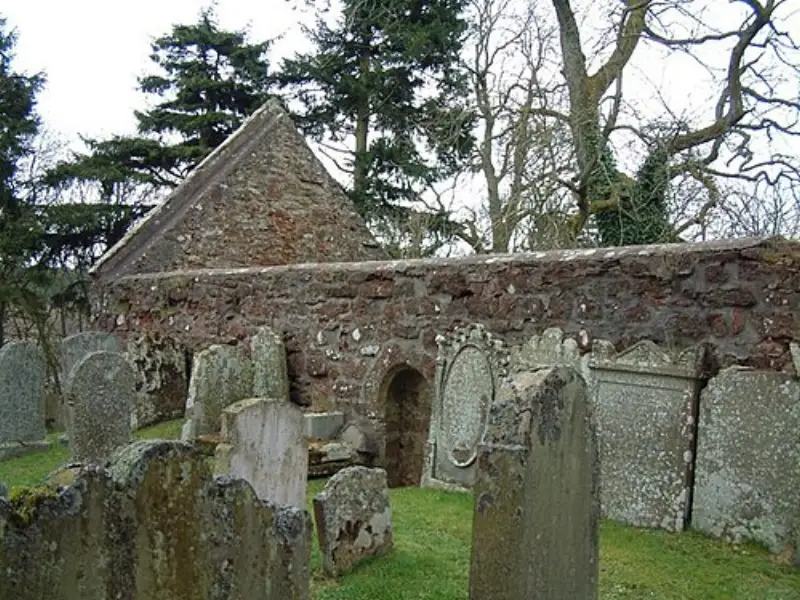
After leaving Ireland, Muirchu relates, Palladius came among the Scots of North Britain, and Scottish church tradition honors him as the president of a Christian community there for about twenty years. A group of church dedications in the Mearns, around the village of Auchenblae, is believed to mark his last resting place, and devotion to him ran deep in that corner of Scotland: even in the days of King James V the crown was still paying for a fresh reliquary for the church, and an annual fair known as the Paldy Fair was held at least until the Reformation. When and where he actually died is uncertain. Alban Butler, following Hector Boethius and Camden, places his death at Fordoun, a settlement some fifteen miles below Aberdeen, near the year 450. The Vita tripartita, by contrast, states that he died at Cell Fine, usually identified with Killeen Cormac in County Kildare, where he deposited his books, his writing tablet, and relics of the apostles Peter and Paul. The Annals of Ulster add a final puzzle, recording deaths of 'Patrick' under 457, 461, 492, and 493, and some scholars conclude that the earlier entries refer to Palladius, his story having been partly merged with Patrick's.
§ Death
An Apostle Honored Since Antiquity
Palladius belongs to the company of saints whom the church has honored from before the age of formal canonization, by the ancient custom in which a bishop who dies in the odor of sanctity is acclaimed by the people and his cult spreads among the churches. He is venerated today in the Catholic Church, the Eastern Orthodox Church, and the Anglican Communion, a breadth that reflects the antiquity and reach of his cult across the Celtic lands and beyond. His title in tradition, Apostle of the Scots, pairs him with Patrick, apostle of the Irish, and preserves the memory of the people he served in North Britain during his last decades. In Ireland his patronage is claimed by Leinster, the province where he landed and preached first; in Scotland his name is woven into the devotional geography of Kincardineshire and the Mearns, where his grave was sought and his fair was kept. Few missionaries of the fifth century are remembered across so many churches and so many shores: the Roman deacon who was sent to one island and buried his labors in another remains in all of them an apostle.
§ Ireland
The Bishop Before Patrick
The historical importance of Palladius lies in what his mission proves: that Irish Christianity was organized, in touch with Rome, and already requesting bishops before Patrick's arrival, and that the conversion of Ireland was not the work of one man. The churchmen Auxilius, Secundinus, and Iserninus, once folded into Patrick's legend, are now associated by modern scholarship with Palladius, and the communities of Leinster and the midlands around Clonard likely trace their origins to his mission. His name also stands at the head of a scholarly question that has enlivened Irish historical studies for generations: the problem of the two Patricks, and of how the stories of the first bishop and the great apostle were interwoven in the annals and the vitae. The Irish chronicles themselves acknowledged his preaching before Patrick, and the books, tablet, and relics of the apostles that the Vita tripartita says he left at Cell Fine picture him exactly as scholarship finds him, a learned and equipped bishop of the old Gallo-Roman church. In Scotland his memory outlived the medieval kingdom itself, surviving in stone dedications, royal alms for his shrine, and a country fair that kept his name alive into modern times.
§ Background
Timeline
- 417
Named by the poet Rutilius Claudius Namatianus as a young kinsman dispatched from Gaul to the imperial capital for legal studies.
§ Background
- 424
His father Exuperantius, praetorian prefect of the Gallic provinces, is killed in an army mutiny at Arles.
§ Background
- 429
Urges Pope Celestine I to send Germanus of Auxerre to Britain to combat Pelagianism.
§ Ireland
- 431
Ordained a bishop by Pope Celestine and sent as first bishop to the Irish believing in Christ; lands at Arklow.
§ Ireland
- 450
By Alban Butler's account, drawn from Hector Boethius and Camden, dies at Fordoun, fifteen miles south of Aberdeen, about this year.
§ Death
- 457
The Annals of Ulster record the repose of 'the elder Patrick, as some books state', an entry some scholars connect with Palladius.
§ Death
- 461
A second Annals entry, 'here some record the repose of Patrick', offers another possible date for his death.
§ Death
In Their Own Words
Palladius, having been ordained by Pope Celestine, is sent as first bishop to the Scotti believing in Christ.
God hindered him...and neither did those fierce and cruel men receive his doctrine readily, nor did he himself wish to spend time in a strange land, but returned to him who sent him.
The Record
- Patron of
- Leinster·Kincardineshire
- Canonization
- Pre-congregation; venerated from antiquity by the Catholic Church, the Eastern Orthodox Church, and the Anglican Communion.
Prayer
Bibliography
Show 13 sources
- "Christianity in Ireland before Patrick". The Irish News. 21 January 2021.
- Moran, Patrick Francis Cardinal. "St. Palladius." The Catholic Encyclopedia. Vol. 11. New York: Robert Appleton Company, 1911.
- Duff, J. Wight and A. M. Duff trans. (1922). Minor Latin Poets. Loeb Classical Library. pp. 782f.
- Ó Croinín, Daibhi. Early Medieval Ireland 400-1200. Routledge, 2016. ISBN 9781317192695.
- Breen, Aidan. "Palladius", Dictionary of Irish Biography, October 2009.
- Hughes, Kathleen. "The church in Irish society, 400-800", A New History of Ireland: Prehistoric and early Ireland, (Daibhi Ó Croinín, ed.) Oxford University Press, 1976, ISBN 9780198217374, p. 302.
- Cusack, Margaret Anne, "Mission of St. Palladius", An Illustrated History of Ireland, Chapter VIII, 1868.
- Stalmans, Nathalie and T.M. Charles-Edwards. "Meath, saints of", Oxford Dictionary of National Biography, Oxford University Press, 2004.
- Butler, Rev. Alban, "St Palladius, Bishop and Confessor, Apostle of the Scots", The Lives of the Saints, Vol. VII, 1866.
- "Muirchú's text in English (Transl. L. Bieler) | St. Patrick's Confessio".
- "New light on Palladius?", Peritia iv (1986), pp. 276–83.
- Ó Cróinín (2000). "Who was Palladius 'First Bishop of the Irish'?". Peritia. 14: 205–37. doi:10.1484/j.peri.3.400.
- Vita tripartita Sancti Patricii (MS).
Profile text adapted from the Wikipedia article, licensed CC BY-SA 4.0.
Pray with this saint every day
Save St. Palladius to your favorites, read the full profile, and get feast-day reminders in the Saints app.
Get the Saints AppFree on the App Store for iPhone and iPad