
died c. 541·Feast June 21
St. Palladius of Embrun
Bishop-builder and prophet of the Alps
Overview
Saint Palladius of Embrun, called Pallade or Pelade in French and Patllari or Palladi in Catalan, was a sixth-century bishop of Embrun who died around 541. Raised in a Christian family, he was formed in sacred learning by Catulin, bishop of Embrun, and stood by his master when the bishop was exiled to Vienne after opposing the Arian party of Sigismund of Burgundy following the Council of Epaone in 517. In exile he gave himself to the study of Scripture, took priest's orders and, so legend tells, was granted the prophetic gift, foretelling the downfall and death of Sigismund himself. Elected bishop of Embrun after Catulin's death, he adorned his mountain diocese with churches at Chorges, Sauze, and Rama, and raised sanctuaries in honor of Martin of Tours and of the martyrs Vincent, Orontius, Victor, and Genesius of Arles. Traditions of his prayer speak of an extraordinary power in petitioning God, of familiarity with the holy angels, and of victories over demonic assault won simply by the sign of the cross. His relics were carried to Catalonia, where under the name Patllari he has been venerated for centuries as patron of Camprodon, with a feast on June 21.
The Complete Life
Formed by a Bishop in Exile's Making
The young Palladius was born to a Christian family at a time when the old Roman provinces of the Alps were ruled by the new Burgundian kingdom, and the faith he received at home was deepened by an extraordinary teacher. His master in sacred learning was Catulin, bishop of Embrun, a prelate of conviction who in 517 attended the Council of Epaone, the assembly of the bishops of Burgundy gathered to reform the church of their realm. That fidelity carried a price. When the Arian influence at court and King Sigismund of Burgundy turned against the council's work, Catulin was driven from his see and exiled to Vienne. Palladius did not abandon his bishop in disgrace; he went with him into exile, and there, far from his own diocese, he turned the years of banishment into a school, studying Scripture extensively. The pattern of his whole life was set in those days: fidelity to the truth of the council, loyalty to a suffering shepherd, and the conviction that even banishment is a classroom when the book studied is the word of God.
§ Introduction
Priest and Prophet
During or after the years of exile Palladius was ordained to the priesthood, and with the office came, according to legend, an extraordinary charismatic endowment: the gift of prophecy. The tradition records that he predicted the fall and death of Sigismund, the very king whose policy had exiled his master. The prophecy was not spoken in vindictiveness but in the manner of the prophets of Israel, who announced judgment on rulers to recall them to justice; and history, in the hagiographer's telling, proved the word true. Alongside prophecy the accounts place other signs of a man marked out by God: a power in prayer so remarkable that one source says he possessed exceptional efficacy in obtaining whatever he asked of the Almighty, a mystical familiarity with the holy angels, and an untroubled authority over the enemy of souls, whom he defeated simply by tracing the sign of the cross. When Catulin died around 518, the succession of the diocese pointed naturally to the disciple who had shared his exile; in due time Palladius was elected bishop of Embrun, returning as chief shepherd to the church he had served in hardship.
§ Introduction
Bishop of the Alpine Valleys
As bishop of Embrun, the metropolitan see of the Alpine provinces, Palladius spent his episcopate building. The record of his foundations is remarkably specific for the sixth century: churches rose at Chorges, at Sauze, and at Rama, binding the scattered valleys of the diocese together under the worship of God. He also raised sanctuaries in honor of the great saints of the western church, dedicating altars to Martin of Tours, the wonder-working bishop whose cult was spreading across Gaul, and to the martyrs Vincent, Orontius, Victor, and Genesius of Arles, linking his mountain flock to the company of the confessors. His biographers emphasize that these material works were the overflow of a spiritual power: many miracles were attributed to him, his intercession was believed to be irresistible in heaven, and his combat with evil was waged with the simplest of weapons, the sign of the cross. He governed until his death around the year 541, leaving behind a diocese marked with churches, a reputation for prophecy and holiness, and the beginning of a cult that would carry his name far beyond the Alps.
§ Introduction
The Donkey and the Springs of Camprodon
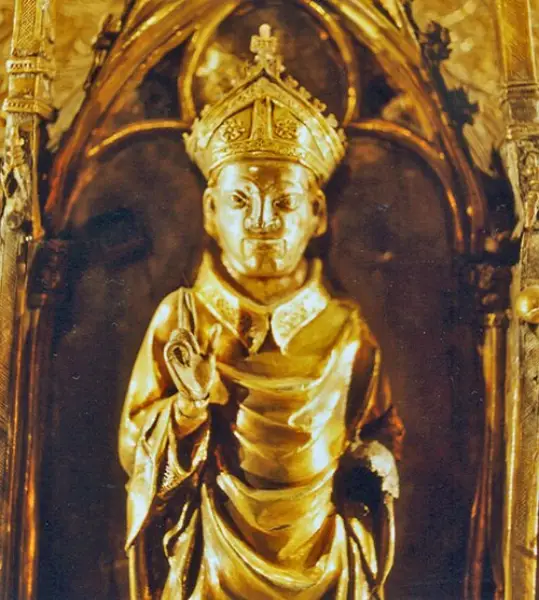
After his death the bishop's cult crossed the Pyrenees under a Catalan name, Patllari, and attached itself to the town of Camprodon, where he has been patron for many centuries. The legend of the translation tells that Benedictine monks journeyed to Embrun to carry his relics to Spain, and set the sacred burden in a container borne by a donkey. At the outskirts of Camprodon the animal stopped and would not move; neither urging nor force availed, until it stamped upon the ground and three springs of water gushed forth from the earth, a wonder that readers have compared to the spring of Hippocrene. Released, the donkey walked into the town, walked past Carme and Santa Maria on its way and into Sant Pere monastery, where it stayed; the monks took the sign and left the relics there. History records the relics today in the church of Santa Maria de Camprodon, a building of Romanesque, Gothic, and Baroque fabric, while the fourteenth-century reliquary known as the Arqueta de Sant Patllari likely came from Sant Pere. Each June 21 the town keeps his feast with sardana dances, music, and a procession of giants.
§ Veneration
Timeline
- 517
His teacher Catulin, bishop of Embrun, attends the Council of Epaone, incurring the opposition of the Arians and Sigismund of Burgundy.
§ Introduction
- 518
Catulin dies around this year after his exile to Vienne; Palladius later succeeds to the see of Embrun.
§ Introduction
- 541
Dies around this year after an episcopate marked by church building, prophecy, and reported miracles.
§ Introduction
In Their Own Words
possessed an exceptional efficacy in obtaining whatever he petitioned God for
mystical familiarity with the angels ... [and] successfully defeated the machinations of the devil simply by making the sign of the cross
The Record
- Major works
- Churches at Chorges, Sauze, and Rama·Sanctuaries dedicated to Saint Martin of Tours, Saints Vincent, Orontius, and Victor, and Genesius of Arles
- Patron of
- Camprodon
- Symbols
- episcopal attire
- Canonization
- Venerated by the Roman Catholic Church from ancient times; no formal act of canonization is recorded.
Prayer
Bibliography
Show 7 sources
- "l'espai on comença la festa". festes.org.
- "Saint Palladius". Forum Orthodoxe Francophone.
- "St. Palladius - Saints & Angels". Catholic Online.
- de Dalmases, Núria and José i Pitarch, Antoni. Història de l'art català. Vol. III. Edicions 62. Barcelona, 1984. ISBN 84-297-2104-5.
- Amades, Joan. Costumari català, vol. III. Salvat Editores, Ed. 62. Barcelona, 1983. ISBN 84-345-3676-5.
- "Festa Major de Sant Patllari de Camprodon". festacatalunya – Festes majors de municipis.
- "Sant Patllari a l'equador". ElRipolles.info.
Profile text adapted from the Wikipedia article, licensed CC BY-SA 4.0.
Pray with this saint every day
Save St. Palladius of Embrun to your favorites, read the full profile, and get feast-day reminders in the Saints app.
Get the Saints AppFree on the App Store for iPhone and iPad