
died c. 287·Feast May 10
St. Palmatius
Soldier-martyr of the Trier persecution
Overview
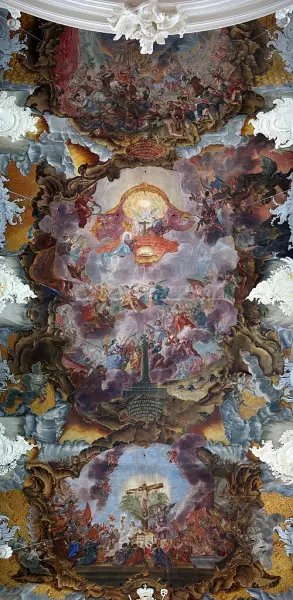
Saint Palmatius was a Christian martyr of the third century, put to death in the imperial city of Trier in around 287 together with eleven companions. The persecutions that claimed him were those carried out under the emperor Maximian by Rictius Varus, the vicarius who governed Roman Gaul on the emperor's behalf, and Palmatius and his fellow sufferers belonged to the great band of victims remembered as the Martyrs of Trier. He is portrayed in the tradition as a soldier who gave to Christ the ultimate allegiance that once belonged to the army, and his iconography joins the two identities, soldier and martyr, in a single figure. In the baroque church of St. Paulinus in Trier a fresco depicts the company of martyrs to which he belonged, and a statue of the saint stands in the same basilica. The Roman Catholic Church and the Eastern Orthodox Church both honor him; his own feast is kept on May 10, while his eleven companions, the Martyrs of Trier as a body, receive a separate commemoration on October 6.
The Complete Life
Martyrdom at Trier
In the last decades of the third century the city of Trier, one of the capitals of the Roman west, became a killing ground for Christians, and Palmatius was among those who died there. The ancient catalogues of the martyrs place his death in around 287, the period of the persecutions conducted under the emperor Maximian, who then ruled the western provinces. The instrument of that persecution in Gaul was Rictius Varus, the vicarius who exercised imperial authority over the Roman diocese of Gaul on Maximian's behalf, and his courts and executions claimed a great company of the faithful in Trier. Palmatius did not die alone: eleven companions suffered with him, bound to him by a common confession and a common death, and the church has never separated their memory from his. Tradition pictures him as a soldier, a man whose profession was obedience and whose final act of obedience was rendered not to the emperor but to Christ; the shield and the palm together make up his witness. What the sources do not preserve of his words, his silence completes, for the martyr's blood was the only sermon left to him.
§ Introduction
Remembered by East and West
Palmatius died long before the church instituted formal processes for declaring saints, and his recognition belongs to the oldest stratum of Christian memory: a martyr's cult arose where the blood was shed and spread with the pilgrims and calendars of the early church. He is venerated in the Roman Catholic Church and in the Eastern Orthodox Church alike, one of those witnesses of the undivided church whom both communions honor without dispute. His feast is kept on May 10, the day assigned to him in the Roman Martyrology and the Orthodox calendars, while the eleven companions who died with him received a distinct commemoration of their own on October 6 under their collective title, the Martyrs of Trier. The distinction between the feast of the leader and the feast of the band is itself a small monument to the care with which the ancient churches guarded the names of those who died, recording each with his own date rather than letting the company dissolve into anonymity. Such antiquity of veneration is itself the martyr's truest canonization. The calendars have kept his witness faithfully across seventeen centuries.
§ Introduction
The Martyrs in Stone and Paint
The memory of Palmatius lives on most vividly in Trier itself, in the basilica of St. Paulinus, the great baroque church that stands over the memory of the city's martyrs. There a fresco depicts the Martyrs of Trier as a whole company, among whom Palmatius is numbered, and a statue of the saint adorns the basilica, presenting him to worshippers in his twin character of soldier and martyr. His commemoration belongs to a city that was itself a seat of emperors, and the contrast has never been lost: the rulers whose courts condemned the Christians have passed away, while the condemned are honored in stone and paint above the altars. Through the Roman Martyrology, printed and translated for the modern church, and through the lists of the saints kept by Catholic and Orthodox observers alike, his name has traveled far beyond the Moselle valley. Every May 10 the church recalls a man about whom almost nothing is recorded except the one thing that mattered to those who preserved his memory, that he loved Christ more than life. Trier remembers its own, and its own have never ceased to intercede for it.
§ Martyrs of Trier
The Record
- Symbols
- soldier·martyr
- Canonization
- Pre-congregation; venerated since antiquity by the Roman Catholic and Eastern Orthodox churches.
Prayer
Bibliography
Show 3 sources
- The Roman Martyrology. Translated by the Archbishop of Baltimore. Last Edition, According to the Copy Printed at Rome in 1914. Revised Edition, with the Imprimatur of His Eminence Cardinal Gibbons. Baltimore: John Murphy Company, 1916. p. 307.
- "Martyrs of Trier - Saints & Angels". Catholic Online.
- "Latin Saints of the Orthodox Patriarchate of Rome".
Profile text adapted from the Wikipedia article, licensed CC BY-SA 4.0.
Pray with this saint every day
Save St. Palmatius to your favorites, read the full profile, and get feast-day reminders in the Saints app.
Get the Saints AppFree on the App Store for iPhone and iPad