
c. 305 – c. 390·Feast July 18
St. Pambo
Desert Father and Founder of the Nitrian Monasteries
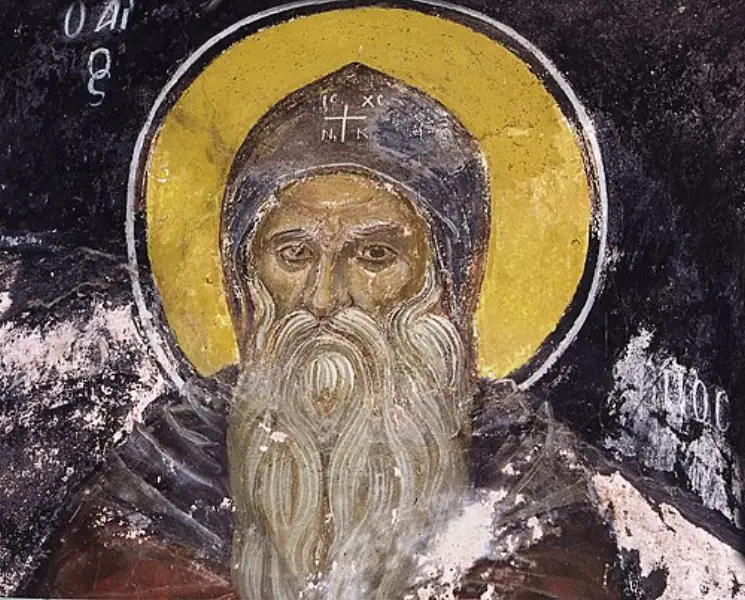
Overview
Pambo was a Coptic ascetic of the fourth century who became one of the founding figures of monasticism in the Nitrian Desert of Egypt. A disciple of Anthony the Great, he settled among the austere community of Nitria, where he established monasteries and gained a reputation for wisdom that drew visitors from across the Christian world. Athanasius of Alexandria called on him for support during the Arian controversies, the wealthy ascetic Melania the Elder became a patron of his community, and seekers such as Ammonas of Egypt consulted him. He served as spiritual father to figures who would themselves be canonized, among them Pishoy and John the Dwarf. His most celebrated discipline was silence, a penance he began early and reportedly never abandoned. Accounts of his holiness describe his face as shining like lightning. He died at Nitria, traditionally around 390, weaving a basket at the hour of his death; that basket became his first relic, carried away by Melania the Elder. He is venerated by Oriental Orthodox, Eastern Orthodox, and Catholic Christians, with a feast on July 18.
The Complete Life
A Youth Given to the Desert
The sources for Pambo's life open almost entirely with his entrance into monasticism, and they acknowledge how little can be recovered of the years before it. He was born in Roman Egypt, traditionally in the opening decades of the fourth century, and as a young man he sought out Anthony the Great, the celebrated pioneer of desert monasticism, to become his disciple. From Anthony's direction his path turned toward the Nitrian Desert, the rocky region reached from the Nile delta that was then filling with cells and small communities of ascetics, and there he would spend the remainder of his life. What distinguished him from the start was not learning or administrative gifts but a radical habit of restraint. When his spiritual father set before him the opening words of Psalm 39, with its resolve to watch his ways so as to keep his tongue from sin, Pambo answered by refusing to speak a single word to his master for six months while he worked the verse into his heart. Eighteen years afterward he could still tell other monks that he had scarcely mastered the lesson. The detail, preserved among the memories of the desert communities, set the tone for everything that followed.
§ Early monastic life
Abbot and Spiritual Father
Pambo's vocation matured within the monastic settlements of Nitria, where he eventually bore the responsibilities of a founder and spiritual father. Much of what is known of him passes through the Lausiac History of Palladius, with briefer notices by Jerome and Tyrannius Rufinus, and these accounts portray a man whose authority rested on lived asceticism rather than formal education. He established monasteries in the Nitrian Desert and gathered disciples who carried his teaching forward; among those formed under his guidance were Pishoy and John the Dwarf, both of whom would be honored as saints in their own right. His circle included the leading monks of the Egyptian deserts, among them Bessarion, Isaiah, Paësios, Arsisius, and Serapion the Great, and collections of monastic sayings preserve exchanges between Pambo and several of them. Rufinus, who visited him in 374, belonged to the wider world of readers who knew his name. Later generations of scholars would label the Nitrian monks Origenists, but modern historians such as Graham Gould have found little basis for treating Pambo himself as a learned partisan of that school; his renown was that of a father of monks, not a polemical theologian.
§ Biography
Counsel to the Powerful
Pambo's standing grew to the point that the church's most powerful figures sought him out. During the early Christian struggles over Arianism, Athanasius of Alexandria brought Pambo from Nitria to support him before the Alexandrian courts, and afterward the bishop wrote of him as well pleasing to God. The aristocratic ascetic Melania the Elder sustained his monastery with lavish gifts and maintained a close bond with the community, at one point traveling with Pambo and a group of clergy that included Isidore, Pisimius, Adelphius, and Paphnutius on a journey or banishment to Palestine. The tradition also remembers his startling independence before her wealth: when Melania presented him with several hundred pounds of silver, he distributed it at once to poor monasteries without acknowledging the gift, an act remembered as a deliberate corrective to her pride in money. His judgments were sought on the spiritual questions of the age. Asked to weigh two brothers, one who gave away a large inheritance outright and another who built a monastery from it and cared for those in need, he declared the two equals and described a vision in which he saw them both standing before God.
§ Spiritual father and abbot
The Penance of Silence
The discipline for which Pambo was most remembered was silence. As a young monk he received from his spiritual father the opening of Psalm 39, with its resolve to guard against sinning with the tongue, and he answered it by six months of unbroken muteness before his master. Even late in life he confessed to fellow monks that he had hardly absorbed the verse's meaning, a humility that itself became a lesson passed among the desert communities. Contemporaries saw in him a holiness of unusual intensity; it was told that lightning seemed to play upon his countenance, a sign the tradition reserved for the purest of ascetics. The sayings collections of the Egyptian monks preserve him in conversation with Bessarion, Isaiah, Paësios, Arsisius, and Serapion the Great, and his replies display the terse, searching practicality that desert Christians prized. One teaching in particular circulated widely: asked which of two brothers was holier, the one who surrendered an inheritance at once or the one who built a monastery from it and served the poor, Pambo pronounced them equal, a judgment that has shed light on how the earliest monastic communities understood their own purpose.
§ Spiritual father and abbot
Death with a Basket in His Hands
Pambo died at Nitria, and the traditions disagree on the date: some place the death of the historical Pambo between 373 and 374, the Lausiac History records only that he died before Palladius entered the desert and therefore before 385, a Catholic daily martyrology gives about 390, Alban Butler's Lives of Saints offers around 390, and still others hold to 393. The narrative of his passing, however, is consistent and characteristic. He was weaving a basket as he died, and that unfinished work became the first of his relics. At the hour of his death he is reported to have said that from the time he came to his place of solitude, built his cell, and dwelt in it, he could not recall having eaten anything except what his own hands had toiled for, nor having repented of a single word he had spoken; and so, he concluded, he was going to the Lord as one who had scarcely set out upon the service of God. Melania the Elder, whose habit was gathering memorials from many holy men, chanced to be at Nitria when he died, and to her hands the basket itself passed as his memorial.
§ Death
A Saint of the Undivided Desert
Honored as a saint since the earliest centuries of monasticism, Pambo never passed through any formal process of canonization; his cult arose, as with nearly all the desert fathers, from the reverence of the communities that preserved his memory. He is numbered among the saints of the Oriental Orthodox, Eastern Orthodox, and Roman Catholic churches alike. His feast is kept on July 18, a date observed in the Eastern Orthodox liturgical calendar and recorded in Western martyrologies as well; a Catholic daily martyrology commemorates him on that day, and the Orthodox Church in America remembers him as the Venerable Pambo the Hermit of Egypt. The continuity of his cult is striking given the fragility of the evidence for his life: the monasteries of Nitria transmitted his sayings, Palladius, Jerome, and Rufinus wrote of him, and his spiritual children, among them Pishoy and John the Dwarf, carried his influence into later generations of Egyptian monasticism. In the Coptic tradition he stands in the company of the great monks of the desert, honored beside Anthony, Pachomius, Macarius, and Arsenius among the fathers venerated by the Church of Alexandria.
§ Veneration
Memory, Controversy, and Poetry
Pambo's afterlife in Christian memory was eventful. Scholars branded him and other Nitrian monks as Origenists, but the historian Graham Gould has argued that there is little historical basis for thinking Pambo a man of wide learning, or for linking him during his own lifetime to the Origenist party; the accusation grew chiefly out of the disputes that gathered about certain of his disciples and monastic companions, the Tall Brothers of Kellia. A story in which he reproaches a younger monk, warning that troparia and echoi exercise a corrupting influence and opposing women's liturgical singing, was long used by scholars such as Johannes Quasten as evidence that early monastics resisted complex church music, but more recent scholarship generally dates the account no earlier than the sixth century, and the collection preserving it was published in the eighteenth century; James McKinnon calls the story bluntly apocryphal. Pambo even entered fiction and poetry: a version of him appears in the sixth-century Legend of Hilaria under the transliterations Bamu or Bamfu, and in the nineteenth century Robert Browning took the first verse of Psalm 39, the lesson of Pambo's silence, as the basis for a poem titled Pambo.
§ Legacy
Timeline
- 305
Born in Roman Egypt, traditionally between about 305 and 315, into the world of the early Egyptian church.
§ Biography
- 374
The historian and theologian Tyrannius Rufinus visited Pambo at Nitria.
§ Spiritual father and abbot
- 390
Died at Nitria while weaving a basket; Alban Butler dates the death around 390, others to 393 or as early as 373.
§ Death
In Their Own Words
From the time that I came into this place of solitude and built my cell and dwelt in it I do not call to mind that I have eaten save what my hands have toiled for, nor repented of any word that I spoke... And so I go to the Lord as one that has not yet made a beginning of serving God.
well pleasing to God
The Record
- Major works
- Founding of monasteries in the Nitrian Desert·Sayings preserved in the desert monastic collections
- Patron of
- monks and hermits of the desert tradition
- Symbols
- unfinished woven basket
- Canonization
- Pre-congregation; venerated since antiquity by the Oriental Orthodox, Eastern Orthodox, and Catholic churches.
Prayer
Bibliography
Show 5 sources
- Smith, Sir William (1887). A Dictionary of Christian Biography, Literature, Sects and Doctrines: Being a Continuation of 'The Dictionary of the Bible'. Little, Brown & Company. p. 177.
- Felicity, Sister (1962). 'St Pambo'. Life of the Spirit (1946-1964). 16 (188): 398.
- Butler, Alban. Butler's Lives Of The Saints Complete Edition. p. 137.
- Gould, Graham (1990). 'Review of Dogma and Mysticism in Early Christianity: Epiphanius of Cyprus and the Legacy of Origen'. The Journal of Theological Studies. 41 (2).
- McKinnon, James W. (1994). 'Desert Monasticism and the Later Fourth-Century Psalmodic Movement'. Music & Letters. 75 (4): 508.
Profile text adapted from the Wikipedia article, licensed CC BY-SA 4.0.
Pray with this saint every day
Save St. Pambo to your favorites, read the full profile, and get feast-day reminders in the Saints app.
Get the Saints AppFree on the App Store for iPhone and iPad