
died 410·Feast August 30
St. Pammachius
Roman Senator Turned Servant of Pilgrims
Overview
Pammachius was a Roman senator of noble birth who became one of the notable lay ascetics of the late fourth century. A boyhood friend and fellow student of rhetoric with Jerome, he rose through Roman public life to the office of proconsul. In 385 he wed Paulina, the second daughter born to Paula of Rome, and after her death in childbirth in 397 he turned from worldly advancement to works of charity, relieving the poor of Rome in memory of her. Encouraged by his friend Paulinus of Nola, he built with Fabiola the Xenodochium at Porto, at the mouth of the Tiber, as a guest-house for pilgrims. He corresponded with the great doctors of the age, joining Oceanus in pressing Jerome to translate Origen's De Principiis and to soften his language against opponents, and earning the gratitude of Augustine of Hippo for a letter urging the people of Numidia to abandon the Donatist schism. He never entered holy orders, living instead a secluded life of devotion, penance, and charity until his death in 410. The Eastern Orthodox and Roman Catholic churches venerate him, keeping his feast on 30 August.
The Complete Life
A Noble Roman Youth
Pammachius came of a noble Roman family, and one ancient tradition identifies that house with the old patrician line of the Furii. He grew up in the city that still anchored the senatorial aristocracy of the empire, amid wealth and rank that would have made a purely secular career the natural expectation for a man of his station. Among his boyhood companions was Eusebius Hieronymus, the future Jerome, who shared his classes in the schools of rhetoric where the sons of the Roman elite were trained in argument and style. The friendship formed in those classrooms became one of the defining relationships of his life: Jerome would later address several of his commentaries on scripture to Pammachius, rely on him for support during the storms of the Origenist controversy, and receive from him, however grudgingly accepted, counsel about the vehemence of his pen. The young Roman thus belonged from his earliest years to the Christian circles that were reshaping the late imperial aristocracy, a world in which senators and their families were beginning to renounce the ambitions their ancestors had pursued without question.
§ Biography
Senator and Ascetic
Pammachius's adult life joined two callings that rarely stood so close together: the public service of a Roman senator and the hidden discipline of a Christian ascetic. He sat in the Senate and rose to the dignity of proconsul, an office of the first rank in the administration of the empire, yet he was also numbered, probably, among the men of the highest birth and conspicuous religion who in 390 denounced the teaching of Jovinian to Pope Siricius. In 385 he had married Paulina, the second daughter of Paula of Rome, the noble matron who had gone with Jerome to the Holy Land; the marriage bound him to one of the great Christian households of the age. When Paulina died in childbirth in 397, Pammachius did not seek another wife. After her funeral he bestowed generous alms upon the needy to secure the rest of her soul, and at the prompting of Paulinus of Nola, his friend, he abandoned public ambition altogether, consecrating his remaining years to devotion, penance, and charity while remaining, to the surprise of some later writers, a layman to the end.
§ Biography
Charity at the Mouth of the Tiber
The visible center of Pammachius's charity was the hospice he founded with the widowed ascetic Fabiola. In 398 the two raised the Xenodochium of Pammachius at Porto, where the Tiber meets the sea across from Ostia, as a shelter for pilgrims arriving through the great harbor of Rome. The foundation answered a practical need of travelers to the apostolic city and gave lasting expression to Pammachius's conviction that a Christian nobleman's wealth belonged to the poor and the stranger. His wider mission was carried on largely with his pen. In 399 he joined Oceanus in writing to Jerome, urging him to translate Origen's De Principiis into Latin and repudiating the insinuation of Rufinus that Jerome was secretly of one mind with him concerning Origen. His correspondence with Jerome on doctrinal questions pressed the aging doctor — though all in vain — to soften the language he hurled at his opponents. Jerome, for his part, inscribed many of his scriptural commentaries to Pammachius in recognition of that bond. In 401 Augustine of Hippo thanked him for a letter to the people of Numidia, where the senator held estates, urging them to leave the Donatist rupture behind.
§ Biography
Devotion, Penance, and Friendship
The spirituality of Pammachius was that of a Christian gentleman who never took holy orders yet ordered his whole existence around the gospel. The sources describe him as withdrawn from the world after Paulina's death, giving his whole attention to prayer, penance, and the service of the poor. His grief for his wife passed into almsgiving: the substantial sums he gave the poor at her funeral were offered for the repose of her soul, an early and eloquent instance of funeral charity remembered by later hagiographers. His circle of friends reads like a roll of the church's greatest fourth-century teachers. Paulinus of Nola counseled him toward the ascetic life; Jerome confided in him, argued with him, and dedicated works to him; Augustine thanked him for laboring among the Donatists of Numidia; and Fabiola joined him in the pilgrim hospice at Porto. His letters show a man more concerned for peace than for victory, one who risked the irritation of the century's most formidable polemicist by asking him to temper his words. In that restraint, as much as in his generosity, his contemporaries recognized sanctity.
§ Biography
The Quiet Last Years
The last years of Pammachius's life were passed in the seclusion he had chosen after Paulina's death, far from the offices he had once held and from the public disputes in which he had twice intervened. He does not appear to have sought or accepted elevation within the church's hierarchy; the tradition expressly records that he never entered holy orders, contrary to what some had supposed. His days were given to devotion and penance, while his fortune continued to sustain the poor and the pilgrims received at the Xenodochium by the Tiber. His correspondence with Jerome continued into the first years of the fifth century, the friendship of two aging men who had known each other since the schools of rhetoric, and Augustine's gratitude for his letter to Numidia shows that his influence reached from Rome into the African church even in his retirement. He died in 410, the year in which the old imperial capital itself would know the terror of invasion, and he passed from the scene having spent the second half of his life in precisely the opposite spirit from that which was bringing the Roman world to ruin.
§ Biography
Veneration of a Lay Saint
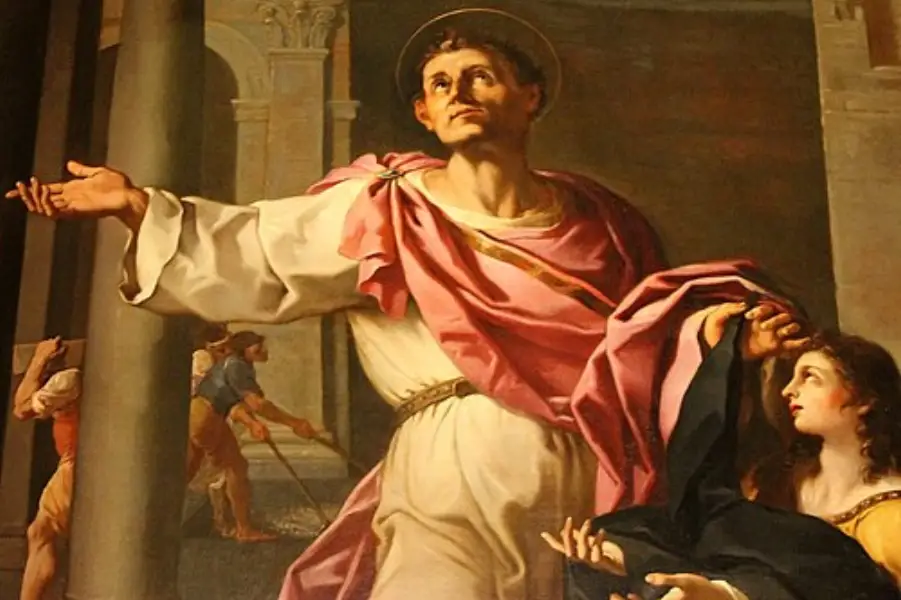
Pammachius was never formally canonized, for he belongs to the company of saints whose veneration took root in the centuries before any process existed. He is honored as a saint by the Roman Catholic Church and the Eastern Orthodox Church, and his liturgical feast is kept on 30 August. His memory found a home in the sacred art of Rome: a painting of Saint Pammachius looks down from one of the side altars of the Caelian church of Saints John and Paul, where the senator's image keeps his presence among the churches of the city he served. The endurance of his cult owes less to written legend than to the institutions and friendships he left behind, for the hospice at Porto, the alms of 397, and the letters exchanged with Jerome and Augustine kept his name alive in the memory of the Western church. As a married man, a magistrate, and finally a lay ascetic, he became for later generations a pattern of holiness achieved within the world, proof that the senatorial class of late antiquity could produce saints as well as statesmen.
§ Biography
Peacemaker Among the Doctors
Pammachius's legacy has two faces: the charity he built and the peace he sought. The Xenodochium at Porto stood as a monument to a new ideal of aristocratic wealth, converted from villas and spectacles into lodging for the poor pilgrims of Rome, and it associated his name permanently with the tradition of Christian hospitality. In the learned world his significance was quieter but real. He was among the laymen who dared to correct Jerome, urging charity in controversy at a moment when the Origenist dispute threatened to divide the Latin church, and his joint letter of 399 with Oceanus marks him as a participant in one of the great theological quarrels of the age. Augustine's letter of thanks from 401 shows that his appeal to the Christians of Numidia counted for something in the struggle against the Donatist schism, a cause on which his African property gave him a personal stake. Many of Jerome's scriptural commentaries, dedicated to Pammachius, carried his name into every medieval library that copied the great doctor's works, so that the Roman senator remained present in the scholarship of the church long after his death in 410.
§ Biography
Timeline
- 385
Married Paulina, second daughter of Paula of Rome.
§ Biography
- 390
Probably among the men of highest rank who denounced Jovinian's teaching to Pope Siricius.
§ Biography
- 397
Paulina died in childbirth; her husband bestowed generous alms upon the needy to secure the rest of her soul.
§ Biography
- 398
Built the Xenodochium of Pammachius, a guest-house for pilgrims, at Porto with Fabiola.
§ Biography
- 399
Wrote with Oceanus to Jerome, asking him to translate Origen's De Principiis and repudiating Rufinus's insinuations.
§ Biography
- 401
Thanked by Augustine of Hippo for a letter urging the people of Numidia to abandon the Donatist schism.
§ Biography
- 410
Died in Rome after years of seclusion devoted to prayer, penance, and charity.
§ Biography
The Record
- Major works
- Xenodochium of Pammachius, a guest-house for pilgrims at Porto·Letter to the people of Numidia against the Donatist schism
- Canonization
- Pre-congregation; venerated as a saint from antiquity in the Roman Catholic and Eastern Orthodox churches.
Prayer
Bibliography
Show 6 sources
- Paulinus. Letters of St. Paulinus of Nola: Letter 1-22. United Kingdom, Newmann Press, 1966. p. 6.
- Holböck, Ferdinand. Married Saints and Blesseds: Through the Centuries. Ignatius Press, 2017.
- Butler, Alban. 'Saint Pammachius, Confessor'. Lives of the Fathers, Martyrs, and Principal Saints. 1866. CatholicSaints.Info. 19 August 2014.
- Bacchus, Francis Joseph. 'St. Pammachius.' The Catholic Encyclopedia. Vol. 11. New York: Robert Appleton Company, 1911.
- 'St. Pammachius', FaithND. Archived from the original on 23 October 2023.
- Herbermann, Charles, ed. (1913). 'St. Pammachius'. Catholic Encyclopedia. New York: Robert Appleton Company.
Profile text adapted from the Wikipedia article, licensed CC BY-SA 4.0.
Pray with this saint every day
Save St. Pammachius to your favorites, read the full profile, and get feast-day reminders in the Saints app.
Get the Saints AppFree on the App Store for iPhone and iPad