
died 16 February 309·Feast February 16
St. Pamphilus of Caesarea
Priest, Scholar, and Hieromartyr of Caesarea
Overview
Pamphilus of Caesarea, priest and biblical scholar, stood chief among the learned men of his generation and made the church of Caesarea Maritima a center of sacred study. Born in the latter half of the third century, probably at Berytus in Phoenicia, to a family of wealth and standing, he bestowed his estate upon the needy and bound himself to the ascetic masters of his day. At Alexandria he studied under Pierius, head of the famous catechetical school, and conceived a lasting devotion to the works of Origen. Settling at Caesarea, he was ordained a priest and devoted himself to collecting sacred literature and to copying and correcting the scriptures. When the Diocletianic persecution reached Palestine he was seized, tortured on refusing to sacrifice, and consigned to prison; from his cell, for two years, he continued his scholarly labor, composing with his imprisoned friend and pupil Eusebius a defense of Origen in five books. He was beheaded in February 309 with the members of his household. Eusebius commemorated him in a three-book life now lost, and the churches honor this hieromartyr on 16 February.
The Complete Life
A Son of Berytus
Pamphilus was born in the latter half of the third century, probably at Berytus, the great city of Roman Phoenicia that stands where modern Beirut rises today. The evidence for his origins is early and convergent: the Martyrs of Palestine of Eusebius attests that his kindred at Beirut possessed both wealth and repute, while the learned patriarch Photius records Berytus as his birthplace. He was a native of Phoenicia, formed in the Hellenized culture of that coastal province, and heir to wealth that would have secured him a distinguished place in the life of the empire. What he did with that inheritance became the first great fact of his biography. Following a radical ascetic resolve, he surrendered his whole estate to the needy and joined the company of those he judged the perfect men, the devoted Christians whose manner of life he wished to imitate. In the pursuit of learning he went to Alexandria, the intellectual capital of Christian Egypt, where Pierius, presiding over the celebrated catechetical school, instructed him, and where he first gave himself to the study of the works of Origen that would shape the rest of his life.
§ Biography
Priest of the Church at Caesarea
From Alexandria Pamphilus made his way to Caesarea Maritima, the administrative capital of Roman Palestine and the city whose Christian school, Origen's old home, preserved the tradition he had learned to love. There he was ordained a priest of the church. The ordination set the course of his remaining years: he became the organizing spirit of the scriptural studies for which Caesarea was famous, collecting sacred literature and directing the copying and correction of manuscripts of the Bible. He gathered students around him, among them Apphianus and Aedesius of Palestine and, above all, Eusebius, who would call himself Pamphilus's friend and pupil and who learned from him the scholarship that produced the Ecclesiastical History. So close was the bond between master and disciple that Eusebius afterward wrote a life of Pamphilus in three books, regrettably lost, recording the details of his career. The pupil concealed his discipleship at first, as Eusebius would later recount with amusement, but in time the household of Pamphilus became a community of scholars, ascetics, and future martyrs, the last great flowering of the Origenist school before the persecution swept it away.
§ Biography
The Library and the Scriptorium
The mission of Pamphilus was carried out with pen and parchment rather than in journeys or public preaching. At Caesarea he devoted himself and his resources to the collection of sacred literature and to the accurate transmission of the scriptures, copying and correcting manuscripts so that the churches might read the word of God in texts cleansed of error. This labor stood in the lineage of Origen, whose Hexapla and scholarly methods had made Caesarea the leading center of biblical study in the East, and it gathered into the city the collection later known as the Theological Library of Caesarea. The work did not stop when persecution came. During his two years in prison Pamphilus continued the enterprise, producing and correcting books with his companions, and in collaboration with Eusebius, who shared his confinement, he wrought a five-book Apology for Origen, whose editing and completion Eusebius afterward supplied with a sixth book. Only the first book survives, in the Latin version of Rufinus, but it shows the direction of his scholarship: a defense of the great Alexandrian teacher's orthodoxy, grounded in copious extracts from his writings and anxious above all to keep the rule of faith handed down from the Apostles.
§ Biography
Humility and the Rule of Faith
The portrait of Pamphilus that emerges from the ancient testimony is that of a scholar whose learning was held together by humility and orthodoxy. Eusebius records that he renounced his family's wealth for the sake of the poor and bound himself to the ascetic masters he called the perfect men; Photius preserves the voice of the Apology itself, with its portrait of Origen as a man of deep humility, of commanding weight in the church of his generation, and held in priestly honor. Above all things, the Apology declares, its author's one care was fidelity to the apostolic rule of faith received from of old, and it vindicates the soundness of doctrine concerning the Trinity and the Incarnation with copious extracts from Origen's own works. In defending Origen against nine charges of false teaching, Pamphilus was defending the possibility of a learned Christianity obedient to the church's faith, and he endorsed, as the orthodox understanding of apokatastasis, the hope of universal reconciliation that he found in the master's writings. His gentleness appeared even in his discipleship: Apphianus joined him secretly, unknown to the household itself, and Pamphilus's prison became a school where confessors studied while awaiting death.
§ Biography
Confessor and Martyr
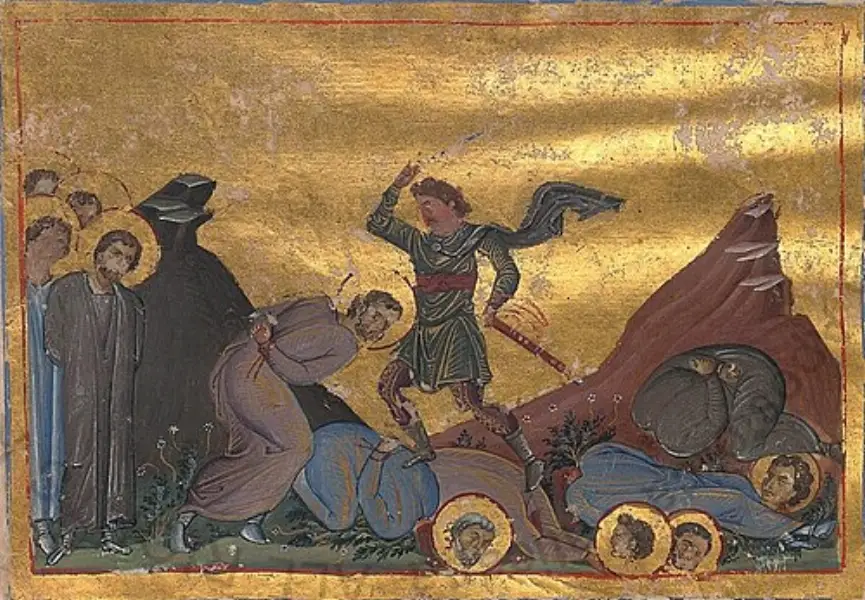
The Diocletianic persecution, begun in earnest in 303, claimed Pamphilus's disciples before it claimed him. In 306 the young Apphianus boldly cut short the governor of Palestine while he was offering sacrifice, and died a martyr for the daring act; his brother Aedesius, at Alexandria and in about the same season, came to the same end. Pamphilus's turn came in November 307, when he stood trial before Urbanus, who then governed the province. On refusing to offer sacrifice he was cruelly tortured and relegated to prison, where he passed two years in the labors already described. In February 309 the sentence of beheading was pronounced upon him and upon the members of his household, together with Valens, deacon of the church of Jerusalem, and Paul of Jamnia, men celebrated for the vigor of mind and body. As the sentence was pronounced, a youth called Porphyrius, once Pamphilus's slave and his best-loved pupil, asked that the bodies of the condemned be given up for burial; for this he was racked and slain, the news reaching his master before the executioner's blade. Pamphilus was beheaded on 16 February 309, in the third year of the persecution, and his companion Patriklos soon followed him.
§ Biography
Hieromartyr of the Persecution
Pamphilus was honored as a martyr from the moment of his death, for the church of Palestine had watched his confession through two years of imprisonment and the execution ground of Caesarea. No process of canonization existed in that age; he was Pre-congregation in the strictest sense, numbered among the martyrs whose memory the calendars of the church preserved. The Roman Catholic Church and the Eastern Orthodox Church alike regard him as a saint, and in the East he bears the title of hieromartyr, a priest who died for the faith. His feast is kept on 16 February, the day of his beheading, while the Roman church adds a further commemoration on 1 June. The Menologion prepared for the emperor Basil II at the turn of the second millennium includes his image among the saints of the Byzantine year, showing how firmly he had entered the cycle of universal veneration. Ancient martyrologies record him, Eusebius wrote his life, and the sees that remembered his disciples, from Caesarea to the Cappadocian and Syriac traditions, transmitted his story as one of the glories of the Great Persecution.
§ Veneration
The Scholar's Afterlife
Pamphilus's influence outlasted him in books and in controversy. The Apology for Origen, though reduced to Rufinus's Latin of its first book, remained a fundamental document in the long quarrel over the Alexandrian master's reputation. Jerome at first stated in his De Viris Illustribus that two apologies existed, one by Pamphilus and one by Eusebius, then, when Rufinus's translation appeared at the height of the controversy, charged Rufinus with palming off Eusebius's work under the martyr's name; the evidence of Photius, who read the Greek original and found no Arian taint in it, together with abundant testimony, confirms that the work was the joint product of Pamphilus and Eusebius. Other writings gathered around his name: their late fourth-century compiler attributed to him the canons of the supposed Council of the Apostles held at Antioch, Gennadius's attribution to him of a treatise against the astrologers sprang from a misunderstanding of Rufinus's preface, and a Summary of the apostolic Acts, found among the writings linked with Euthalius, bears his inscription. David Hume, centuries later, thought the martyr-scholar's name apt for the voice of his Dialogues Concerning Natural Religion.
§ Works and influence
Timeline
- 303
The Diocletianic persecution began in earnest, opening the crisis that would reach the church of Caesarea.
§ Biography
- 306
Apphianus, a disciple of Pamphilus, died a martyr at Caesarea for boldly cutting short the governor while he offered sacrifice.
§ Biography
- Nov 307
Brought before Urbanus, governor of Palestine, Pamphilus refused to offer sacrifice, was cruelly tortured, and was relegated to prison.
§ Biography
- Feb 309
His devoted disciple Porphyrius asked that the bodies of the condemned be surrendered for burial, and was racked and slain for it.
§ Biography
- 16 Feb 309
Beheaded at Caesarea with the members of his household, the deacon Valens, and Paul of Jamnia, after two years in prison.
§ Biography
The Record
- Major works
- Apology for Origen, five books composed with Eusebius (only the first book survives, in Rufinus's Latin version)·Scriptural copying and correcting enterprise of the church at Caesarea
- Canonization
- Pre-congregation; venerated as a martyr by the Roman Catholic and Eastern Orthodox churches from the earliest centuries.
Prayer
Bibliography
Show 6 sources
- McClintock, John; Strong, James (1880). Cyclopaedia of Biblical, Theological and Ecclesiastical Literature. Vol. 7. New York: Harper & Bros. p. 606.
- Pamphilus, Eusebius (1953). Ecclesiastical History, Books 1-5 (The Fathers of the Church, Volume 19). Translated by Deferrari, Roy J. The Catholic University of America Press. p. 4.
- Foxe, John (1978). Fox's Book of Martyrs: A History of the Lives, Sufferings and Triumphant Deaths of the Early Christian and the Protestant Martyrs. Edited by William Byron Forbush. Zondervan. p. 31.
- Müller-Kessler, Christa (2019). The Unknown Martyrdom of Patriklos of Caesarea in Christian Palestinian Aramaic from St Catherine's Monastery (Sinai, Arabic NF 66). Analecta Bollandiana 137, pp. 63-71.
- Bacchus, Francis Joseph. 'St. Pamphilus of Cæsarea.' The Catholic Encyclopedia. Vol. 11. New York: Robert Appleton Company, 1911.
- Hoever, Rev. Hugo, ed. (1955). Lives of the Saints, For Every Day of the Year. New York: Catholic Book Publishing Co. pp. 211-212.
Profile text adapted from the Wikipedia article, licensed CC BY-SA 4.0.
Pray with this saint every day
Save St. Pamphilus of Caesarea to your favorites, read the full profile, and get feast-day reminders in the Saints app.
Get the Saints AppFree on the App Store for iPhone and iPad