
died c. 700·Feast April 28
St. Pamphilus of Sulmona
Bishop of Sulmona and Shepherd of Abruzzo
Overview
Pamphilus of Sulmona, known in Italian as Panfilo di Sulmona, governed the diocese of Sulmona and Corfinio (Valva) in the mountains of Abruzzo during the late seventh century. Born in Abruzzo probably around the middle of the seventh century, his father, a pagan, cast him off at the very moment of his conversion to Christianity, an early wound that marked a life spent among a half-converted land. Elected bishop of Sulmona in 682, he led his church through the decades in which Lombard power dominated the region, and tradition remembers him as a man of generous and kindly spirit, deeply set on winning the Lombard invaders to the gospel. His episcopate was not without trial: his own clergy accused him of Arianism, but Pope Sergius I acquitted him of the charge and sent alms for the poor of his diocese as a mark of the pope's confidence. His life closed at Corfinio around the year 700, and his body was laid to rest in Sulmona Cathedral, which is dedicated to him, and he is honored as patron saint of Sulmona, Spoltore, Scerni, and Ocre, with a feast on 28 April.
The Complete Life
A Convert's Son of Abruzzo
Pamphilus was born in the Abruzzo, it is thought near the midpoint of the seventh century, in the rugged central Italian region whose valleys lead from the Apennines down toward the Adriatic. The age was one of religious mixture: the old catholic population lived under the rule of the Lombards, invaders of the Arian persuasion, and the Christian faith was still establishing itself in the mountain communities. Into this world came the personal drama that shaped his childhood. His father was a pagan, and when the boy converted to Christianity his father repudiated him, casting him off precisely at the moment he most needed a family. The sources preserve no further detail of his youth, but the pattern they suggest is telling: a boy who lost his natural father's favor for the sake of Christ would grow into a shepherd renowned for a very generous and kindly spirit, one who understood what it cost to stand alone. In an era when conversion often meant estrangement from kin, his early experience made him, in the providence the tradition glimpses, a fitting father for converts, strangers, and the abandoned faithful of his diocese.
§ Biography
Bishop in Troubled Times
In 682 the church of Sulmona elected Pamphilus as its bishop, joining to his office the ancient see of Corfinio, known as Valva, so that he governed the united diocese of Sulmona-Valva in the final decades of the seventh century. The episcopate he assumed was demanding in ways that went beyond ordinary administration. His territory lay within the Lombard sphere of power, its people only recently and imperfectly Christian, and its clergy capable of faction. Tradition describes him as a person of very generous and kindly spirit, deeply intent on winning the Lombard newcomers to the gospel, and this concern set the direction of his ministry: he regarded the conquerors of his homeland not as enemies to be resisted but as souls to be won. The trust he earned did not shield him from trouble. His own clergy accused him of Arianism, a grave charge in an age when the Arianism of the Lombard court made any suspicion of that heresy dangerous for a catholic bishop. The case was carried to Rome, where Pope Sergius I examined it and acquitted Pamphilus of the accusations entirely.
§ Biography
Reconciliation and the Lombard Mission
The two great works of Pamphilus's episcopate were the conversion of the Lombards and the healing of his own wounded reputation. Toward the Lombard settlers he directed the patient work of evangelization, teaching the faith to the people whose armies had overwhelmed the region and whose Arian version of Christianity competed with the catholic confession of the old inhabitants. The tradition's phrase, that his concern was the conversion of the invaders themselves, records a pastoral instinct ahead of its time: he sought to make the strangers of the seventh century into the faithful of the Abruzzo rather than a permanent enemy nation within it. Toward his accusers his conduct was equally instructive. Acquitted by Pope Sergius I of the charge of Arianism, he received from the pope not only vindication but alms sent for the poor of his diocese, a gesture that joined the Roman see to the mountain church in charity. The bishop who had been slandered as a heretic returned to his people with the pallium of the pope's confidence, and nothing in the tradition suggests that he pursued vengeance upon the clergy who had denounced him.
§ Biography
Death at Corfinio
Pamphilus governed the united diocese of Sulmona and Corfinio until his death, which took place at Corfinio around the year 700. He thus closed his life almost exactly at the turn of the century, some eighteen years or more after his election in 682, having led his church across the threshold from the seventh century into the eighth. The place of his death was fitting, for Corfinio, the ancient Corfinium that had once been the capital of the Italian allies, remained the seat of the Valva portion of his diocese. The tradition records no dramatic circumstances, no persecution and no exile, only the quiet end of a long episcopate in a mountain town. What followed his death, however, reveals how his people judged him. His remains were enshrined and became an object of veneration, and in time they were gathered to Sulmona Cathedral, the mother church of the diocese he had governed. That cathedral came to be dedicated to him under the name of Saint Pamphilus, so that the bishop who had been accused by his own clergy became the titular protector of the church in which their successors worship.
§ Biography
Patron of Four Cities
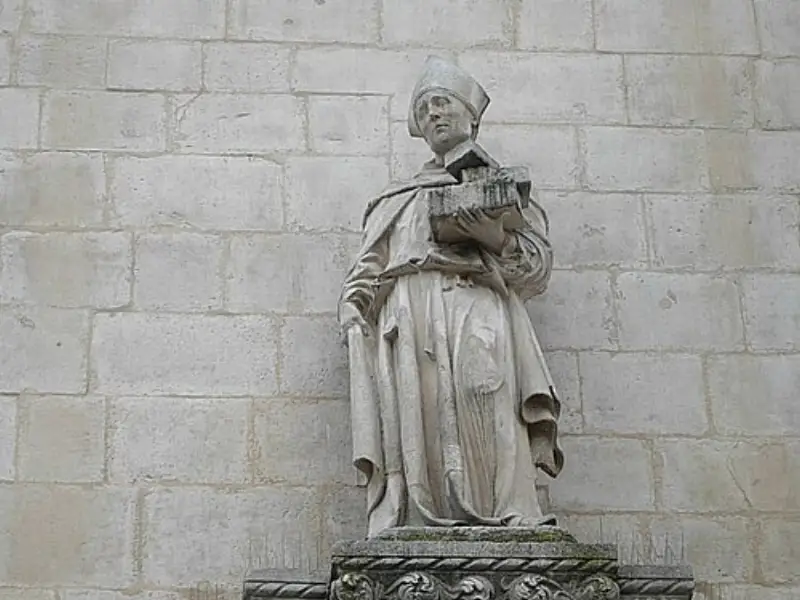
The veneration of Pamphilus took root firmly in the soil of the Abruzzo. Both the Catholic Church and the Eastern Orthodox Church revere him as a saint, and his feast is kept on 28 April. Four cities — Sulmona, Spoltore, Scerni, and Ocre — claim him as their patron, each of which maintains churches dedicated to him, among them Sulmona Cathedral itself, the church that holds his remains and bears his name. This network of dedications across four towns shows a cult that spread beyond the boundaries of his former diocese, carried by the devotion of the mountain communities that claimed his protection. His memory also entered the artistic and civic identity of Sulmona, where a statue of the saint adorns the front of the Palazzo dell'Annunziata, keeping his presence in the public square of the city that honors him as its chief patron. Historians of the Italian episcopate, from the great catalogues of the sees to modern dictionaries of the saints, record him as bishop of Sulmona-Valva of the late seventh century, the kindly bishop who turned the invaders of his homeland into his flock.
§ Veneration
Timeline
- 682
Elected bishop of Sulmona, in the Abruzzo region of central Italy.
§ Biography
- 700
Died at Corfinio, around the year 700, after roughly two decades of episcopal service.
§ Biography
The Record
- Major works
- Evangelization of the Lombard settlers of the Sulmona region
- Patron of
- Sulmona·Spoltore·Scerni·Ocre
- Canonization
- Pre-congregation; revered as a saint by the Catholic Church and the Eastern Orthodox Church from ancient tradition.
Prayer
Bibliography
Show 5 sources
- Gams, Pius Bonifatius (1931). Series episcoporum ecclesiae catholicae: quotquot innotuerunt a beato Petro apostolo. Vol. 2. K.W. Hiersemann. p. 928.
- Watkins, Basil (2015). 'Pamphilus of Sulmona'. The Book of Saints: A Comprehensive Biographical Dictionary. 8th ed. Bloomsbury Publishing. p. 563.
- 'Saint Pamphilus of Sulmona'. CatholicSaints.Info. 2022-02-18.
- Menzies, Lucy (1924). The Saints in Italy: A Book of Reference to the Saints in Italian Art and Dedication. Medici Society Limited. p. 332.
- 'Nel borgo la processione e il concerto per San Panfilo'. Il Centro. 2023-04-26.
Profile text adapted from the Wikipedia article, licensed CC BY-SA 4.0.
Pray with this saint every day
Save St. Pamphilus of Sulmona to your favorites, read the full profile, and get feast-day reminders in the Saints app.
Get the Saints AppFree on the App Store for iPhone and iPad