
c. 289 – 304·Feast May 12
St. Pancras of Rome
Fourteen-Year-Old Martyr of the Diocletianic Persecution
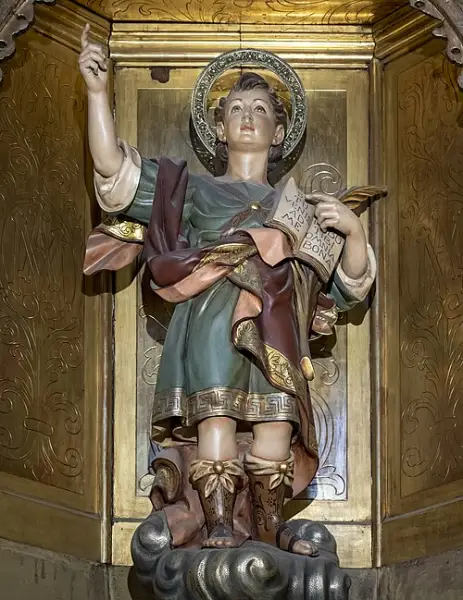
Overview
Pancras — in Greek Pankratios, a name that means all-powerful — was born a Roman citizen, embraced the Christian faith, and paid for it with beheading at only fourteen years of age, about the year 304. Tradition sets his birth around 289 near Synnada in Phrygia, to parents who were Roman citizens. Left an orphan in childhood, he was brought to Rome by his uncle Dionysius, and the two were converted and baptized by one Marcellinus. When the persecution of Christians under Emperor Diocletian reached the city, the boy was brought before the authorities and ordered to sacrifice to the Roman gods. He refused, resisted the emperor's promises of wealth and power, and was condemned to death on the Via Aurelia. A Roman matron named Octavilla recovered his body, anointed it, wrapped it in precious linens, and laid it in a sepulchre in the catacombs. From the fifth century his grave was a place of pilgrimage: Pope Symmachus raised a basilica over it, Gregory the Great sent his relics to England, and he became one of the most widely honored of the child martyrs, invoked against headaches, cramps, and perjury.
The Complete Life
An Orphan from Phrygia
The account of Pancras's early life, preserved in the traditions of his cult, begins in the far interior of Asia Minor. He is said to have been born around 289 near Synnada, a city of Phrygia Salutaris in what is now Turkey, to parents who possessed Roman citizenship, a status that would follow their son to the capital of the empire. His childhood was marked early by loss: his mother Cyriada died in giving birth to another child when the boy was only nine years of age, and his father died of grief not long afterward. The orphaned boy was entrusted to the care of his uncle Dionysius, who took charge of his upbringing and his property. Together uncle and nephew left Phrygia and moved to Rome, settling in a villa on the Caelian Hill, one of the old residential heights of the city. There, in the capital, the decisive turn of their lives occurred: both were converted to Christianity through the teaching of one Marcellinus, and Pancras embraced his new faith with the wholehearted zeal that would soon define him. When Dionysius in turn died, the boy of perhaps twelve or thirteen was left alone in the great city, rich, baptized, and unbowed.
§ Legend
A Zealous Young Christian
The conversion described in the traditions of Pancras was no half-measure. Converted along with his uncle by Marcellinus, he became what the legend calls a zealous adherent of the Christian religion, a boy who took his baptism with a seriousness rare at any age. In the Rome of the late third century such zeal carried real risk. The church had known periods of quiet growth, but the emperor Diocletian's resolve to restore the old worship was moving toward the terrible persecution that would begin in 303, and Christians in the city knew that sacrifice to the Roman gods might one day be demanded of them. Pancras's inheritance placed him among the propertied class of the city, yet the faith he had learned from Marcellinus taught him to measure wealth differently from the world around him. His Greek name, Pankratios, all-powerful, came to seem to later generations a prophecy of the strength he would display. When the testing came, it found him at fourteen, an age when the tradition of the church expects least resistance and honors most the courage that defies expectation. His brief Christian life was about to become his whole memorial.
§ Legend
Martyrdom on the Via Aurelia
During the persecution of Christians under Diocletian, around the year 303, Pancras was brought before the authorities and commanded to perform sacrifice to the Roman gods. He refused. The tradition preserves a striking detail: the emperor himself, impressed by the boy's determination to resist, tried persuasion where force had failed, promising him wealth and power if he would comply. The offer only met with renewed refusal, and at last the emperor ordered him beheaded. The execution took place on the Via Aurelia, on 12 May, in the traditional reckoning of the year 303, when Pancras was fourteen years old; other testimony assigns his death to 304, and modern scholars note that the traditional dating sits awkwardly with the emperor's whereabouts and with the bishop of Rome mentioned in the accounts. A Roman matron named Octavilla recovered the body of the young martyr, embalmed it with balsam, wound it in costly linens, and laid it to rest in a fresh-hewn tomb among the catacombs of Rome. His head was placed in a reliquary, the same reliquary that, tradition holds, still exists today in the Basilica of Saint Pancras on the Janiculan hill.
§ Legend
The Martyr of the Basilica
Pancras belongs to the long line of martyrs honored by the church without any formal canonization, his sanctity ratified by his death and by the devotion that gathered at his grave. Devotion to him existed from the fifth century onward, when Pope Symmachus, who held the see of Rome from 498 to 514, raised the basilica of Saint Pancras above the spot where the young martyr lay; the earliest account of his passion appears likewise to date from that same age. The shrine drew the attention of the greatest of the popes: Gregory the Great gave fresh impulse to the cult, sending Augustine to England carrying relics of Pancras and including the martyr's legend in his Liber in Gloria Martyrum, a gesture behind the many English churches dedicated to him, among them St Pancras Old Church in London, among the most ancient places of Christian prayer in England. In the liturgy of the West he was joined for centuries with the soldier saints Nereus and Achilleus in a joint feast on 12 May, a celebration ranked and reformed through the Tridentine calendar, the revision of 1960, and finally the calendar of 1969, which gave him his own optional memorial.
§ Veneration
The Saint of the Ordinary Places
The cult of Pancras spread across the medieval world and settled, remarkably, in the most ordinary settings of life. Popular devotion names him protector of children, of employment, and of health, and his name is called upon against cramps, against lying witnesses, against head pains, and against false oaths, a catalogue of the misfortunes of working people. Statues of him stand not only in churches but in many bars, restaurants, and other places of business, where shopkeepers keep him as a familiar guardian of daily commerce, and the Italian city of San Pancrazio Salentino counts him as its patron. In art he took the form medieval painters gave him: a young soldier, clad in the armour of a Roman legion, owing to his ancient pairing with the twin soldier martyrs Nereus and Achilleus, bearing the martyr's palm branch, a book, a quill, and the sword of his execution. His head, preserved in the reliquary of the Basilica of Saint Pancras in Rome, remains the heart of his cult, while his fresco among the saints of Sant'Apollinare Nuovo in Ravenna shows him honored beside Vincent of Saragossa, Polycarp, and Chrysogonus in the great mosaic program of the sixth century.
§ Veneration
Timeline
- 289
Born near Synnada in Phrygia Salutaris, to parents of Roman citizenship, around the year 289.
§ Legend
- 12 May 303
Beheaded on the Via Aurelia in Rome on 12 May, in the traditional account under Diocletian, at the age of fourteen.
§ Legend
- 498
Pope Symmachus, whose pontificate ran from 498 to 514, built the basilica of Saint Pancras over the young martyr's burial place.
§ Veneration
- 1595
The name of Domitilla was added to the joint feast of Nereus, Achilleus, and Pancras kept on 12 May.
§ Veneration
- 1960
The combined observance honoring Nereus, Achilleus, Domitilla, and Pancras was reclassified as a third-class feast in the calendar revision of 1960.
§ Veneration
- 1969
The revised General Roman Calendar assigned Pancras his own optional memorial on 12 May, distinct from Nereus and Achilleus.
§ Veneration
The Record
- Patron of
- children·jobs·health·against cramps·against false witnesses·against headaches·against perjury·San Pancrazio Salentino
- Symbols
- Roman legion armour·martyr's palm branch·book·quill·sword
- Canonization
- Pre-congregation; honored as a martyr from the earliest centuries, with his cult attested from the fifth century onward.
Prayer
Bibliography
Show 6 sources
- Phelan, Patrick. 'Who is St Pancras?'. St. Pancras Old Church.
- Drobner, Hubertus. Der heilige Pankratius: Leben, Legende und Verehrung. 2nd rev. ed. 2005. Paderborn: Bonifatius Verlag.
- 'San Pancrazio su santiebeati.it'. Santiebeati.it. Retrieved 2020-04-13.
- 'St Pancras'. Lewes Priory Trust.
- Spencer, Eleanor P., and Stechow, Wolfgang. 'Sts. Nereus and Achilleus in the Fifteenth Century'. The Art Bulletin 48.2 (June 1966): 207-209.
- Calendarium Romanum. Libreria Editrice Vaticana. p. 123.
Profile text adapted from the Wikipedia article, licensed CC BY-SA 4.0.
Pray with this saint every day
Save St. Pancras of Rome to your favorites, read the full profile, and get feast-day reminders in the Saints app.
Get the Saints AppFree on the App Store for iPhone and iPad