
died c. 200·Feast July 7
St. Pantaenus
Stoic philosopher and missionary teacher of Alexandria
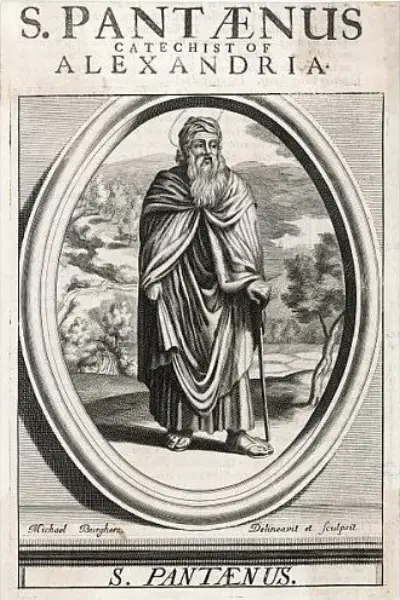
Overview
Pantaenus was a Sicilian theologian who became one of the formative figures of Christian education in Alexandria. Trained first as a Stoic philosopher, he taught that school of thought in the Egyptian city before embracing the Christian faith and setting out to reconcile the Gospel with the Greek philosophical tradition. From around AD 180 he led the Catechetical School of Alexandria, the earliest institution of its kind and one that shaped the development of Christian theology profoundly. Among his students was Clement, who succeeded him as head of the school and affectionately remembered his teacher as the Sicilian bee. Although none of Pantaenus's writings survive, his influence reached the early Church's debates on the interpretation of Scripture, the Trinity, and the person of Christ, and he supported Serapion of Antioch in resisting the spread of Gnosticism. Eusebius of Caesarea records that he also served as a missionary, traveling as far as India, where he reportedly found Christian communities in possession of a version of the Gospel of Matthew written in Hebrew letters. Jerome, drawing on Eusebius, adds that he preached Christ to the Brahmans and philosophers of that distant land. He is honored by the Roman Catholic, Oriental Orthodox, and Eastern Orthodox Churches, and his memory is kept on July 7.
The Complete Life
A Philosopher of Sicily and Alexandria
Pantaenus was born on the island of Sicily, though the sources preserve no record of his family or the circumstances of his youth. By the time he enters history he had already traveled far intellectually and geographically, established in Alexandria as a teacher of Stoic philosophy. The Stoicism he professed was not a casual affiliation but a serious school of thought, one that prized reason, self-mastery, and the conviction that the universe is governed by a rational order. These commitments shaped the cast of his mind long before he encountered the Christian preaching. Alexandria itself was the natural meeting place for such a man: the city held the greatest library of antiquity, a thriving Jewish community, and a restless intellectual culture in which Greek philosophy, Egyptian religion, and Eastern thought were in constant conversation. A philosopher who taught there moved among merchants and scholars from across the Mediterranean world, and the ancient seaport routes that connected Egypt to Arabia and India were familiar lines on the maps of his contemporaries. It was in this cosmopolitan setting, saturated with argument and speculation, that the Sicilian philosopher first heard the Christian claim that the rational order he sought had taken flesh in Jesus Christ. His origins among the Greek-speaking communities of Sicily and his formation in a distinguished pagan school gave him a rare double inheritance: the precision of the Stoa and the openness of a convert, qualities that would define his later work as a Christian teacher.
§ Stoic philosopher
Conversion and the School of Alexandria
Pantaenus's conversion to Christianity transformed his career without erasing his past. Rather than abandoning the philosophical training of his former life, he undertook the demanding work of reconciling his new faith with the Greek intellectual tradition, becoming one of the earliest Christian thinkers to attempt that synthesis deliberately. His gifts found their field in the Catechetical School of Alexandria, an institution devoted to instructing converts and grounding believers in the faith, and the earliest school of its kind. From around AD 180 he stood at its head, and under his direction it became a force in the development of Christian theology. Among those who sat under his teaching was Clement, the most celebrated student of the school, who later succeeded Pantaenus as its head and who described his master as the Sicilian bee, an image of one who moved from teaching to teaching and gathered honey for the hive of the Church. Though Pantaenus wrote, no treatise of his has survived; his legacy lives instead in the institution he led and in the students he formed. His influence extended into the great doctrinal struggles of the age: the school he directed took part in the early debates over the interpretation of the Bible, the doctrine of the Trinity, and the person of Christ, and Pantaenus himself stood as the principal supporter of Serapion of Antioch when that bishop acted against the inroads of Gnosticism. The Christian mind of the third century bears the imprint of his classroom.
§ Convert to Christianity
Missionary to India
Eusebius of Caesarea records that alongside his work as a teacher, Pantaenus devoted a period of his life to missionary labor, and that his journeying carried him as far as India. There, according to the historian, he discovered Christian communities already in existence, who showed him a copy of the Gospel of Matthew written in Hebrew letters, a treasure they said had been left among them by the Apostle Bartholomew; some scholars have suggested the book may have been the Gospel of the Hebrews. The account has invited debate. Some writers propose that Pantaenus, struggling with the language of the Saint Thomas Christians, misheard their reverence for Mar Thoma, the Aramaic name of Saint Thomas, and took it for Bar Tolmai, the Hebrew name of Bartholomew, thereby misidentifying the apostle credited by the Syrian Churches with bringing the faith to India in the first century. Whatever the truth of that detail, the ancient trading world made such a journey plausible: the seaport of Muziris on the Malabar Coast, in modern Kerala, was a regular destination for Egyptian merchants in the early centuries. Jerome, writing later and apparently relying on Eusebius, adds that Pantaenus made his way to India to announce Christ to the Brahmans and to the philosophers of that country, and affirms that many of his commentaries on Scripture still existed in his own day, though that claim likely rests on Jerome's personal knowledge rather than independent testimony.
§ Convert to Christianity
Legacy and Modern Study
The memory of Pantaenus has endured in the Churches of East and West alike. He is venerated by the Roman Catholic Church, the Oriental Orthodox Church, and the Eastern Orthodox Church, and his feast is kept on July 7. The Coptic synaxarium names him alongside Clement of Alexandria in its notice of how Pope Paul VI restored the relics of Mark the Apostle to his own see, though the synaxarium gives Pantaenus no feast of his own. Modern scholarship has returned to him chiefly through the question of universal salvation. The historian J. W. Hanson and the patristic scholar Ilaria Ramelli have argued that Pantaenus taught the doctrine of universalism to Clement of Alexandria and, through him, to Origen, so that the Alexandrian school never knew any contrary teaching from its foundation. This thesis has not gone unchallenged: Andrew C. Itter contends that the universalism ascribed to Clement was in tension with his insistence on the freedom of the will to refuse God's chastisements, and that Clement may never have embraced a strict doctrine of apokatastasis, a conclusion that casts doubt on how firmly the teaching can be traced back to the Sicilian master. The debate is a measure of his peculiar standing among the Fathers: a teacher whose own voice is lost, whose thought must be reconstructed entirely from what his students and successors remembered, and who nonetheless remains a living presence in the history of Christian doctrine.
§ 19th century and modern study on Pantaenus
Timeline
- 180
Became a leading figure of the Catechetical School of Alexandria, the earliest catechetical school.
§ Biography
- 200
Died at Alexandria, Egypt, around the time Clement succeeded him as head of the school.
§ Biography
In Their Own Words
the Sicilian bee
The Record
- Symbols
- lecturing from a pulpit
- Canonization
- Pre-Congregation canonization by the early Church
Prayer
Bibliography
Show 8 sources
- Orthodox Calendar. Holy Trinity Russian Orthodox Church, a parish of the Patriarchate of Moscow
- Saint Pantaenus, Father of the Church. July 7. Rev. Alban Butler. 1866. Volume VII: July. The Lives of the Saints
- Saint Pantaenus, Doctor of the Church and Apostle to the Indies
- Church History by Eusebius. Book V Chapter 10. Pantaenus the Philosopher.
- Jerome, De viris illustribus 36
- Ramelli, Ilaria L. E. "The Mysteries of Scripture: Allegorical Exegesis and the Heritage of Stoicism, Philo, and Pantaenus". Clement's Biblical Exegesis. Brill. pp. 80-110. doi:10.1163/9789004331242_005
- Alban Butler; Paul Burns. Butler's Lives of the Saints, Volume 7. A&C Black. p. 48.
- Paona 15: Lives of Saints: Synaxarium - CopticChurch.net
Profile text adapted from the Wikipedia article, licensed CC BY-SA 4.0.
Pray with this saint every day
Save St. Pantaenus to your favorites, read the full profile, and get feast-day reminders in the Saints app.
Get the Saints AppFree on the App Store for iPhone and iPad