
c. 275 – 305·Feast July 27
St. Pantaleon
Physician-Martyr and Unmercenary Healer of Nicomedia
Overview
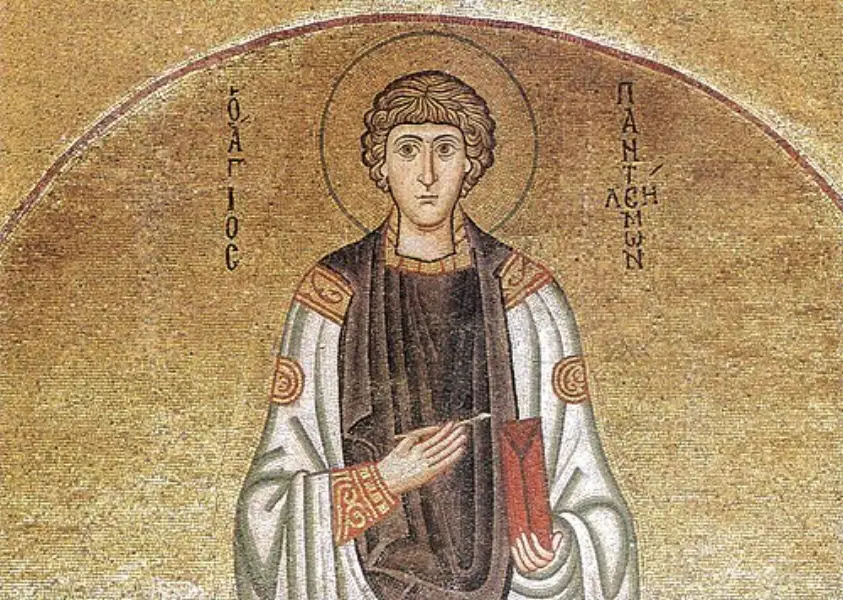
Pantaleon, whose Greek name Panteleimon means 'all-compassionate', was a Christian of Nicomedia in Bithynia, put to death during the Diocletianic Persecution around 305. The son of the rich pagan Eustorgius and his Christian wife Eubula, he was raised in the faith, but after his mother's death he drifted from it while training in medicine under the renowned physician Euphrosinos, and rose to become physician to the emperor Maximian. The priest Hermolaus won him back to Christ, arguing that Christ was the better physician, and his recovery of faith was sealed when, calling on the name of Jesus, he opened the eyes of a man born blind — and the wonder brought his own father to the faith. On his father's death he inherited a great fortune, freed his slaves and gave his wealth to the poor. Denounced by envious colleagues during the persecution, he confessed his faith before the emperor and healed a paralytic as proof; condemned as a magician, he endured, in the legends, a succession of failed tortures before being beheaded, receiving as he forgave his executioners the name Panteleimon, 'mercy for everyone'. He is honored in the West among the Fourteen Holy Helpers and in the East among the Holy Unmercenary Healers, patron of physicians and midwives.
The Complete Life
A Physician's Divided House
Pantaleon was born at Nicomedia, the great city on the Bithynian shore, around the year 275, into a household divided in religion: his father Eustorgius was a rich pagan, his mother Eubula a Christian who instructed her son in the faith. Her death broke that early formation. While he studied medicine under Euphrosinos, a physician of renown, the boy fell away from the church of his childhood, and his talents carried him upward in the imperial world — under Euphrosinos's patronage he became physician to the emperor himself, Maximian, or in another account Galerius. The martyrologies that preserve the outline give the story a deliberate shape: a Christian mother's teaching, a pagan father's house, a career at court, and a conscience adrift. Medicine was the profession through which he rose, and it became the vocabulary of his conversion; the acts of his life turn on the claim that the healing he practiced by art pointed beyond itself to a deeper health. Nicomedia was then one of the chief cities of the Roman East, and a young doctor with an imperial appointment stood at the center of its world — as far from the endangered assemblies of the persecuted church as ambition could place him.
§ Life of Pantaleon
The Better Physician
The turn in Pantaleon's life came through Hermolaus, a priest of Nicomedia whom the later literature honors as a bishop of the city. Discoursing with the young physician, Hermolaus praised the study of medicine — and then asked what all its acquirements were worth in a man ignorant of the science of salvation. The question, preserved in Alphonsus Liguori's retelling, went to the root: Christ, Hermolaus convinced him, was the better physician. Pantaleon returned to the faith of his mother, and his first act as a Christian was of a piece with his profession. By invoking the name of Jesus he healed a blind man, and the miracle worked its second cure: his father Eustorgius, witnessing it, was converted to Christ. When Eustorgius died, Pantaleon came into a large fortune, and he treated it as the blind man had treated his darkness — he freed his slaves and distributed the wealth among the poor. The exemplum that the medieval church read in his life was exactly this reversal: the emperor's physician learning to put faith before any prescription of his art, and the heir of a rich house learning that its fortune belonged to the poor.
§ Life of Pantaleon
Healing in the Name of Christ
What Pantaleon did with his restored faith made him, in the memory of both East and West, the model of the unmercenary healer — the physician who takes no fee. The acts attribute to him a cure performed in the emperor's very presence: when he openly confessed his faith, he offered as proof that Christ is the true God the healing of a paralytic, and accomplished it. The emperor, refusing to see anything but sorcery in the wonder, wrote the wonder off as sorcery on display — the confession mattered less to him than the claim that its power was divine. Envious colleagues had already denounced Pantaleon to the authorities during the Diocletian persecution, and the emperor, who wished to save the physician he valued, sought to persuade him to apostasy. Between the offer of life on the empire's terms and the confession that invited death, Pantaleon chose as he had once chosen in Hermolaus's company. His healing ministry and his martyrdom were one continuous act: the same Lord he had invoked over the blind man and the paralytic was the Lord he would not deny before the throne.
§ Life of Pantaleon
The Torments That Failed
The legends of his passion pile miracle upon miracle. His flesh was burned with torches, and Christ appeared to all present in the form of Hermolaus, healing him and extinguishing the flames; a bath of molten lead grew cold when the apparition stepped into the cauldron beside him; loaded with a great stone, he was sunk in the sea and the stone floated; thrown to wild beasts, he was fawned on by them until he blessed them away; bound on the wheel, he saw the ropes snap and the wheel break; the sword bent at the headsman's stroke, and the executioners were converted. Eastern tradition keeps Hermolaus alive through these torments, martyred with his companions Hermippas and Thermocrates only shortly before Pantaleon's end. At the last the martyr prayed for his executioners, begging Heaven to forgive them, and for that all-merciful intercession he received, in the legend, the name by which the East calls him: Panteleimon, mercy for everyone. The sword that had bent then did its work, and he was beheaded at Nicomedia around 305. The Catholic Encyclopedia judges the ornate vitae behind these stories late and valueless as history; the martyrdom they adorn, however, rests on veneration whose testimony reaches back to the fifth century.
§ Life of Pantaleon
An Ancient and Universal Cult
No act of canonization belongs to Pantaleon; his cult is of the ancient, pre-congregation kind, and its documented roots reach almost to the generation after his death. Veneration for the martyr of Nicomedia is attested in the fifth century, among other places in a sermon on the martyrs by Theodoret of Cyrus, who died around 457; his name appears in the Martyrologium Hieronymianum; and Procopius of Caesarea, writing of the buildings of Justinian, records that the emperor rebuilt the shrine of Pantaleon at Nicomedia itself — a sixth-century emperor endowing the church of the physician his predecessor had killed. From Nicomedia his relics passed to Constantinople. In the West his standing was fixed by another route: after the Black Death of the mid-fourteenth century, when plague-stricken Europe sought protectors against disease, he was numbered among the Fourteen Holy Helpers, the guardian martyrs invoked in sickness — fittingly, for a healer. In Eastern Christianity he holds a parallel rank among the Holy Unmercenary Healers, and the Coptic church keeps his feast as well. Neither council nor pope made him what he is; the memory of a physician who healed freely and died forgiving did.
§ Early veneration
From the Jordan to the Atlantic
The geography of Pantaleon's cult runs from the Jordan desert to the Atlantic. Monasteries and churches bear his name across East and West — the St. Panteleimon Monastery on Mount Athos, Agios Panteleimon in Crete, the monastery at Myrtou in Cyprus, the twelfth-century church at Gorno Nerezi in North Macedonia. In the Caucasus, Movses Kaghankatvatsi records his relics brought to the town of Tsri by Grigoris, a church raised to him at Beghame'j by Catholicos Lazar of Albania, and King Vachagan III rediscovering his remains for the Amaras Monastery and naming his firstborn son after the saint. Western Europe took him to heart after the Black Death: relics reached Saint Denis in Paris, his head is venerated at Lyon, and Cologne's Romanesque church of Saint Pantaleon is the oldest church of his cult west of Byzantium. France keeps six communes named Saint-Pantaléon; Venice honored him so thoroughly that the commedia's pantaloon may remember him, and the church of San Pantalon holds Veronese's painting of the saint healing a child. At Ravello a phial of his blood was said to liquefy yearly on his feast, and Porto, of which he is a patron with John the Baptist, has kept his relics in its cathedral since 1499.
§ Veneration in the East
Timeline
- 275
Is born at Nicomedia in Bithynia, by the traditional dating
§ Life of Pantaleon
- 305
Is beheaded at Nicomedia in the Diocletianic Persecution, after surviving, in the legend, fire, molten lead, the sea, wild beasts and the wheel
§ Life of Pantaleon
- 1187
A chapel dedicated to him at Chichester Cathedral is possibly under construction shortly before the cathedral's great fire of this year
§ England
- 1453
Armenian refugees carry part of his relics to Porto after the Turkish occupation of Constantinople
§ Portugal
- 1499
His relics at Porto are transferred from the Church of Saint Peter of Miragaia to the cathedral
§ Portugal
- 1735
The Church of St. Panteleimon, one of the oldest in St Petersburg, is built between this year and 1739
§ Life of Pantaleon
- 1905
The Russian battleship Potemkin is renamed Panteleimon after her recovery following the mutiny of this year
§ Eponym
In Their Own Words
But, my friend, of what use are all thy acquirements in this art, since thou art ignorant of the science of salvation?
At Ravello, a city in the kingdom of Naples, there is a vial of his blood, which becomes blood every year [on his feastday], and may be seen in this state interspersed with the milk, as I, the author of this work, have seen it.
The Record
- Patron of
- Physicians·Apothecaries·Midwives·Livestock·Invoked against headaches, consumption, locusts, witchcraft, accidents and loneliness·Helper for crying children
- Symbols
- A compartmented apothecary's medicine box with a long-handled spatula or spoon·A martyr's cross·A beardless young physician holding a book with a cross on it
- Canonization
- Pre-congregation; veneration attested from the 5th century by Theodoret, the Martyrologium Hieronymianum and Justinian's rebuilt shrine at Nicomedia
Prayer
Bibliography
Show 8 sources
- Löffler, Klemens (1911). "St. Pantaleon". The Catholic Encyclopedia. Vol. 11. Robert Appleton Company.
- Butler, Alban (2000). Butler's Lives of the Saints. Continuum International Publishing Group. p. 217. ISBN 9780860122562.
- Liguori, Alphonsus (1888). "SS. Hermolaus, Priest; and Pantaleon, Physician". Victories of the Martyrs. London: Benziger Brothers. pp. 308-311.
- Theodoret of Cyrus. "Sermo VIII, 'De martyribus'". Graecarum affectionum curatio. Vol. LXXXIII. Migne, Patrologia Graeca. p. 1033.
- Procopius of Caesarea. "ix; V, ix". De aedificiis Justiniani. Vol. I.
- Proud, Joana (1997). "The Old English 'Life of Saint Pantaleon' and its manuscript context". Bulletin of the John Rylands Library. 79 (3): 119-132.
- Jockle, Clemens (1995). Encyclopedia of Saints. London: Alpine Fine Arts Collection. p. 349.
- Herbermann, Charles, ed. (1913). "St. Pantaleon". Catholic Encyclopedia. New York: Robert Appleton Company.
Profile text adapted from the Wikipedia article, licensed CC BY-SA 4.0.
Pray with this saint every day
Save St. Pantaleon to your favorites, read the full profile, and get feast-day reminders in the Saints app.
Get the Saints AppFree on the App Store for iPhone and iPad