
c. 251 – 4th century·Feast September 11
St. Paphnutius of Thebes
Confessor-bishop and defender of clerical marriage
Overview
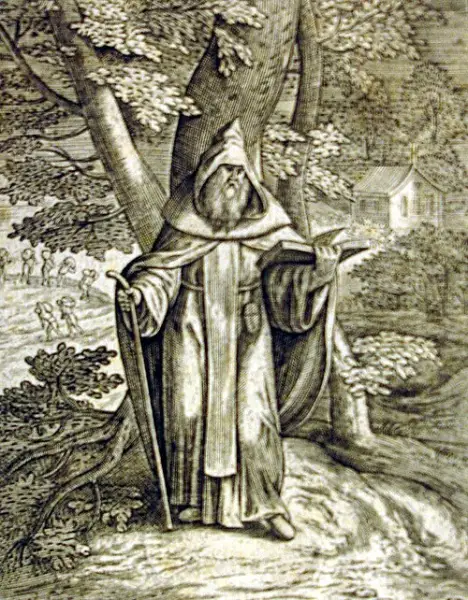
Paphnutius of Thebes, also called Paphnutius the Confessor, was an Egyptian ascetic and bishop whose name became attached to one of the most consequential episodes of the First Council of Nicaea. Born around 251, he was a disciple of Anthony the Great, the father of monasticism, and in the early fourth century he served as bishop of a city in the Upper Thebaid whose name has not survived. Persecution marked him early: under the Emperor Maximinus he was tortured for the faith, losing his right eye and being hamstrung on the left side, before being condemned to labor in the mines. The wounds left him a living testimony, a confessor honored wherever he went. In 325 he attended the First Ecumenical Council at Nicaea, where, according to ancient authors, the assembled bishops were inclined to impose strict continence on all married clergy. Paphnutius, himself celibate from his earliest years, rose to urge that the Church not separate from their wives those men who had married before ordination, invoking the ancient tradition of the Church; his plea prevailed. He was greatly honored by the Emperor Constantine, and in 335 he joined forty-seven other Egyptian bishops and Potomon of Heraclea in accompanying Saint Athanasius to the Synod of Tyre. He remained a zealous opponent of Arianism until his death in the fourth century.
The Complete Life
Disciple of Anthony in the Thebaid
Paphnutius was an Egyptian by birth, born around the year 251 in the age when the Church of his homeland was being purged by persecution and purified by the desert. He attached himself as a disciple to Anthony the Great, whose withdrawal into the Egyptian wilderness had drawn countless imitators and given birth to Christian monasticism. From Anthony he learned the disciplines of prayer, fasting, and continence that he would observe with the strictest rigor for the whole of his life. In the early fourth century his path led from the desert to the altar: he became bishop of a city in the Upper Thebaid, the stretch of the Nile valley south of Thebes where so many of the first monks and martyrs had their home. The name of his see has not come down to history, but the character of its bishop has. He bore in his body the marks of the confessors, and the ancient Church accorded special reverence to those who had suffered for the faith without dying under the executioner's hand. The combination was rare and powerful: the ascetic training of Anthony's school joined to the pastoral office of a bishop, in a province where the memory of martyrdom was fresh in every Christian household and where the desert still stood at the edge of every village.
§ Life
Confessor Under the Persecution
The faith that Paphnutius professed cost him dearly. Under the Emperor Maximinus he was arrested for his Christian beliefs and subjected to a mutilation designed to leave him alive but broken: his left side was hamstrung, destroying the use of his leg, and his right eye was torn out for the faith. Nor did his torment end there, for he was subsequently condemned to the mines, the cruelest punishment the Roman state reserved for those it wished to wear away slowly through forced labor in disgrace and darkness. By the standards of the age, a man who emerged from such torments alive carried an authority no title could confer. The Church called such survivors confessors, and held them in honor second only to the martyrs themselves. When Paphnutius later stood before emperors and councils, he did so with one eye and a ruined leg, a living page of the Church's book of sufferings. The Emperor Constantine himself was said to have honored him greatly at Nicaea, treating the scarred Egyptian bishop with a veneration that acknowledged what his wounds proclaimed. It was this authority, earned in the mines and sealed in his flesh, that would give decisive weight to the words he spoke when the greatest council of the ancient Church turned to the question of the married clergy.
§ Life
The Bishop Who Saved Marriage at Nicaea
The First Ecumenical Council, gathered at Nicaea in 325, took up among its many questions the subject of clerical celibacy. Most of the bishops present seemed ready to imitate the rule set twenty years earlier at Elvira, which had forbidden conjugal relations to bishops, priests, deacons, and subdeacons who had been married before their ordination. Against this severity Paphnutius rose, and ancient authors have preserved the substance of his plea. With urgent pleading he begged his brother bishops to spare the married clergy so heavy a yoke, pointing instead to the Church's ancient custom: only men already celibate at their ordination should be bound to continence, while no man should be separated from the wife to whom he had been united before receiving orders. The force of his plea came from his own life: the deep respect he commanded, joined to the fact known to all that he had kept chastity with the utmost rigor from his earliest years, left no one room to accuse him of pleading his own cause. His proposal was adopted unanimously, and the council left married clergy to their own discretion in continuing or ending their marital relations. The scarred confessor had preserved for the whole Church a balance between the honor of celibacy and the dignity of marriage.
§ Life
Orthodoxy and the Desert Tradition
The spirituality of Paphnutius joined two great streams of Egyptian Christianity: the ascetical inheritance of the desert and the doctrinal fidelity of the episcopal office. From Anthony he had received a formation in which continence was not a burden imposed from outside but a joy freely chosen, and this explains both the severity of his own life and the gentleness of his conduct toward others. He never asked of married clergy a renunciation he had not himself made; rather, having embraced chastity willingly from his youth, he understood that a vow loses its meaning when it is exacted by force. The same conviction that shaped his counsel at Nicaea shaped his theology: he fought zealously for orthodoxy wherever the Arian teaching threatened it, a doctrine that denied the full divinity of the Son of God. His fidelity was not the quiet fidelity of the desert cell but the public fidelity of a bishop who traveled across the eastern Mediterranean to stand with Athanasius. In 335 he joined Potomon of Heraclea and forty-seven other Egyptian bishops in accompanying Saint Athanasius to the First Synod of Tyre, the assembly designed to break the great defender of Nicaea. The Egyptian bloc of bishops, of which Paphnutius was a prominent member, stood firm for the Nicene faith, carrying the desert's loyalty to the Incarnate Christ into the councils of the empire.
§ Life
Memory and Disputed History
The veneration of Paphnutius has endured in both East and West: the Eastern Orthodox Church, the Roman Catholic Church, and Oriental Orthodoxy all honor him, keeping his feast on 11 September. Yet his memory has also been the object of one of the longest debates in church history. The historian Friedrich Winkelmann has contested his very existence, observing that Athanasius, who fought the same battles, never mentions him, and that the Church History of Socrates Scholasticus, the earliest surviving source, stands nearly alone as a witness. His presence at Nicaea has been disputed by Alfons Maria Cardinal Stickler, who notes that the council's historian Eusebius of Caesarea never mentions him, that Socrates was born too late to have spoken with a council member as he claimed, and that the Synod of Trullo in 691 omitted the Paphnutius story when it allowed marriage to priests. On the other side, eminent scholars have defended the tradition: Karl Josef von Hefele set out the classic case in his Conciliengeschichte of 1855, taken up by Franz Xaver von Funk, by Elphège Vacandard in the Dictionnaire de théologie catholique, and by Henri Leclercq. Alban Butler judged nothing in the narration repugnant, and Rufinus expressly attests the bishop's presence at Nicaea, leaving the confessor of the Thebaid an honored and debated figure still.
§ Historicity
Timeline
- 251
Born in Egypt around this year.
§ Life
- 325
Attended the First Council of Nicaea and persuaded the bishops not to forbid marital relations to clergy married before ordination.
§ Life
- 335
Traveled with Saint Athanasius to the First Synod of Tyre alongside Potomon of Heraclea and forty-seven other Egyptian bishops.
§ Life
The Record
- Canonization
- Pre-congregation canonization; venerated as a confessor from the age of the martyrs
Prayer
Bibliography
Show 8 sources
- Butler, Alban. "Saint Paphnutius, Bishop and Confessor". Lives of the Fathers, Martyrs, and Principal Saints, 1866. CatholicSaints.Info. 11 September 2016
- Hassett, Maurice. "Paphnutius." The Catholic Encyclopedia Vol. 11. New York: Robert Appleton Company, 1911. 5 August 2018
- Monks of Ramsgate. "Paphnutius". Book of Saints, 1921. CatholicSaints.Info. 24 July 2016.
- "St. Paphnutius", Catholic News agency
- "Свети Пафнутије Исповедник". Вечити православни календар (in Serbian). Retrieved 2024-09-24.
- Winkelmann, Friedrich. "Paphnutios, der Bekenner und Bischof." In: Probleme der koptischen Literatur. Halle 1968, p. 145-153.
- Stickler, Alfons Maria Cardinal: The Case for Clerical Celibacy. San Francisco: Ignatius Press, 1995.
- Hefele, Karl Josef von (Bishop of Rottenburg): Conciliengeschichte. 7 vols, Freiburg, 1855-74. English translation: History of the Councils of the Church, 7 vols, 1871-1882.
Profile text adapted from the Wikipedia article, licensed CC BY-SA 4.0.
Pray with this saint every day
Save St. Paphnutius of Thebes to your favorites, read the full profile, and get feast-day reminders in the Saints app.
Get the Saints AppFree on the App Store for iPhone and iPad