
c. 70 – c. 130·Feast February 22
St. Papias of Hierapolis
Apostolic Father and collector of the Lord's sayings
Overview
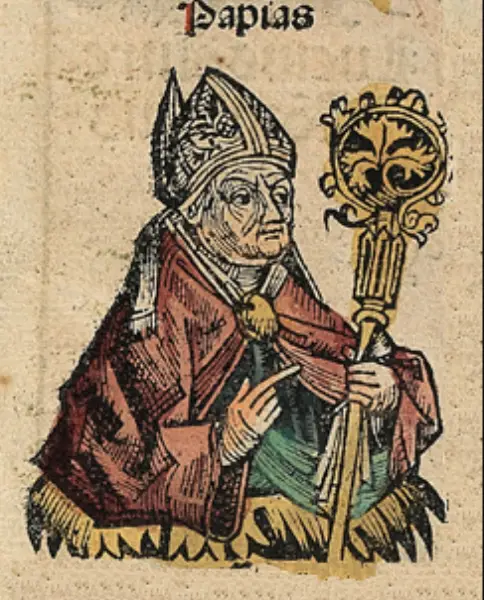
Papias was a Greek Apostolic Father and Bishop of Hierapolis in Phrygia, in Asia Minor, a city whose site is marked by the modern Pamukkale in Turkey. Born around the year 70, he stood at the hinge between the apostolic age and the settled Church of the second century, and he devoted his episcopate to gathering what the immediate disciples of the Lord still remembered. Irenaeus of Lyons calls him an ancient man, a hearer of John, and a companion of Polycarp; Eusebius of Caesarea places him alongside Ignatius of Antioch and Polycarp and pictures him as a learned collector of Christian tradition. Around the year 110 he compiled a five-volume Exposition of the Lord's Sayings, gathering the oral testimony of John the Elder, of Aristion, and of Philip's daughters, who lived at Hierapolis. Though the full text is now lost, excerpts preserved by Irenaeus and Eusebius supply the oldest surviving narrative of the Gospels' authorship, connecting Mark with Peter's preaching and recording that Matthew first arranged the sayings in the Hebrew language. Eusebius derided his intelligence and his literal expectation of an earthly millennium, yet Papias remained a foundational witness to the origins of the canonical Gospels. He died around 130, and his feast is kept on February 22.
The Complete Life
A Man of Hierapolis in the Apostolic Age
Papias belonged to the Greek-speaking Church of Asia Minor, and his very name points to his origins: it was common in the region around Hierapolis, suggesting that he was a native of the area. The city stood in Phrygia, near the Lycus valley, not far from Colossae and Laodicea and within reach of Ephesus, where the aged John dwelt. Although his precise dates cannot be fixed, tradition places his birth around 60 to 70, so that his youth overlapped with the last years of those who had known Jesus in the flesh. He flourished in the early second century as Bishop of Hierapolis, occupying a see that the episcopal lists assign to him before the year 155, with the Apostle Philip among his predecessors by local tradition. The testimonies of his contemporaries sketch the man: Irenaeus, himself a disciple of Polycarp of Smyrna, describes Papias as an ancient man, a hearer of John of Ephesus, and a companion of Polycarp. Eusebius sets him in the same generation as Ignatius of Antioch and Polycarp and portrays a bishop whose consuming interest was the tradition of the Lord's words and deeds. He knew several of the books that would become the New Testament, and he moved among circles where the memory of the Twelve was still carried by living voices.
§ Life
The Inquiry of a Bishop
In the preface to his great work, Papias explained the method that made him unique among the early Fathers. He refused to be impressed by speakers who said much or taught novelties; he sought instead those who delivered the commandments given by the Lord to the faith. Any traveler who had sat at the feet of the elders became for him an interview: he would ask what Andrew or Peter had said, or Philip, or Thomas, or James, or John, or Matthew, or any other of the Lord's disciples, and what Aristion and the presbyter John, disciples of the Lord, were still saying. His informants were remarkable. Aristion was probably the bishop of nearby Smyrna. John the Elder lived in Ephesus and taught Papias directly, and despite Eusebius's protest he is usually identified with John the Evangelist. Philip's daughters, settled at Hierapolis, passed on to him further traditions of the apostolic age. His stated reason has become one of the most discussed sentences in patristic literature: he judged that books could not profit him as much as instruction received from a living, enduring voice. Twentieth-century scholars heard in it the preference of an age that still trusted oral transmission; others reply that the phrase was a standard expression for personal instruction, so that Papias meant simply that direct teaching surpasses even the best books.
§ Sources and methods
The Earliest Account of the Gospels
From this labor of questioning emerged the oldest surviving narrative of Gospel authorship. On Mark, Papias hands on the teaching of John the Elder: Mark, who served as Peter's interpreter, set down faithfully and from memory whatever he recalled of the Lord's words and deeds, though without an ordered arrangement, for he had neither heard the Lord nor accompanied him; Peter had taught in the form of brief anecdotes without intending a systematic arrangement, and Mark's single concern was to omit nothing he had heard and to falsify nothing. On Matthew, his notice was brief: Matthew arranged the sayings in an ordered composition in the Hebrew language, and each reader interpreted them as he was able. Eusebius adds that Papias also drew on the First Epistle of John and the First Epistle of Peter. These testimonies have provoked debate ever since. Some have doubted whether Peter truly stood behind the Gospel as the Elder claimed, even while accepting that John Mark wrote it; the claim that Matthew wrote in Hebrew, echoed by many ancient authorities, has generated theories ranging from an early Semitic recension to a distinct lost work. Yet scholars increasingly weigh in Papias's favor: Ulrich Luz observes that he lived near to the Gospels in both time and place, and was anxious for the tradition of Jesus, and Dale Allison notes that in Jewish antiquity the less brilliant transmitter of tradition was often deemed the more reliable guardian of what was received.
§ Gospel origins
Hope of the Coming Kingdom
Eusebius, concluding his account, condemns Papias as a chiliast who read the Millennium as a literal reign of Christ on earth, charging that his mind was of narrow reach, and blaming his misreadings for leading Irenaeus and others astray. What the historian disparaged was, in fact, a hope drawn from the Lord's own teaching. Irenaeus preserves, from the fourth book of the Exposition, a saying of Jesus recounted by John the Evangelist in which the Lord describes the days to come: vines with ten thousand shoots bearing ten thousand clusters, each grape yielding twenty-five measures of wine, and a single grain of wheat producing ten thousand heads of ten thousand grains each, while the animals that feed on such bounty become peaceful and subject to humankind. These things, the Lord concludes, are believable to those who believe; when Judas the traitor asked how such growth would be accomplished, the answer came that those still alive in that day would see it for themselves. Parallels to this vision have been noted in contemporary Jewish texts such as 2 Baruch, and the picture belongs to the apocalyptic imagination of first-century Christianity rather than to credulity. Papias knew the Revelation of John well and treasured it. Yet his reading of Scripture was not uniformly literal: he is elsewhere said to have understood the six days of Creation mystically, as referring to Christ and the Church, a nuance that complicates the historian's caricature.
§ Eschatology
Death and the Question of Martyrdom
Papias died around the year 130, by the chronology modern scholarship has largely adopted; the claim that he suffered death around 164 belongs to a late and likely mistaken report, usually put down to a mix-up with the martyr Papylus. Two late sources, Philip of Side and George Hamartolus, preserve a further report drawn from the second book of his Exposition: that Papias recorded John, the son of Zebedee, as having been killed by the Jews, in fulfillment of the Lord's prophecy over the sons of thunder. Some modern scholars doubt the reliability of these two late witnesses regarding what Papias actually wrote, while others argue that he did indeed speak of John's martyrdom. Whatever the truth of that particular fragment, the bishop of Hierapolis closed his life in the city of his flock, remembered by the next generation as an ancient man whose memory reached back to the companions of the Lord. He had not written a systematic theology or founded a school; he had done something quieter and, as time proved, more durable. He had asked the old men what they remembered, and had written it down. Within a few decades of his death, Irenaeus was quoting his fourth book as an authority on the words of Jesus, and the tradition he gathered had entered the mainstream of Christian teaching.
§ Death
Fragments, Debates, and Modern Recovery
The five books of his great Exposition vanished at some point after the late Middle Ages, but their contents survived in quotation and summary. Irenaeus of Lyons drew on the fourth book around 180; Eusebius of Caesarea copied excerpts into his Church History around 320, along with notices of Papias's traditions about the death of Judas, and of the woman charged with many transgressions before the Lord, a story resembling the adulteress passage in John's Gospel, the miracle of Justus Barsabbas who drank deadly poison unharmed, and the raising of Manaem's mother. Bauckham argues that the Muratorian Canon drew on Papias, and Hill contends that Eusebius's earlier telling of how the four Gospels arose likewise goes back to Papias. Eusebius held Papias's intellect in low esteem, in all likelihood because he distrusted chiliasm, and modern scholars have continued to debate his reliability as a witness to the Gospel origins. Yet the scholarly consensus has settled on dating his work around 110, and the surviving pieces are reckoned a major early witness to oral Christian tradition and to how the canonical Gospels took shape. Venerated by the Roman Catholic, Eastern Catholic, Oriental Orthodox, and Lutheran traditions, with his feast on February 22, the bishop of Hierapolis stands today as the first Christian whose questioning of the apostolic memory was itself recorded as an act of faith.
§ Gospel origins
Timeline
- 70
Born around this year, traditionally in or near Hierapolis in Phrygia.
§ Life
- 110
Composed his five-volume Exposition of the Sayings of the Lord, the date favored by scholarly consensus.
§ Dating
- 130
Died around this year, by the chronology of Dale B. Martin.
§ Death
- 180
Irenaeus of Lyons quoted the fourth book of his Exposition in his own writings.
§ Eschatology
- 320
Eusebius of Caesarea preserved excerpts of his work in the Church History.
§ Gospel origins
In Their Own Words
I did not think that what was to be gotten from the books would profit me as much as what came from the living and abiding voice.
Mark, in his capacity as Peter's interpreter, wrote down accurately as many things as he recalled from memory—though not in an ordered form—of the things either said or done by the Lord.
Therefore Matthew put the logia in an ordered arrangement in the Hebrew language, but each person interpreted them as best he could.
The Record
- Major works
- Exposition of the Sayings of the Lord (Logion Kyriakon Exegesis), five volumes
- Canonization
- Pre-congregation canonization; honored as one of the Apostolic Fathers
Prayer
Bibliography
Show 10 sources
- Butler, Alban; Burns, Paul, eds. (1998). Butler's Lives of the Saints. Vol. 2. A&C Black. p. 220. ISBN 0860122514.
- Kok, M. J. (2017). Did Papias of Hierapolis Use the Gospel according to the Hebrews as a Source? Journal of Early Christian Studies, 25(1), 29-53. doi:10.1353/earl.2017.0001
- Carlson, Stephen (2025). "The Imposition of Authorship: Michel Foucault's Author-Function and Papias of Hierapolis on the Gospel of Mark". Harvard Theological Review. 118 (2): 242-63.
- Hill, C. E. (2006). Papias of Hierapolis. The Expository Times, 117(8), 309-315. doi:10.1177/0014524606065065
- Huttner, Ulrich (2013). Early Christianity in the Lycus Valley. BRILL. p. 216. ISBN 978-9004264281.
- Bauckham, Richard (2006). Jesus and the Eyewitnesses: The Gospels as Eyewitness Testimony. pp. 417-437. ISBN 0802831621.
- Holmes, Michael W. (2006). The Apostolic Fathers in English. Baker Academic. ISBN 0801031087.
- MacDonald, Dennis R. (2012). Two Shipwrecked Gospels: The Logoi of Jesus and Papias's Exposition of Logia about the Lord. Atlanta: Society of Biblical Literature. ISBN 978-1589836914.
- Shanks, Monte A. (2013). Papias and the New Testament. Eugene, Oregon: Pickwick Publications.
- Norelli, Enrico (2005). Papia di Hierapolis, Esposizione degli Oracoli del Signore: I frammenti. Paoline. ISBN 8831527525.
Profile text adapted from the Wikipedia article, licensed CC BY-SA 4.0.
Pray with this saint every day
Save St. Papias of Hierapolis to your favorites, read the full profile, and get feast-day reminders in the Saints app.
Get the Saints AppFree on the App Store for iPhone and iPad