
10th/11th century·Feast October 27 (Gregorian calendar; October 14 Julian)
St. Paraskeva of the Balkans
Ascetic of Epivates and patroness of needle workers
Overview
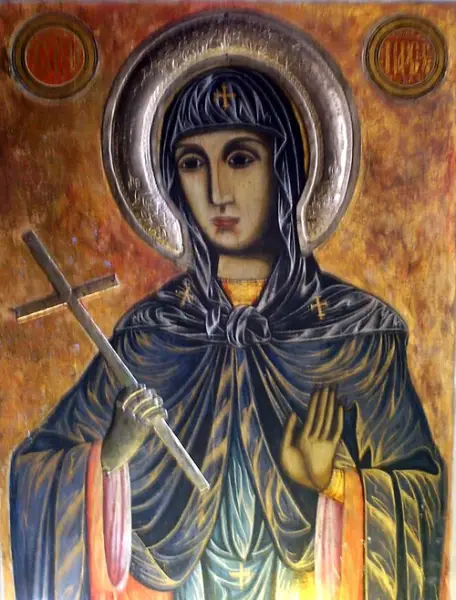
Paraskeva of the Balkans, also beloved as Petka, was an ascetic of the eleventh century whose short life and far-traveled relics made her one of the most venerated women saints of the Orthodox world. Born in Epivates, a town on the Sea of Marmara near Constantinople, to wealthy landowners, she heard as a child in church the Lord's command to deny oneself, take up the cross, and follow Him, and determined to give her rich clothes to the poor and flee. Her parents, who opposed her ascetic resolve, searched for her in city after city. She passed through Chalcedon and lived at the church of the Most Holy Theotokos in Heraclea Pontica in Bithynia, leading an austere life marked by visions of the Virgin Mary. She journeyed to Jerusalem with the wish to end her days there, then withdrew to a monastic house in the Jordan wilderness. At twenty-five an angel directed her to return to her homeland; she died two years later, at twenty-seven, in the village of Kallikrateia. Her grave, long forgotten, was rediscovered when her incorrupt body was unearthed, and her relics began a journey across the Balkans: to Veliko Tarnovo in 1238, Belgrade in 1393, Constantinople in 1521, and in 1641 to Iași in Moldavia, where hundreds of thousands of pilgrims still gather each October.
The Complete Life
A Daughter of Epivates
Paraskeva first saw the light at Epivates, a town on the Marmara coast not far from Constantinople, a place known today as Selimpaşa in the Istanbul region of Turkey. Her parents were wealthy landowners, and by every outward measure she was destined for the comfortable life of a provincial family of means. Her Greek name, Paraskeuē, carried a meaning that would shape her whole afterlife in popular devotion: it means the preparation of the Sabbath, understood as Friday, the day of the Crucifixion, and in the languages of the Slavic and Romanian peoples who later honored her it was rendered literally as Saint Friday. As a child she was found in church among the worshipers when she heard the words of the Lord from the Gospel: whoever wishes to come after Him must deny himself, take up his cross, and follow. Those words, so the tradition relates, settled upon her heart and determined the course of her life. While still young she gave her rich clothing away to the poor and fled her father's house for Constantinople. Her mother and father, unwilling to accept the ascetic and religious path she had chosen, hunted for her from city to city, but the girl who had left home had disappeared into the vast Christian world of the eastern provinces.
§ Life
The Flight to the Ascetic Life
The path of Paraskeva's vocation led first to Chalcedon in Asia Minor, and afterwards to Heraclea Pontica in Bithynia, where she took up residence at the church of the Most Holy Theotokos. There she embraced an austere life, given to fasting, vigil, and prayer, and there, according to the account of her life, she was granted visions of the Virgin Mary that confirmed her in her chosen course. Her longing for the places made holy by the Lord drew her at length on pilgrimage to Jerusalem, where she wished to spend the remainder of her days. Having seen the holy city, she made her home instead in a monastic community out in the Jordan wilderness, joining the ascetics who had carried monastic life back to the wilderness where John had preached and where the Lord himself had fasted. The refusal of her parents, the flight from wealth, the wandering from shrine to shrine, and the final withdrawal to the desert form a classic pattern of early Byzantine female asceticism, in which a daughter of the world became a stranger to it for the sake of the Kingdom. She was still in her twenties, a woman of no office and no fame, known only to the communities of prayer among which she moved and to the heavenly visitor her biographers say she encountered.
§ Life
The Angel's Command and the Return Home
At the age of twenty-five, according to the narrative of her life, an angel appeared to Paraskeva with a command that reversed the direction of her pilgrimage: she was to return to her homeland. The ascetic who had fled family, wealth, and country in obedience to the Gospel was now sent back toward all she had left, and her obedience was as complete on the road home as it had been on the road out. She returned first to Constantinople and then settled a short distance to the west, passing her final two years at Kallikrateia and dwelling at the church of the Holy Apostles in that village. There she died at the age of twenty-seven, a young woman whose entire adult life had been given to self-denial, prayer, and the visions said to have accompanied her. The village of her death has long since changed: the former Kallikrateia is now a neighbourhood of Eastern Thrace called Mimarsinan. Her spirituality, as the tradition preserves it, joined the contemplative withdrawal of the desert convent to a final hiddenness in a village church, dying not among the famous monasteries of Constantinople but in an obscure parish of Thrace, where her grave was dug, filled, and in time forgotten by all but God.
§ Life
The Forgotten Grave and the Incorrupt Body
For many years after her death Paraskeva's grave in Kallikrateia lay unmarked and unknown. The tradition relates that a change came when a person described as an old sinner was buried beside her long-forgotten resting place, and that Paraskeva came in a dream to a monk of the place, grieved that an impure neighbor now lay beside her. In the same vision she revealed to the monk the place where she had been buried. When the ground was opened and the body unearthed, it was found to be incorrupt, the sign by which the Orthodox Church has always recognized the bodies of the saints. The relics were translated with honor to the church of the Holy Apostles in Kallikrateia, the same church where she had passed her final years, and from that recognition her public veneration began. The story of the forgotten grave, the displeased saint, and the monk's dream belongs to the classic form of the inventio, the finding of a saint's remains, and it marks the transition of Paraskeva from the hiddenness she had chosen to the publicity she could not escape. The ascetic who had fled the world became, through her body, a presence that the world would pursue across four countries and eight centuries, from the Sea of Marmara to the Carpathians.
§ Discovery
Veneration, Hagiographers, and a Saint's Many Names
No formal act of canonization is recorded for Paraskeva; she belongs to the saints whom the Church recognized through the spread of her cult. Her veneration began to spread in the fourteenth century from Bulgaria into the Danubian Principalities of Wallachia and Moldavia, and in the same century Bishop Euthymius of Tarnovo, who lived from 1332 to 1402, composed his notable Hagiography of Saint Petka of Tarnovo, drawing on the Greek vita that the deacon Basilikos had written in 1150 at the request of Patriarch Nicholas IV Mouzelon of Constantinople. Later hagiographers kept her memory in constant retelling: Metropolitan Mattheos of Mira wrote her life in 1605, Metropolitan Varlaam of Moldavia in 1643, Nikodimos the Athonite in the nineteenth century, and the Romanian bishop Melchisedec of Roman published his life and miracles of the saint with a history of her relics in 1889. Her identity, however, became entangled in a famous confusion. Because her Greek name means Friday, it was translated literally as Saint Friday in Serbian and Romanian, and scholars sometimes connected the translated name with figures of Slavic folk tales. Her cult merged with that of the third-century virgin martyr Paraskevi of Iconium and with a pre-Christian Slavic deity of Friday known as Petka, Pyatnitsa, or Zhiva, so that one scholar could ask whether the maiden, the personification of the day, and the saint of the Slavs were one figure or three.
§ Veneration
A Relic Road Through the Balkans
The relics of Paraskeva made one of the longest journeys of any saint's remains, tracing in bone the shifting frontiers of the Orthodox world. From Kallikrateia they were taken in 1238 to Veliko Tarnovo, the capital of the Second Bulgarian Empire, where she is honored as Sveta Petka Tarnovska. In 1393 they were moved to Belgrade and the Ružica Church; when that city fell to the Ottomans in 1521 they were carried to Constantinople itself. In 1641 they came to the Trei Ierarhi Monastery in Iași, in Moldavia, now the eastern part of Romania, and in 1888 to the Metropolitan Cathedral of Iași, where they remain. In the drought of 1946-47, Metropolitan Justinian Marina permitted the first procession of her coffin through the deserted villages of eight counties of Moldavia, and the money raised on the route went to orphans and widows, to the disabled, to school canteens, to churches still being built, and to monasteries that fed ailing monks. Today the pilgrimage to her shrine in the Metropolitan Cathedral of Iași is one of the major religious events of Romania: hundreds of thousands gather each year on the second weekend of October, while the city holds its Celebration Days at the same time. Churches bear her name from Nesebar and Sofia to Belgrade, Skopje, and Croatia, and in her birthplace of Epivates a church stood over her birth house, remembered since the thirteenth century, until its demolition in 1979.
§ Relics' journey
Timeline
- 1150
Deacon Basilikos wrote the Greek vita of Paraskeva at the request of Patriarch Nicholas IV Mouzelon of Constantinople.
§ Hagiographies
- 1238
Her relics were carried from Kallikrateia to the Bulgarian royal city of Veliko Tarnovo, seat of the second empire of the Bulgarians.
§ Relics' journey
- 1393
The relics were transferred to Belgrade and enshrined in the Ružica Church.
§ Relics' journey
- 1521
When Belgrade fell to Ottoman forces, the relics were moved for safety to Constantinople.
§ Relics' journey
- 1641
The relics were transferred to the Trei Ierarhi Monastery in Iași, Moldavia, in present-day Romania.
§ Relics' journey
- Aug 1817
A great fire completely destroyed the church built over her birthplace at Epivates.
§ Birthplace church in Epivates
- 1820
The Epivates church was rebuilt with support from the citizens of Constantinople and Prince Alexander Kallimachi.
§ Birthplace church in Epivates
- 1888
Her relics were transferred to the Metropolitan Cathedral of Iași, their home today.
§ Relics' journey
- 1947
During the severe drought of 1946-47, Metropolitan Justinian Marina permitted the first procession of her relics through the villages of Moldavia.
§ Modern-day veneration in Romania
In Their Own Words
Was Parasceve, or Paraskeva, an early Christian maiden named in honor of the day of the Crucifixion? Or was she a personification of that day, pictured cross in hand to assist the fervor of the faithful? And was the Paraskeva of the South Slavs the same who made her appearance in northern Russia?
The Record
- Patron of
- embroiderers, needle workers, spinners, weavers
- Canonization
- Pre-congregation canonization; veneration spread through the Orthodox East from the 14th century
Prayer
Bibliography
Show 10 sources
- "Saint Petca Parasceva". Patron Saints Index. 2010. Archived from the original on June 15, 2010. Retrieved March 31, 2010.
- "Venerable Paraskevi (Petka) of Serbia". www.oca.org. Retrieved 2024-10-03.
- Petkov, Kiril. The Voices of Medieval Bulgaria, Seventh-Fifteenth Century: The Records of a Bygone Culture, Volume 5. BRILL, 2008. ISBN 90-04-16831-1, p. 274.
- "St. Petca-Parasceva". Orthodox America. 2010. Archived from the original on January 11, 2001. Retrieved April 1, 2010.
- Riasanovsky, Nicholas Valentine; Struve, Gleb; Eekman, Thomas. California Slavic Studies, Volume 11. University of California Press, 1980, p. 39.
- Hubbs, Joanna. Mother Russia: the feminine myth in Russian culture. Indiana University Press, 1993, p. 117.
- Rybakov, Boris (2010). "Ancient Slavic Paganism". Bibliotekar.ru. Retrieved April 1, 2010.
- Life of Saint Paraskeva by Bishop (Saint) Evtimy of Tarnovo. Romanian title: Viața Sfintei Parascheva, de Sfântul Eftimie din Tarnovo, Editura Agapis.
- Life and miracles of Saint Paraskeva the New and the History of Her Relics, by Bishop Melchisedec of Roman. București, 1889.
- "Dobrogea". Centrul de pelerinaj. 2010. Archived from the original on August 13, 2009. Retrieved March 31, 2010.
Profile text adapted from the Wikipedia article, licensed CC BY-SA 4.0.
Pray with this saint every day
Save St. Paraskeva of the Balkans to your favorites, read the full profile, and get feast-day reminders in the Saints app.
Get the Saints AppFree on the App Store for iPhone and iPad