
c. 117 – c. 180·Feast July 26
St. Paraskevi of Rome
Second-century martyr and healer of the blind
Overview
Paraskevi of Rome is honored as a Christian martyr of the second century, remembered chiefly as a healer of the blind. Born near Rome to Agathon and Politia, Christians of Greek origin who had long prayed for a child, she received a name meaning Friday in Greek, because she was born on the day of the Lord's suffering. Raised in the faith and well educated, she refused marriage and, after her parents died, gave away her possessions and set out to preach. Arrested repeatedly over the following decades, she endured torments under the emperors Antoninus Pius and Marcus Aurelius without renouncing Christ. Tradition records that her endurance under torture brought many onlookers to baptism, that a blinded emperor recovered his sight through her prayer, and that a deadly serpent fell dead before her sign of the cross. Her final arrest came at the hands of the official Tarasius, who had her beheaded after the idols of a pagan temple shattered at her entrance. Her cult spread through the Orthodox and Eastern Catholic worlds, where she is commemorated on July 26 and invoked against diseases of the eyes, and her relics were venerated in Constantinople by the year 1200.
The Complete Life
A Child Born on Friday
Paraskevi's birth took place in a village in the Roman countryside, most probably under the reign of the emperor Hadrian, which spanned the years from 117 to 138. Her father Agathon and her mother Politia were Christians of Greek descent who had begged God for many years to grant them a child. When Politia at last bore a daughter, the infant arrived on a Friday, the day on which Christians remembered the passion of the Lord. The parents saw providence in the timing and named the girl Paraskevi, the Greek word for Friday, which literally means the day of preparation for the sabbath, the term the Gospel of Mark uses for the day of the crucifixion. The child grew into a devout and learned woman. She studied her faith diligently and became well read at a time when educated Christian women were rare. Suitors sought her hand, but she declined them all, keeping herself for the service of the Church. The household that had prayed so long for her birth became the first school of her discipleship, and the memory of her parents' petitions shaped a life that would later be poured out for the Gospel.
§ Early life
Preacher in the Cities of the Empire
When Agathon and Politia died, Paraskevi inherited their estate and promptly disposed of it, distributing her goods to the poor in the manner counseled by the Gospel. Freed of property and family obligations, she undertook the work of an itinerant preacher of the Christian faith, an extraordinary vocation for a woman of the second century. At about the age of thirty she left Rome and began to move through the towns and villages of the eastern provinces, teaching Christ wherever she was received. Her preaching was not a private piety but a public act, carried out in communities where the name of Christ could attract the attention of imperial officials. The tradition presents her as a tireless traveler who made the roadside her monastery and the marketplace her pulpit. The towns she visited included Therapia near Constantinople, where her word would soon bring her before a tribunal. In this way a daughter of Rome, named for the day of the crucifixion, carried the message of the cross across the Greek-speaking world, preparing by her words and still more by her sufferings the harvest of conversions that followed her everywhere.
§ Early life
Before the Emperors
In the village of Therapia near Constantinople, soldiers of Antoninus Pius arrested Paraskevi and brought her to trial on a charge of blasphemy, blaming her words for the calamities that had recently struck the empire. The emperor himself examined her, urged her to abandon her faith, and according to some accounts even proposed marriage. She refused, and the tortures began: a steel helmet, its lining studded with nails, was bound upon her head and screwed tight by a vice. No torment broke her, and her endurance converted many of the bystanders. At his wit's end the emperor ordered her plunged into a great kettle of oil and tar, yet she emerged without injury. Accused of sorcery, she flung the boiling liquid into his face, and he was blinded. In his agony he begged the help of the woman he had tortured; she restored his sight, and the miracle moved Antoninus Pius to believe in Christ, to free her, and to cease persecuting the Christians. Under his successor Marcus Aurelius the laws turned harsh again, for the Antonine Plague led many, including the emperor, to blame the gods' anger on the Christians. In a city whose governor, a man called Asclepius, had her seized, she was cast into a pit together with a great serpent; she signed herself with the cross and the snake dropped dead. Asclepius believed and released her, and she pressed on from city to city.
§ Persecution
Faith as Her Namesake
The hymnody of the Orthodox Church captures the inner logic of Paraskevi's life: the dismissal hymn in her honor declares that she worshipped with the readiness her name bears and obtained faith as her dwelling place. Preparedness of heart, in her story, mattered more than any single exploit. From her parents she inherited a faith that had been sought in long prayer before she was ever born, and she repaid that inheritance by making her whole existence an act of preparation for encounter with Christ. Her characteristic gesture in the martyrdom accounts is the sign of the cross, made at the decisive moment: before the serpent in the pit, and again in the Temple of Apollo. In that sign she confessed the power she would never deny under torture. Her healing of the blinded emperor reveals the shape of her spirituality as well; she answered violence not with retaliation but with restoration of sight, turning her persecutor into a witness. Later generations understood her intercession in the same key, calling her temple a spiritual clinic in the kontakion sung on her feast, a place where the faithful come for the healing she poured out on earth and continues to dispense from heaven.
§ Hymns
The Temple of Apollo and the Sword
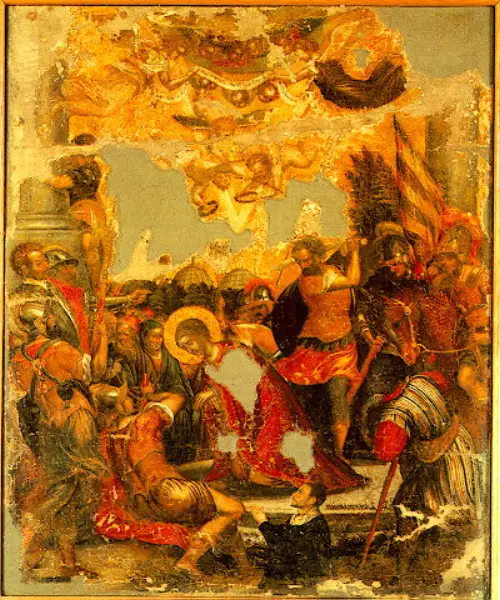
Paraskevi's travels ended when she fell into the hands of a Roman official named Tarasius, who had her taken to the Temple of Apollo, apparently intending to force her to sacrifice to the god. She entered the pagan sanctuary and marked herself with the sign of the cross, and at that gesture every idol in the temple was shattered. The account notes a tragic reversal: where her earlier miracles had melted persecutors into converts, this sign hardened the onlookers into a mob. Enraged at the destruction of their gods, the crowd seized and beat her, and Tarasius pronounced the sentence of death by beheading. An alternate strand of Orthodox tradition compresses the final sequence, holding that Asclepius and Tarasius arrested her at the same time, so that the governor who marveled at the serpent lying dead in the pit wished to release her while the harder official demanded her execution once the idols had fallen. Whichever shape the tradition takes, the outcome is the same: the woman named for the day of the Lord's death was condemned around the year 180 to die as her Lord had died, condemned unjustly and put to the sword, winning by her blood the crown the Church has never ceased to honor.
§ Death
Feast and Veneration
Paraskevi never passed through a formal process of canonization; the Church recognized her martyrdom from the earliest generations and enrolled her among the saints by continual liturgical commemoration. She is venerated today in the Eastern Orthodox Church and the Eastern Catholic Churches, and the Catholic calendar of martyrs also honors her. Her feast falls on July 26 and is kept with a Matins service followed in the morning by the Divine Liturgy of Saint John Chrysostom. The appointed scripture readings at the liturgy are Galatians 3:23 to 4:5 and Mark 5:24 to 34, the passage of the woman healed of hemorrhage after twelve years, a reading suited to the great healer of the blind. Two hymns anchor her celebration. The apolytikion, in the First Tone, greets her as a champion who worshipped with the readiness her name implies and obtained faith as her abode, and who now pours forth healing for our souls. The kontakion, in the Plagal of the Fourth Tone, hails her temple as a spiritual clinic where the faithful gather to honor the venerable martyr. In popular devotion she stands foremost among the female healing saints, invoked with confidence for every affliction of the eyes.
§ Veneration
Relics, Legends, and Enduring Miracles
At some uncertain date the remains of Paraskevi were translated to Constantinople, where they were being shown to pilgrims by about the year 1200. Her cult also took deep root in Epirus, in northwestern Greece, where a strong local tradition insists that she was martyred not in Rome but in Thesprotia, on the spot where the Monastery of Saint Paraskevi of Pounta stands beside the river Acheron. According to this account her executioners dragged her to the river's edge to behead her, and as the sword was lifted she seized a stone pillar and gripped it so hard that the imprint of her hands melted into it, leaving a mark that pilgrims venerated for centuries. A church rose over the tomb and housed her relics; her skull was later set into the church walls and is kept today at the Moni Petraki in Athens. Pilgrims chipped away fragments of the miraculous pillar as talismans until, by 1960, the stone had been reduced to half its original size. The tradition of Epirus also records that her wonders did not end with her death: at her tomb the blind recovered sight, barren women conceived, and the lame rose and walked, while even the dirt of her grave was believed to carry power from God.
§ Legends
Timeline
- 117
Born near Rome to Agathon and Politia, Christians of Greek origin, during the reign of Emperor Hadrian.
§ Early life
- 180
Beheaded on the order of the official Tarasius after the idols of the Temple of Apollo were destroyed at her entrance.
§ Death
- 1200
Her relics were exhibited in Constantinople so that pilgrims could venerate them.
§ Veneration
- 1960
Pilgrim devotion had reduced the stone pillar she grasped at Pounta to half its original size.
§ Legends
In Their Own Words
Appropriate to your calling, O Champion Paraskevi, you worshipped with the readiness your name bears. For an abode you obtained faith, which is your namesake. Wherefore, you pour forth healing and intercede for our souls.
O most majestic One, we have discovered your temple to be a spiritual clinic wherein all the faithful resoundingly honor you, O famed and venerable martyr Paraskevi.
The Record
- Patron of
- healer of the blind·invoked against ailments of the eyes
- Symbols
- depicted holding two eyeballs in her hands
- Canonization
- Pre-congregation; venerated as a martyr since the early centuries of the Church
Prayer
Bibliography
Show 8 sources
- "The Lives of the Saints - St Paraskevi". orthodoxchristian.info. Retrieved 2020-03-27.
- "Saint Paraskevi Greek Orthodox Shrine Church". Archived from the original on 2020-01-22. Retrieved 2020-03-27.
- "Saint Paraskevi". St. Barbara Greek Orthodox Church, Orange, Connecticut.
- "Martyr Parasceva of Rome". Orthodox Church in America. Retrieved 2020-03-27.
- "Antonine Plague". World History Encyclopedia. Retrieved 2020-03-27.
- Russell, Eugenia; Burnand, Teodora (2011). "Donors, Texts and Images. Visualisation of the Hagiographical Cycle of St Panteleimon". Byzantion. 81: 288-325. ISSN 0378-2506.
- Petrova, Maya (2008). "Once Again on the Cult and Hagiographic Texts about St. Paraskeve/Petka of Rome in the South-Slavic Middle Ages". Scripta & e-Scripta. 6: 325-250.
- "Feast of the Holy Righteous Martyr Saint Paraskevi - Feasts of the Church - Greek Orthodox Archdiocese of America". Retrieved 2020-03-27.
Profile text adapted from the Wikipedia article, licensed CC BY-SA 4.0.
Pray with this saint every day
Save St. Paraskevi of Rome to your favorites, read the full profile, and get feast-day reminders in the Saints app.
Get the Saints AppFree on the App Store for iPhone and iPad