
657 – c. 737·Feast October 6
St. Pardulphus
Frankish abbot of Gueret and hermit ascetic
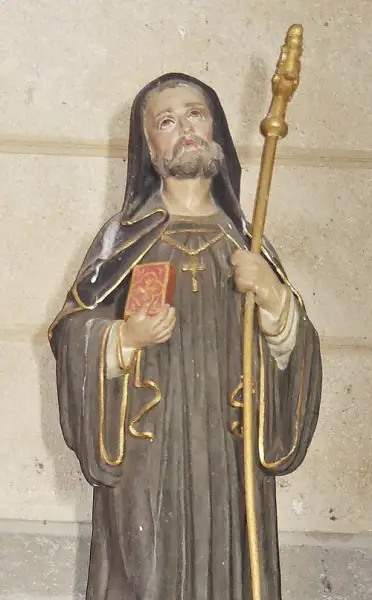
Overview
Pardulphus, also called Pardulf or Pardoux, was a Frankish saint and Benedictine abbot who lived from 657 to about 737. Born to a peasant family at Sardent in Austrasia, he worked as a shepherd in his youth. According to his legend, a terrible storm convinced him to take up the eremitical life, and he later joined the monastery that Count Lantarius of Limoges had founded at Gueret, eventually becoming its abbot. He was famed for harsh penances: he refused all warmth except the rays of the sun, ate only once a week, rejected poultry altogether, and lived largely on the mushrooms the local peasants brought him, though in old age he allowed himself occasional hot stones against the cold. Near the midpoint of the eighth century an anonymous monk of his community set down his life in the Vita Pardulfi, a work that preserves a miracle in which he lengthened timbers cut too short for the church of Saint-Aubin at Gueret. Tradition holds that when Umayyad forces retreated through the region after the Battle of Tours, his monastery was spared, a deliverance attributed to his prayers. His cult endured in the Limousin, where numerous villages still bear his name and his feast is kept on October 6.
The Complete Life
Shepherd of Sardent
Pardulphus was born in 657 at Sardent, a village in Austrasia, the northeastern division of the Frankish realms, in what is now France. His family were peasants, and his early years were spent in the labor and solitude of shepherding, a circumstance his biographers saw as providential training for the pastoral care of souls. The turning point of his youth came, according to his legend, in the midst of a terrible storm. Awed by the manifestation of divine power in the tempest, the young shepherd resolved to withdraw from the world and live as a hermit, seeking God in prayer and austerity rather than in the ordinary life of his village. This decision set him apart from his origins without severing him from them: the peasants of the region around his later monastery would remain his companions in a very concrete way, bringing him the mushrooms on which he chiefly lived. The Vita Pardulfi, written within living memory of his disciples, presents him as a man formed by the soil of the Limousin, whose sanctity grew from peasant endurance raised to heroic discipline rather than from noble birth or courtly learning.
§ Saint Pardulphus
The Monastery at Gueret
The hermit life to which Pardulphus withdrew found its stable form when he joined a monastery at Gueret, in the Limousin, founded by Lantarius, count of Limoges. There he took up the Benedictine discipline and in time was chosen to govern the community as its abbot. His rule of himself was severer than his rule of others: he practiced strict penances, never allowed himself to be warmed by any artificial heat, and ate only once a week. His legend insists that he rejected warmth from every source except the rays of the sun, though as an old man he conceded so far to frailty as to make occasional use of hot stones against the cold. He refused to eat poultry of any kind, sustaining himself instead on the mushrooms that the local peasants carried to him as alms. This regimen was not regarded by his contemporaries as eccentricity but as a living sermon; the abbot who would not be warmed by fire taught his monks and neighbors where his treasure lay. Under such leadership the house at Gueret became a center of sanctity in Aquitaine, and the count's foundation fulfilled its purpose as a stronghold of prayer on the frontier lands of the Frankish south.
§ Saint Pardulphus
The Timber of Saint-Aubin
The Vita Pardulfi records one miracle in detail, and it concerns not healing or exorcism but the plain work of building a church. Carpenters engaged in construction for the church of Saint-Aubin at Gueret cut timber in the forest and hauled it back to the building site on carts, only to discover that the beams had been measured too short for their intended place. The superintendent of the works, furious at the wasted labor, demanded that the carpenters be whipped as punishment for their carelessness. Pardulphus intervened before the lash could fall. By his prayer the wood was made whole, stretching to the proper measure and even surpassing the length first intended, so that the excess had to be sawn off. The trimmed remnants were not discarded: the faithful hung them in the church as objects of veneration, tangible proof of the abbot's favor with God. The story reveals how his sanctity was understood in his own world, where the line between the monastery and the works of everyday life ran thin. The builder's crisis, the threat of the whip, and the carpenters' fear were answered not by rebuke but by abundance, and the church of Saint-Aubin rose with timbers that testified to mercy.
§ Saint Pardulphus
Austerity as Prayer
The spirituality of Pardulphus was one of bodily austerity joined to unceasing intercession. His weekly meal, his rejection of meat and poultry, and his refusal of every fire except the sun were not merely mortifications of appetite; they expressed a conviction that the monk should depend on God and the natural order rather than on human provisioning. The detail of the hot stones in his old age, preserved honestly by his biographer, marks the boundary between heroic asceticism and human frailty, and shows a tradition confident enough to record that even saints grow old and cold. His chief labor, however, was prayer, and it was prayer that his contemporaries credited with the great deliverance of his last years. When Umayyad raiders swept north into France and then fell back in retreat after their defeat at the Battle of Tours, armed men arrived at Gueret. The monastery stood defenseless, yet the forces passed it by, and the region attributed its survival to the intercession of its aged abbot. In this episode the ascetic and the intercessor coincide: a man who had disciplined his body into constant prayer was believed to stand as a stronger rampart than any wall of stone.
§ Saint Pardulphus
Old Age and Deliverance
Pardulphus lived to an advanced age, dying around the year 737 after some eighty years of life. His final years fell in a dark season for Aquitaine, when the Umayyad invasion of southern France brought raids and destruction deep into the Frankish lands. The aged abbot did not abandon his monastery as the danger approached; he remained at his post in Gueret while the armies moved through the country. According to the tradition preserved in his cult, the retreating Umayyad forces, withdrawing southward after their defeat at the Battle of Tours, actually reached the monastery, yet spared it from attack and passed on without harming the community. The preservation of the house was universally attributed to the prayers of its abbot, and the episode became one of the foundations of his renown. He died not long afterward, mourned by the monks he had governed and by the peasants who had fed him mushrooms and received his blessing. The Vita Pardulfi, set down by an anonymous author a few decades after his passing, near the midpoint of the eighth century, fixed the memory of his last years and remains a precious witness to monastic life in Aquitaine in his generation.
§ Vita Pardulfi
Cult and Relics
Pardulphus was never canonized by a formal process; he belongs to the great company of pre-congregation saints whose cult arose spontaneously among the people and was confirmed by liturgical observance. He is venerated in both the Roman Catholic Church and the Eastern Orthodox Church, and his feast is kept on October 6. His cult remained centered in the Limousin, the land of his birth and ministry. A reliquary containing his arm was preserved for centuries at the church of Sardent, the village where he was born, binding his memory to his native soil; in modern times the reliquary was transferred to the Museum of Fine Arts at Gueret, where it can still be seen. Church dedications spread his name across the region: the Church of Saint-Pardoux in Haute-Vienne stands under his patronage, and a whole cluster of French communes, such as Saint-Pardoux-de-Drone, took their very names from him, the vernacular form Pardoux preserving the popular affection in which he was held. Few saints of the Merovingian and Carolingian borderlands left so dense a trace on the map, and the annual observance of his feast has kept his memory alive in the dioceses of central France for well over a millennium.
§ Veneration
The Vita Pardulfi and Its Witness
The chief monument of Pardulphus after his cult is the Vita Pardulfi Abbatis Waractensis, the Life of Saint Pardulf of Gueret, composed around the middle of the eighth century by an anonymous monk. The work is valued by historians far beyond the circle of hagiography, for the insight it offers into daily existence in Aquitaine at the moment when the Frankish south was being contested between the mayors of the palace and the Aquitanian dukes. Of particular interest to modern scholarship is the picture it preserves of Duke Odo of Aquitaine, whom the vita treats with evident esteem. This favorable portrait stands in sharp contrast to the hostile account given by the Continuations of Fredegar, which were compiled at the direction of Duke Childebrand, half-brother of Odo's rival Charles Martel. The vita thus preserves a southern, monastic perspective on the politics of the age, written close to the events and shaped by a community that remembered its abbot's world. Through this text the peasant shepherd of Sardent, who wanted nothing from history, has nonetheless left one of the most informative testimonies to eighth-century Aquitaine, alongside the villages, churches, and reliquary that still carry his name.
§ Vita Pardulfi
Timeline
- 657
Born at Sardent in Austrasia to a family of peasants.
§ Saint Pardulphus
- 737
Died at Gueret after serving as abbot of the monastery founded there by Count Lantarius.
§ Saint Pardulphus
The Record
- Canonization
- Pre-congregation; recognized as a saint by longstanding popular and liturgical cult in the Frankish Church
Prayer
Bibliography
Show 5 sources
- "Mirabile Dictu". CMEMS, University of Colorado, p. 3.
- Riche, Pierre. Daily Life in the World of Charlemagne. University of Pennsylvania Press, 1992, pp. 154-155, 167, 171.
- Fouracre, Paul. The Age of Charles Martel. Pearson Education, 2000. ISBN 0-582-06476-7.
- Gueret, musee des Beaux-Arts.
- LA LEGENDE DE SAINT PARDOUX (in French).
Profile text adapted from the Wikipedia article, licensed CC BY-SA 4.0.
Pray with this saint every day
Save St. Pardulphus to your favorites, read the full profile, and get feast-day reminders in the Saints app.
Get the Saints AppFree on the App Store for iPhone and iPad