
1st century·Feast November 5
St. Parrobus of Pottole
Bishop of the Seventy greeted by Saint Paul
Overview
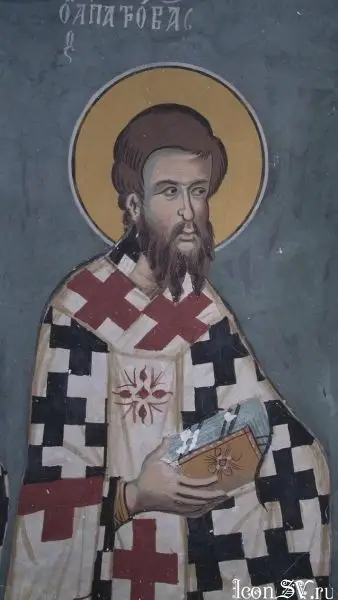
Parrobus of Pottole, whose name appears in Greek as Patrobas and is sometimes rendered Patrobos or Patrobus, belongs to the seventy disciples whom the Lord sent out to preach, and he is one of the few whose name the New Testament itself preserves, for Saint Paul addresses him among the closing greetings of his Roman letter. The tradition of the Church honors him as a bishop, though the ancient sources differ on his see. He is called Bishop of Neapolis, the city that became Naples, while the recounting attributed to Dorotheus associates him instead with Pottole, and both memories have traveled together in his cult. As one of the Seventy he stands in the second circle of the apostolic company, the wider body of witnesses chosen to carry the gospel beyond the Twelve, and his mention in the letter to the Romans shows him in communion with Paul during the apostle's work among the churches. The Church remembers him on November 5, joining him in one feast with his fellow apostles Hermas, Linus, Gaius, and Philologos, several of whom are named in the same chapter of Romans, so that the liturgy keeps together on one day the men whom Scripture salutes in a single breath.
The Complete Life
One of the Seventy
Parrobus is numbered among the seventy disciples, the company beyond the Twelve whom the Lord chosen and sent out to prepare the cities for his coming. In the Church's memory these men and women form the second apostolic rank, witnesses whose names survive only partly in Scripture and partly in the tradition handed down by writers such as Dorotheus, Bishop of Tyre, whose recounting of the choosing of the Seventy was preserved and read in the Orthodox East. Parrobus bears the distinction, rare among the Seventy, of appearing in the New Testament under his own name: in the Epistle to the Romans, among the closing greetings, Saint Paul salutes Patrobas along with the beloved companions of the Roman community. That single verse is the scriptural trace of a whole life of discipleship. It tells of a man known personally to the apostle of the Gentiles, present in the network of believers who carried the gospel from Jerusalem to the capital of the empire, and honored in the congregation that Paul addressed. The vocation of Parrobus was thus apostolic in the fullest sense, belonging to the generation that had seen the Lord and was charged with handing on what it had seen.
§ Parrobus of Pottole
Bishop of Neapolis or Pottole
The tradition assigns Parrobus the oversight of a church as its bishop, though the memory of his see is twofold. He is called Bishop of Neapolis, the ancient name of Naples, which would place his ministry in the Greek-speaking Campania of southern Italy, a land open to the gospel by way of its ports and its Hellenic population. The recounting attributed to Dorotheus, however, connects him instead with Pottole, and the memory of that association is so persistent that the saint is commonly known by it, as his very title shows. Rather than choose between the two, the tradition has kept both, letting the saint stand as apostle of either city, or perhaps as apostle of a region whose communities were joined in one early Christian network. Whatever the precise geography, the substance of the office is clear: Parrobus passed from disciple to apostle, from witness to shepherd, taking responsibility for a local church in the generations immediately after the resurrection. The Greek form of his name suggests a Hellenic milieu, and Naples was precisely such a meeting ground of Greek and Latin Christianity. In either Neapolis or Pottole he would have served as one of the founding bishops of the faith in the Italian peninsula.
§ Parrobus of Pottole
The Feast of November 5
Parrobus has been venerated from the earliest times as one of the Seventy Apostles, without any formal process of canonization; his cult belongs to the common inheritance of the Church. The Church remembers him on November 5, and the choice of that day is itself a piece of apostolic memory: he shares the feast with his fellow apostles Hermas, Linus, Gaius, and Philologos, a company drawn in large part from the same chapter of Romans in which Paul greets Patrobas. The Orthodox tradition, especially as gathered in the Prologue from Ohrid of Saint Nikolai Velimirovic, has preserved and popularized the lives of the apostles of this second rank, and the Orthodox Church in America continues to publish the memory of the Apostle Patrobus of the Seventy for the faithful. The survival of his name from a single Pauline greeting through nineteen centuries of liturgical commemoration is a quiet testimony to the Church's reverence for every witness of the apostolic age. The communities of Campania, above all Naples, have counted him among their first bishops, and his feast on November 5 keeps him joined forever to the friends whom Paul called beloved in the Lord.
§ Parrobus of Pottole
The Record
- Canonization
- Pre-congregation; venerated as one of the Seventy Apostles from the earliest tradition of the Church
Prayer
Bibliography
Show 4 sources
- Romans 16:14.
- Velimirovic, St. Nikolai. The Prologue from Ohrid.
- "Apostle Patrobus of the Seventy". Orthodox Church in America.
- "The Choosing of the Seventy Holy Apostles, as recounted by Dorotheus, Bishop of Tyre". Russian Orthodox Church of St. Nicholas (ROCOR).
Profile text adapted from the Wikipedia article, licensed CC BY-SA 4.0.
Pray with this saint every day
Save St. Parrobus of Pottole to your favorites, read the full profile, and get feast-day reminders in the Saints app.
Get the Saints AppFree on the App Store for iPhone and iPad