
1257 – 1317·Feast September 10
St. Parsoma
Coptic hermit who endured persecution unafraid
Overview
Parsoma the Naked, also known as Barsoum El Arian, was a Coptic saint who lived from 1257 to 1317. Born in Cairo to El-Wageeh Moufdel, scribe of Queen Shajarat al-Durr, and a mother from the noble family of El-Taban, he lost his parents young; when his uncle seized the whole inheritance, he did not quarrel with him but forsook the world entirely. For five years he lived outside the city, exposed to summer heat and winter cold, clothed only in hairy sackcloth after the example of Paul of Thebes. He then shut himself for twenty years in a cave within the church of St. Philopateer Mercurius in Cairo, praying and fasting without cease, and there he befriended and tamed the huge serpent that shared his dwelling through prayer. Afterward he spent fifteen years living on the roof of the church, his skin darkened by worship and asceticism. When a fierce persecution swept Egypt, churches were shut and believers were ordered to don blue turbans; the authorities laid hold of Parsoma, tortured him cruelly, and threw him into jail; on his release he went to the monastery of Shahran and lived on its church roof, wearing his white turban though princes and judges dared not force him to exchange it. He died on September 10, 1317, aged sixty, and Pope John VIII himself presided at his funeral.
The Complete Life
The Scribe's Son of Cairo
Parsoma was born in Cairo around 1257, into a household close to the summit of Egyptian society. His father was El-Wageeh Moufdel, scribe of Queen Shajarat al-Durr, the remarkable ruler of Egypt, and his mother came from the noble family of El-Taban. The boy thus grew up amid wealth, learning, and the politics of the court. His parents died while he was still young, and the trial that followed disclosed the direction of his soul: his uncle took possession of everything the family had left. Parsoma did not contest the seizure, did not plead his rank, and did not quarrel with his kinsman. Instead he renounced his claim altogether and, in the language of the Coptic tradition, forsook the world. The inheritance that others would have fought to recover became for him the door of his vocation; stripped of estate by another's greed, he embraced the poverty he might never have dared to choose. In this decisive renunciation the scribe's son ceased to belong to the court of the queen and placed himself among the poor of Christ, beginning the life of a hermit that would make his name famous throughout Egypt.
§ Early life
Five Years in the Open Air
Leaving the city of his birth, Parsoma lived as a hermit outside Cairo for five years, without shelter from the seasons and without human provision. Summer's blaze and winter's bite were his portion in the open air, and his only clothing a single garment of hairy sackcloth. In this he consciously followed the example of Paul of Thebes, the first hermit of the Egyptian desert, whose legendary life of solitude in skins had shaped centuries of Coptic monastic ideal. The choice of the sackcloth marked him visibly as a man set apart, and the nickname by which he is remembered, Parsoma the Naked, preserves the memory of that near-nakedness before God. The five years in the open were his novitiate, a school in which the body was taught to depend on God alone through deprivation of every comfort. From the wilderness outside the walls he moved inward still further, toward a form of solitude more absolute. The movement of his life ran against the pull of his origins: from palace proximity to city streets, from streets to open country, and at last from country to the silence of a cave in the heart of the church, where his asceticism would enter its most famous chapter.
§ Ascetic life
The Cave and the Serpent
Two decades did Parsoma spend walled within the cave in the church of St. Philopateer Mercurius at Cairo, poured out in unbroken prayer and fasting. The cave, however, was not empty: a huge serpent had made its dwelling there, the very image of the terrors that keep men from solitude. Parsoma did not flee the creature and did not harm it; through his prayers he befriended it and tamed it, and the serpent became his companion in the cave. The story belongs to the oldest tradition of Egyptian monasticism, in which the hermit's holiness is shown by his peace with the wild things that terrify ordinary men, and in which the taming of beasts signifies the taming of the passions. After these twenty years Parsoma left the cave for a new form of witness: he took up his dwelling on the roof of the church, where he remained for fifteen years. Season after season passed over him, and constant devotion turned his skin dark, so that his body became a living record of his prayer. The roof made the recluse visible to the city below, and the darkened figure above the church of St. Mercurius became a standing sermon over Cairo.
§ Ascetic life
Asceticism as Prayer
The spirituality of Parsoma was one of extremity embraced with serenity. His program was not a single heroic act but a lifetime of unrecorded endurance: heat and cold accepted year after year, sleep and food reduced to necessity, and prayer maintained without ceasing through every change of dwelling, from the open desert to the cave to the rooftop. The hairy sackcloth against his skin followed the pattern of Paul of Thebes and bound him to the first fathers of Egyptian monasticism. His asceticism was also marked by an extraordinary gentleness; the serpent of the cave was tamed not by domination but by prayer, and the saint's power over the creature came from his peace. The darkness of his skin, darkened by much worship and asceticism, was read by his contemporaries as a sacramental mark, the outward sign of an interior burning. Most telling of all is what he refused to do: when his uncle seized his inheritance he did not quarrel, and when persecution demanded the blue turban he did not yield, but in both cases the saint's strength lay in quiet, unbending constancy rather than in strife. Parsoma embodies the Coptic ideal of the monk whose whole life is a single extended act of standing in the presence of God.
§ Ascetic life
Persecution and the White Turban
In Parsoma's later years a great persecution befell the Christians of Egypt. The churches were shut, and the faithful were compelled to wear blue turbans, a mark of humiliation imposed by the ruling power. The ascetic of the rooftop could not be overlooked: the authorities laid hold of him, tortured him cruelly, and threw him into jail. Prison could not bend him. Freed, he made his way to the monastery of Shahran and took up his rooftop discipline once more, pressing his austerity further still. There he displayed the defiance for which he is remembered. Princes and judges alike were aware that a white turban never left his head, the covering of a free and honored man, and no one dared to force him to exchange it for the blue cloth of the persecuted. In an age when the mark of faith had been made a badge of disgrace, Parsoma wore the white turban as a public confession, and even the powerful feared to touch it. His final years thus united the two poles of his sanctity, the hiddenness of the ascetic and the public courage of the confessor, and his fame spread among the Christians of Egypt as an assurance that grace could outface the sword.
§ Later life and persecution
Departure and Veneration
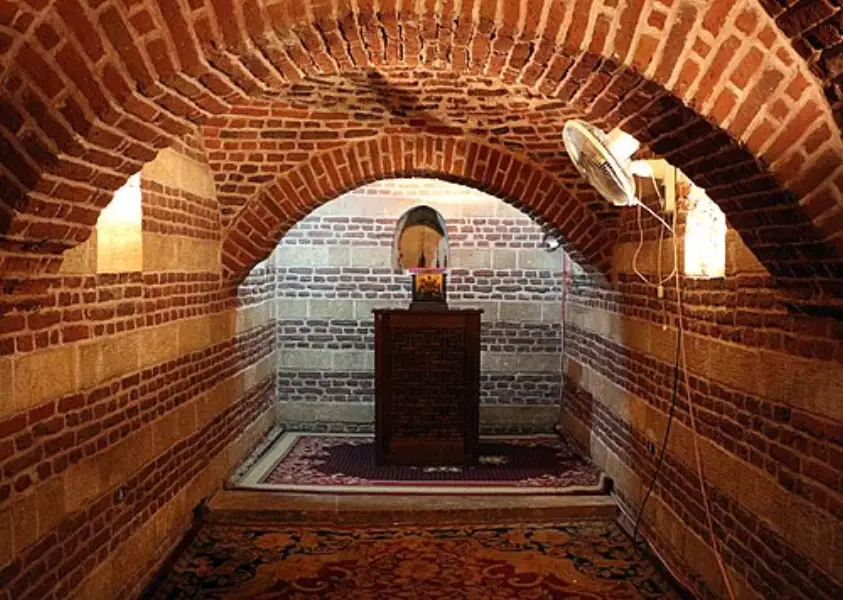
Parsoma died on the fifth day of the Little Month, Koji Enavot, corresponding to September 10, in the year 1317, at the age of sixty. The honor shown him at his death matched the reverence he had won in life: Pope John VIII, patriarch of the Coptic Church, presided over his funeral in person, and the saint was buried at the Monastery of Shahran, the place of his last asceticism. He was never formally canonized; his sanctity was confessed by the Coptic Orthodox Church from the generation that buried him, and he stands in its calendar of monks and anchorites beside Anthony the Great, Pachomius, and Macarius of Egypt. He is remembered under the names that his life generated: Parsoma the Naked, for the sackcloth of his first years, and Barsoum El Arian, the name by which Coptic Christians still invoke him. The church of St. Philopateer Mercurius in Coptic Cairo preserves the memory of his twenty years in the rock, showing pilgrims the prison cell of St. Parsoma, and his story is handed on in the Coptic diaspora as well as in Egypt. His feast is kept on the day of his departure, September 10, when the church gives thanks for the naked, white-turbaned saint of Cairo.
§ Departure
Timeline
- 1257
Born in Cairo to El-Wageeh Moufdel, scribe of Queen Shajarat al-Durr, and a mother of the noble family of El-Taban.
§ Early life
- 1317
Died aged sixty; Pope John VIII personally led his funeral rites, and his body was laid to rest at the Monastery of Shahran.
§ Departure
The Record
- Symbols
- hairy sackcloth·white turban
- Canonization
- Pre-congregation; venerated as a saint in the Coptic Orthodox Church
Prayer
Bibliography
Show 5 sources
- "St Barsoum the Naked" by H. G. Bishop Martyros. ResearchGate website.
- "Presentation on St Barsoum". Website of Saint Mary & Archangel Michael Coptic Orthodox Church, Houston, Texas.
- Meinardus, Otto Friedrich August. Two Thousand Years of Coptic Christianity. American University in Cairo Press, 1999, p. 188.
- "Review of Christianity and Monasticism in Northern Egypt: Beni Suef, Giza, Cairo, and the Nile Delta", edited by Gawdat Gabra and Hany N. Takla (2017). Oxford University Press website.
- "St. Takla Haymanout Coptic Orthodox Website".
Profile text adapted from the Wikipedia article, licensed CC BY-SA 4.0.
Pray with this saint every day
Save St. Parsoma to your favorites, read the full profile, and get feast-day reminders in the Saints app.
Get the Saints AppFree on the App Store for iPhone and iPad