
died 3rd century·Feast May 19
St. Parthenius
Armenian Palace Eunuch Martyred at Rome
Overview
Parthenius was an early Christian martyr of Rome, of Armenian origin, put to death in the third century during the persecution under the emperor Decius. He and his brother Calocerus served as eunuchs in the palace of the empress, the wife of Decius. Accused both of embezzling funds and of the capital offense of Christianity, the brothers let the financial charge go unanswered and defended their faith instead; the court took that defense as proof of their guilt and condemned them both. Parthenius was thrown into a bonfire, but he did not burn, and the guards finished their work by beating him to death with flaming brands snatched from the fire. He was buried in the catacombs beneath Saint Callixtus. A Martyrdom of Calocerus, Parthenius, Victoria, Anatolia and Audax, presumably written in Picenum before the late seventh century, preserved the account. His relics traveled far: moved to Vienna in the eighteenth century, and in 1784, with the permission of Pope Pius VI, to Zhovkva in eastern Galicia, where they remain. He is venerated by Catholics and Orthodox alike and honored as patron of Galicia; his feast falls on 19 May.
The Complete Life
Servants in the Imperial Palace
Parthenius and his brother Calocerus held posts close to the summit of Roman power: they were eunuchs in the palace of the empress, the wife of the emperor Decius, in the middle of the third century. Such men, often of foreign birth, managed the daily life of the imperial household and could rise high in its confidence. The brothers were Armenians by origin, Christians serving within a pagan court, and their position did not shield them when suspicion fell upon it. They were charged with two crimes — embezzlement, and the capital offense of Christianity. The court's procedure, as the martyrdom account preserves it, offered them a way out: only the religious charge carried the true danger, and the accusations over money could have been fought on their own terms. Parthenius and Calocerus ignored the financial charges altogether and defended instead the Christian faith that was the real ground of the case. The judges treated the defense as an admission. A confession of Christ before a Roman tribunal was itself the crime, and the sentence of death followed. Two palace servants, trusted with an empress's household, chose ruin rather than denial.
§ Narrative
Trial and Fire
The execution of Parthenius became the most told part of his passion. He was thrown into a bonfire, and the flames failed to consume him — the account records that he did not burn. The miracle did not spare him; it only changed the manner of his death. Soldiers snatched burning brands from the blaze and battered him with them until he died, so that the fire that would not kill him was made the instrument of his killing. His brother Calocerus suffered with him, and the same act of martyrdom preserves the memory of companion witnesses: Victoria, Anatolia and Audax, witnesses of Rome and Picenum together, whose cult traveled with the brothers' in the liturgical memory of the Adriatic coast. The account itself was set down, so far as can be judged, somewhere in Picenum and before the close of the seventh century — near enough in time to rest on traditions already old. Parthenius was buried with the martyrs in the catacombs beneath Saint Callixtus, the burial ground of the Roman church, where Christians could gather at his grave. In the calendars of both East and West his memorial has remained 19 May.
§ Narrative
From the Catacombs to Galicia
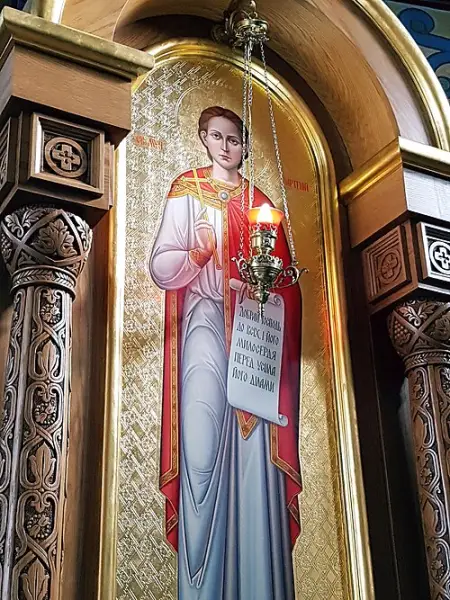
Few martyrs of the early Roman church have followed so long a road after death. Parthenius's relics rested for centuries in the catacombs of Saint Callixtus; in the eighteenth century they were moved to Vienna, capital of the Habsburg monarchy. Then in 1784, with the permission of Pope Pius VI, they were carried east to Zhovkva in eastern Galicia, then a town of the Austrian Empire and today in western Ukraine, and enshrined in the Basilian Ukrainian Greek-Catholic monastery of the Holy Heart of Jesus, where they are preserved still. The journey made an Armenian Roman martyr the treasure of the Greek-Catholic Church of Galicia, which numbers him among its own saints and honors him as its patron. The veneration runs wide as well as far: the Catholic and Orthodox churches alike keep his memory, with a common feast on 19 May. His icon rests above his relics at Zhovkva, in the Church of the Most Holy Heart of Jesus. From a palace household in third-century Rome to a monastery church in Galicia, the relics of Parthenius trace the whole geography of Christian history between his death and our own day.
§ Relics
The Record
- Patron of
- Galicia
- Symbols
- The palm of martyrdom·Flaming brands
- Canonization
- Pre-congregation; ancient martyr cult venerated in the Catholic and Orthodox churches
Prayer
Bibliography
Show 3 sources
- mpignot (2017). "E02486: The Martyrdom of *Calocerus, Parthenius, *Victoria, Anatolia and Audax (martyrs of Rome and of Picenum)". University of Oxford.
- "Православні святині Галичини" [Orthodox Shrines of Galicia] (in Ukrainian).
- "Butler's Lives of Saints: St. Parthenius".
Profile text adapted from the Wikipedia article, licensed CC BY-SA 4.0.
Pray with this saint every day
Save St. Parthenius to your favorites, read the full profile, and get feast-day reminders in the Saints app.
Get the Saints AppFree on the App Store for iPhone and iPad