
1540 – 1592·Feast May 17
St. Paschal Baylón
Franciscan lay brother devoted to the Eucharist
Overview
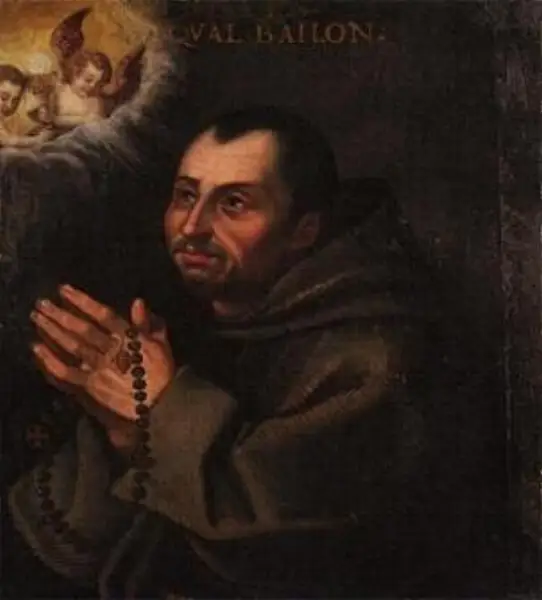
Paschal Baylón was a Spanish lay brother of the Order of Friars Minor, born at Torrehermosa in the Kingdom of Aragon on 16 May 1540. Raised by poor but devout peasant parents, he spent his youth tending sheep, teaching himself to read by asking others for help with words, and sharing his field dinner with the poor. When advisers recommended wealthy monasteries, he answered that he intended to remain poor, and after an initial refusal on account of his age he entered the Reformed Franciscans in 1564, professing vows at the Saint Joseph convent in Orito. He declined ordination, judging the priesthood not his path, and served the friars as cook, gardener, questor, and porter. A threadbare habit, bare feet in the snow, long nights of silent prayer before the altar, and ecstatic visions earned him a reputation for humility, courtesy, and generosity that he himself shrugged off. His devotion centred on the Eucharist: while travelling through France he defended the Real Presence against a Calvinist preacher and narrowly eluded a Huguenot mob that sought his life. He died at Villarreal on 17 May 1592, aged fifty-two. Pilgrims flocked to his tomb at once; he was beatified in 1618, canonized in 1690, and proclaimed patron of Eucharistic congresses and confraternities by Pope Leo XIII in 1897.
The Complete Life
A Shepherd of Torrehermosa
Paschal Baylón came into the world at Torrehermosa, in the Kingdom of Aragon, on the feast of Pentecost in 1540. His parents, Martin and Elizabeth Jubera Baylón, were peasants of little means but strong faith, and local custom required that a child receive the name of the feast on which he was born; he was therefore called Paschal, after the Spanish word for the Pentecost celebration. A brother and two sisters completed the household. From his seventh year until his twenty-fourth he worked as a shepherd, first alongside his father and later hired out to tend the flocks of others to help the household survive. From his mother he received the Little Office of the Blessed Virgin Mary, and since he had no teacher, he learned to read by asking passers-by to help him with difficult words. The poor never left his thoughts: having no money to give, he always set aside a portion of the dinner brought to him in the fields. The rough company of shepherds, given to cursing and quarrelling, learned to watch their tongues around him out of respect for his piety, and his honesty was such that he offered to pay shepherds' compensation for any crops his sheep damaged.
§ Early life
Poverty Chosen Deliberately
When Paschal first spoke of wanting the religious life, well-meaning friends pointed him toward richly endowed monasteries where his needs would be met. His answer became one of the sayings remembered about him: he had been born poor, he said, and was resolved to die in poverty and penance. The Reformed Franciscans at first refused him because of his age, and he returned quietly to the sheepfolds until the door opened. In 1564 he was received among them, beginning his novitiate on 2 February and professing his vows on 2 February 1565 at the Saint Joseph convent in Orito. Superiors urged him toward priestly ordination, convinced his holiness would honour the altar, but he declined, judging that God was calling him to serve as a brother rather than to celebrate at the altar. That choice shaped the rest of his life: he remained a lay brother, taking on the humblest offices of the friary and finding in them his particular way to God. The man who had guarded sheep in Aragon now guarded the friars' door, and the poverty he had chosen as a shepherd became the stable ground of his religious life.
§ Friar
Contemplative in the Kitchen and at the Altar
Within the friary Paschal owned no more than a single habit, and that always threadbare; in winter he walked without sandals through the snow, accommodating himself to every place and season without complaint. His assigned work rotated through the lowliest posts: he cooked, kept the garden, went out begging alms as the community's official questor, and served as porter at the door, where he tended the poor who came seeking help. Guests and brothers alike noticed his humility, unfailing courtesy, and generosity, yet he dismissed any reputation built on his piety. His interior life was marked by contemplation and silent meditation carried on even amid labour, and by frequent ecstatic visions; some nights he spent entirely before the altar in silence. Above all his devotion fixed on the Eucharist, which became the defining mark of his holiness. On a journey through France this devotion turned dangerous: he took issue with a Calvinist preacher over the doctrine of the Real Presence, and an enraged Huguenot crowd came close to killing him for it. He escaped with his life, and the episode only deepened the association between the unlettered Spanish brother and the sacrament he loved.
§ Friar
The Tomb That Drew Pilgrims
Paschal died at Villarreal in the Kingdom of Valencia on 17 May 1592, his fifty-second birthday barely past. His tomb there became an immediate goal for pilgrims, and reports of miracles soon gathered around it. The Church moved swiftly to recognise the brother whose grave drew such crowds: Pope Paul V beatified him on 29 October 1618 at Saint Peter's Basilica in the Papal States, and Pope Alexander VIII canonized him a saint at the same basilica on 16 October 1690. On 15 July 1691 Pope Innocent XII issued Rationi Congruit, the bull that formalized the canonization, fixing the feast of the Franciscan brother a permanent place in the calendar. His fame even crossed the Atlantic in unexpected forms: in 1730 an indigenous Guatemalan claimed a vision of the sainted Paschal appearing as a robed skeleton, and from that report grew the heterodox folk tradition of San Pascualito, a devotion that spread through Central America under his borrowed name. In official devotion, however, the emphasis remained where he had placed it himself: before the Blessed Sacrament, with the monstrance in his hands as the emblem of his life.
§ Veneration
Patron of Eucharistic Congresses
The humble brother from Torrehermosa left a mark far beyond his friary. On 28 November 1897 Pope Leo XIII proclaimed him patron of Eucharistic congresses and confraternities, binding his name officially to the movement of Eucharistic renewal in the modern Church. Towns and parishes across the Spanish-speaking world took his name, from San Pascual in Batangas and Obando in the Philippines to Saint-Pascal in Quebec and the San Pasqual Valley in California. In 1961 Pope John XXIII named him principal patron of the Diocese of Segorbe-Castellón de la Plana, in the region where he had lived and died. Even his remains bore witness to the turbulence of Spanish history: on 13 August 1936, in the Red Terror that swept civil-war Spain, anticlerical militants dug up his remains and burned them, yet what survived of his relics was solemnly moved to a new resting place on 12 May 1992 in the presence of King Juan Carlos I. In art he wears the Franciscan habit and holds a monstrance, a shorthand for the Eucharistic love that made an unlettered shepherd-brother one of the best-loved saints of Spain and Latin America.
§ Veneration
Timeline
- 16 May 1540
Born at Torrehermosa in the Kingdom of Aragon on the feast of Pentecost, to the peasants Martin and Elizabeth Jubera Baylón.
§ Early life
- 2 Feb 1564
Entered the Reformed Franciscans and began his novitiate at the Saint Joseph convent in Orito.
§ Friar
- 2 Feb 1565
Made his religious profession as a Franciscan lay brother at Orito.
§ Friar
- 17 May 1592
Died at Villarreal in the Kingdom of Valencia after falling ill.
§ Friar
- 29 Oct 1618
Beatified by Pope Paul V at Saint Peter's Basilica in the Papal States.
§ Veneration
- 16 Oct 1690
Canonized by Pope Alexander VIII at Saint Peter's Basilica.
§ Veneration
- 15 Jul 1691
Pope Innocent XII published the Bull of Canonization, Rationi Congruit.
§ Veneration
- 1730
An indigenous Guatemalan reported a vision of Paschal as a robed skeleton, giving rise to the San Pascualito tradition.
§ Veneration
- 28 Nov 1897
Pope Leo XIII proclaimed him patron of Eucharistic congresses and confraternities.
§ Veneration
- 13 Aug 1936
In the Red Terror that swept civil-war Spain, anticlerical militants exhumed and burned his remains.
§ Veneration
- 12 May 1961
Pope John XXIII named him patron of the Diocese of Segorbe-Castellón de la Plana.
§ Veneration
- 12 May 1992
His remaining relics were transferred at Villarreal in the presence of King Juan Carlos I.
§ Veneration
In Their Own Words
I was born poor and am resolved to die in poverty and penance
The Record
- Patron of
- Villarreal·Torrehermosa·Alconchel de Ariza·Eucharistic congresses·Eucharistic associations·Obando·Cooks·Shepherds·Male children·Priesthood vocations·Diocese of Segorbe-Castellón de la Plana
- Symbols
- Monstrance·Franciscan habit·Kneeling before the Eucharist
- Canonization
- Canonized by Pope Alexander VIII at Saint Peter's Basilica on 16 October 1690.
Prayer
Bibliography
Show 7 sources
- "San Pasquale Baylon", Santi e Beati, retrieved 13 October 2017
- "Saint Pascal Baylon", Saints SQPN, 8 October 2017, retrieved 13 October 2017
- Foley OFM, Leonard. "St. Pascal Baylon", Franciscan Media, retrieved 13 October 2017
- Staniforth, Oswald. "St. Pascal Baylon." The Catholic Encyclopedia, Vol. 11. New York: Robert Appleton Company, 1911
- Butler, Alban. "St. Pascal Baylon", The Lives or the Fathers, Martyrs and Other Principal Saints, 1864, D. & J. Sadlier & Company
- Acta Ordinis Fratrum Minorum. Ad Claras Aquas, 1897, pp. 207–208
- Feldman, Lawrence H. (1999). The War Against Epidemics in Colonial Guatemala, 1519–1821. C&M Online Media, Inc., pp. 23–27. ISBN 1-886420-60-2
Profile text adapted from the Wikipedia article, licensed CC BY-SA 4.0.
Pray with this saint every day
Save St. Paschal Baylón to your favorites, read the full profile, and get feast-day reminders in the Saints app.
Get the Saints AppFree on the App Store for iPhone and iPad