
785 – 865·Feast April 26
St. Paschasius Radbertus
Carolingian abbot and Eucharistic theologian of Corbie
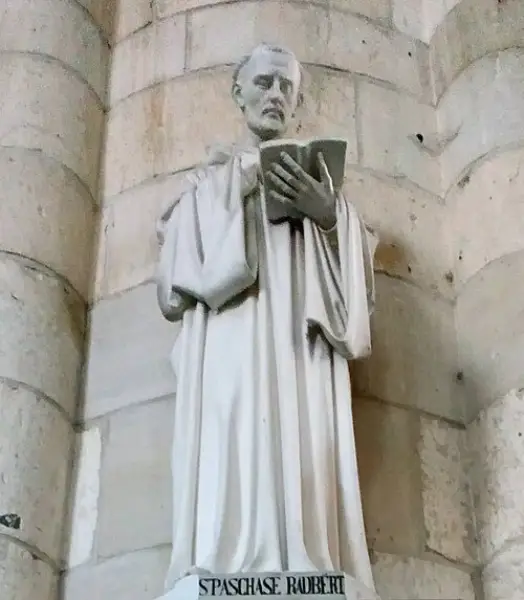
Overview
Paschasius Radbertus was a Carolingian theologian and abbot of Corbie, the Picardy monastery founded in the seventh century by the queen regent Bathilde. Abandoned as a foundling at the door of Notre-Dame de Soissons around 785, he grew up among the nuns there and grew devoted to their abbess, Theodrara, whose brothers Adalard and Wala of Corbie became the models of his life. As a young man he crossed to Corbie to serve under Abbot Adalard, dedicating himself to study and teaching, and in 822 accompanied Adalard into Saxony to help found New Corvey in Westphalia. In 843 he himself became abbot, but resigned the office a decade later, retiring to Saint-Riquier in voluntary exile amid factional disputes, and returned to Corbie only late in life, dying there in 865. His lasting monument is De Corpore et Sanguine Domini, composed in the years 831 to 833 as a teaching aid for his monks and the first long treatise on the Eucharist in the West: it taught that the bread and wine become the true historical body and blood of Christ because God, who is truth itself, cannot speak falsely. The treatise provoked the Carolingian Eucharist Controversy, opposed by Ratramnus and Rabanus Maurus, but ultimately prevailed as the Church's authoritative teaching. He also wrote spiritual biographies of Adalard and Wala, scriptural commentaries, and works on the Virgin Mary. Canonized by Gregory VII in 1073, he is commemorated on 26 April.
The Complete Life
Found at the Convent Door
Paschasius began life with nothing: an abandoned child, laid at the entrance of the convent of Notre-Dame de Soissons in about 785. The nuns took him in and raised him within their cloister, and he formed a deep attachment to the abbess Theodrara. Through her he came to know by reputation her two brothers, Adalard and Wala, monks of Corbie whom he admired greatly and who would shape the whole course of his life. While still fairly young he left the convent that had saved him and travelled to Corbie, the Picardy house established between 657 and 660 under the regent-queen Bathilde by monks sent out from Luxeuil, to serve as a monk under Abbot Adalard himself. There he met Wala in person as well, Adalard's brother and eventual successor. The orphan of Soissons had thus found not only a roof but a lineage of holy men whose memory he would one day preserve in writing. Under both Adalard and Wala as abbots he gave himself to the monastic life, spending his time in study and teaching, and becoming one of the leading scholars of the Carolingian world.
§ Life
Monk of Corbie and Missionary Founder
Corbie was no quiet retreat but a house with an apostolic reach, and Paschasius shared in its enterprises. The decisive episode of his early monastic career came in 822, when he accompanied Abbot Adalard into Saxony for the purpose of founding New Corvey in Westphalia, a missionary daughter-house meant to carry monastic Christianity eastward. This work among the Saxons placed the learned recluse in the front line of the Carolingian mission. When Adalard died in 826, Paschasius used his influence to help ensure that Wala would take the abbacy in his place, keeping the government of Corbie within the family of saints who had formed him. He continued under Wala as a teacher and spiritual writer until Wala's own death in 836, after which Heddo became abbot. Throughout these years Paschasius remained a monk first and a churchman second, devoting himself to the study of Scripture and the formation of the younger brethren. The deaths of his two fathers in God within a decade wounded him deeply, and out of that grief came two of the most remarkable biographical works of the ninth century, written not as official lives but as personal tributes to men he loved.
§ Life
The First Great Eucharistic Treatise
Between 831 and 833 Paschasius composed the work for which he is remembered: De Corpore et Sanguine Domini, a work on the meaning of the Eucharist first composed to instruct the brethren entrusted to him at Corbie, and the first lengthy treatise on the sacrament in the Western world. Taking his cue from Ambrose, he taught that the sacrament holds nothing less than the real, historical body of Jesus Christ. His reasoning rested on the character of God: since God is truth itself, whatever he says and does must be true, and the words spoken by Christ at the Last Supper over the bread and wine must therefore be understood plainly. The transubstantiation of the offered gifts really occurs, and were the gift on the altar anything less than Christ's very body and blood, it could not save the communicant through the direct, personal, physical union between the communicant's flesh and Christ's. The treatise met hostility: Charles the Bald, to whom a copy was presented in 844, ordered Ratramnus to write a rebuttal of the same title, holding the presence to be metaphorical, and Rabanus Maurus soon joined the debate, initiating the Carolingian Eucharist Controversy. In the end the king sided with Paschasius, and Christ's substantial presence in the sacrament stood thenceforth as the Church's settled doctrine.
§ De Corpore et Sanguine Domini
The Image of God in Body and Soul
Behind Paschasius' Eucharistic doctrine lay a distinctive theology of the human body. Against other Carolingian authors, he placed the image of God in the entire human person, flesh no less than soul, taking his stand with Irenaeus of Lyons rather than with Origen of Alexandria, who had excluded the physical body from the image-relationship. He refused to equate sanctification with a metaphysical detachment of soul from body; the human condition in physical form can contribute positively to holiness, even though he admitted a mitigated dualism in which the soul plays the larger part, and acknowledged that flesh struggles against God and can be corrupted. For him life was an opportunity to practise for death, yet the notion of the body as the soul's prison is virtually absent from his work. He also distinguished between veritas, truth, and figura, appearance: Christ's descent from heaven was a declension from truth into appearance, yet no figure is simply false, for Christ is at once truth and figure, his visible humanity the written form of the divine Word, as letters on a page stand to their spoken sound. This teaching, elaborated in his commentaries on Matthew, Lamentations, Psalm 45, and Revelation, made the Incarnate and Eucharistic body the centre of his spiritual vision.
§ Understanding of the human body
Resignation, Exile, and Return
In 843 Paschasius succeeded Abbot Isaac as head of Corbie, but the abbacy sat uneasily on the scholar's shoulders. After ten years he laid down the title and returned to his books, withdrawing from Corbie to the neighbouring house of Saint-Riquier, where he spent several years in self-imposed banishment. He never explained his resignation, and the reason remains unknown; it is likely that factional disputes within the monastic community drove him out, with misunderstandings between the abbot and the younger monks probably contributing to the decision. The episode shows the cost of a temperament more suited to the scriptorium and the altar than to government. Yet the quarrel was not final. Late in life Paschasius came back to his old monastery, and at Corbie he remained until his death in 865. He was first buried in the Church of St. John in Corbie; after numerous reported miracles at his grave, the Pope ordered his remains removed and interred with honour in the Church of St. Peter in Corbie, where his shrine became the centre of his cult. The wandering of his last years ended where his vocation had begun, among the monks he had served and taught.
§ Life
Raised to the Altars
The miracles reported at Paschasius' tomb in the Church of St. John at Corbie drew the attention of Rome, and the Pope ordered the saint's remains translated to the more honourable Church of St. Peter in the same town, a translation commemorated together with his canonization on 12 July 1073, when Pope Gregory VII canonized him. The recognition came more than two centuries after his death, a quiet verdict of the Church on the quarrelsome theologian whose teaching on the altar had divided the Carolingian court. The feast settled mainly on 26 April, the anniversary of his death, while the Benedictine Order keeps a commemoration on 2 January, and 12 July marks his canonization and the translation of his relics. His major shrine is the Church of St. Peter at Corbie, where his body rests. Doctrine, too, ratified his memory: the substantial presence he had defended against Ratramnus and Rabanus Maurus became the authoritative belief of the Catholic faith, so that his canonization confirmed not only a holy man but the teaching for which he had endured hostility in life. His works were later gathered in the Patrologia Latina, and his Eucharistic treatise appeared in a modern critical edition.
§ Veneration
Teacher of the Church on the Altar
Paschasius' influence outlasted the controversies of his century. De Corpore et Sanguine Domini fixed the vocabulary of Western Eucharistic doctrine: the claim that God's truth guarantees the literal fulfilment of Christ's words at the Last Supper, and that communion unites the faithful physically with Christ's flesh and blood, became the settled teaching of the Catholic Church. The Carolingian Eucharist Controversy his treatise provoked, drawing in Ratramnus and Rabanus Maurus, was one of the first great doctrinal debates of the medieval West, and its resolution in his favour shaped centuries of theology, liturgy, and devotion. As a writer he proved equally original. His Vita Adalhardi, comparing his mentor's pursuit of the image of God to the painter Zeuxis' search for the perfect model, and defending the excess of his own grief, marked him as a humanistic voice of the Carolingian age and made a distinctive contribution to consolation literature, anticipating styles of writing not seen again before the twelfth century; his image of the abbot as a mother foreshadowed Cistercian spirituality three hundred years early. The Vita Walae, a dialogue of eight pseudonymous monks woven from Scripture and Terence, preserved the memory of Wala. Commentaries on Matthew, Lamentations, Psalm 45, and Revelation, works on the Virgin Mary, and a life of nuns for the abbess Emma complete a literary monument edited for later generations in the Patrologia Latina.
§ Vitae Adalhardi et Walae
Timeline
- 785
Born at Soissons; placed as a foundling at the convent door of Notre-Dame de Soissons and brought up by the nuns.
§ Life
- 822
Accompanied Abbot Adalard into Saxony to found the monastery of New Corvey in Westphalia.
§ Life
- 826
Adalard died; Paschasius helped secure the election of Wala as abbot and wrote the Vita Adalhardi in mourning.
§ Vitae Adalhardi et Walae
- 831
Composed De Corpore et Sanguine Domini, the first lengthy Western treatise on the Eucharist, as a manual for his monks.
§ De Corpore et Sanguine Domini
- 836
Wala died; Paschasius wrote the Vita Walae in his memory.
§ Vitae Adalhardi et Walae
- 843
Succeeded Abbot Isaac as abbot of Corbie.
§ Life
- 844
Presented a copy of De Corpore et Sanguine Domini, with a special introduction, to King Charles the Bald.
§ De Corpore et Sanguine Domini
- 853
Resigned the abbacy after ten years and withdrew to the monastery of Saint-Riquier in voluntary exile.
§ Life
- 865
Died at Corbie Abbey and was buried in the Church of St. John there.
§ Life
- 12 Jul 1073
Canonized by Pope Gregory VII at Corbie; his relics were translated to the Church of St. Peter in Corbie.
§ Veneration
In Their Own Words
When I begin to think about [Adalard], I am inwardly affected by two contrary emotions, namely, grief, and joy. The Apostle forbids us to mourn in such a situation, but my and our sudden desolation prevents us from rejoicing.
The Record
- Major works
- De Corpore et Sanguine Domini·Vita Adalhardi·Vita Walae·Commentary on the Gospel of Matthew·Exposition on Psalm 45·De Partu Virginis·De Nativitae Sanctae Mariae·Commentary on Lamentations·Commentary on Revelation
- Symbols
- Benedictine habit·Book·Abbot's crozier
- Canonization
- Canonized by Pope Gregory VII at Corbie on 12 July 1073.
Prayer
Bibliography
Show 9 sources
- Radbertus, Paschasius. "The Lord's Body and Blood." Early Medieval Theology: The Library of Christian Classics, ed. George E. McCracken. Philadelphia: The Westminster Press, 1957
- Appleby, David. "Beautiful on the Cross, Beautiful in his Torments: The Place of the Body in the Thought of Paschasius Radbertus," Traditio 60 (2005): 1-46
- Cabaniss, Allen. Charlemagne's Cousins: Contemporary Lives of Adalard and Wala. Syracuse: Syracuse University Press, 1967
- Chazelle, Celia. "Figure, Character, and the Glorified Body in the Carolingian Eucharistic Controversy," Traditio 47 (1992): 1-36
- Matter, Anne E. "The Lamentations Commentaries of Hrabanus Maurus and Paschasius Radbertus," Traditio 38 (1982): 137-163
- Migne (ed.), Sancti Paschasii Radberti Abbatis Corbeiensis Opera Omnia, PL vol. 120 (1852)
- Phelan, Owen M. "Horizontal and Vertical Theologies: 'Sacraments' in the Works of Paschasius Radbertus and Ratramnus of Corbie," Harvard Theological Review 103:3 (2010) 271-289
- Pohle, Joseph. "St. Paschasius Radbertus," The Catholic Encyclopedia Vol. 11. New York: Robert Appleton Company, 1911
- Zirkel, Patricia McCormick. "The Ninth Century Eucharistic Controversy: a Context for the Beginnings of the Eucharistic Doctrine in the West," Worship 68 (January 1994): 2-23
Profile text adapted from the Wikipedia article, licensed CC BY-SA 4.0.
Pray with this saint every day
Save St. Paschasius Radbertus to your favorites, read the full profile, and get feast-day reminders in the Saints app.
Get the Saints AppFree on the App Store for iPhone and iPad