
4th century AD·Feast December 8
St. Patapios
Desert hermit of Thebes and founder at Constantinople
Overview
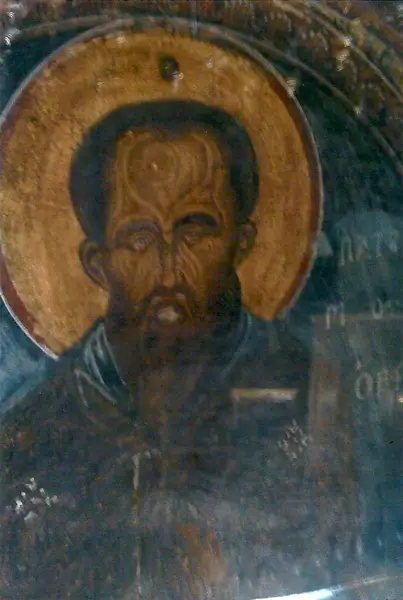
Patapios of Thebes, a fourth-century Egyptian ascetic, is honoured as the patron saint of those suffering from dropsy. Born at Thebes in Roman Egypt to wealthy Christian parents, he abandoned worldly prospects at a young age for the solitude of a hermit in the wilderness, where crowds came looking for his counsel and his preaching. In later life he left Egypt for Constantinople, then the new capital of the Christian world, and joined the circle of ascetics there: he befriended Varas, who would build the monastery of St John the Baptist at Petrion, and Ravoulas, a hermit at the gate of Romanos. At Blachernae, on the slopes of the Xero Oros or dry mountain, Patapios founded a community known as the Monastery of the Egyptians, and there he died. His relics had a long history after his death: rescued from his destroyed monastery in 536, they were kept at Petrion under the protection of the last imperial family, hidden in a cave on Mount Geraneia after the Ottoman conquest of 1453, and rediscovered at Loutraki in 1904. In 1952 a monastery was founded on the site, where his relic rests in the cave today, venerated by pilgrims who take oil and water from the shrine and who keep his memory each 8 December and on the Tuesday after Easter.
The Complete Life
A Rich Man's Son in the Desert
Patapios was born in the fourth century at Thebes in Roman Egypt, the son of wealthy Christian parents. The Thebaid was already becoming synonymous with monasticism, its cliffs honeycombed with the cells of hermits, and the boy who might have inherited a fortune chose instead the inheritance of the desert. While still young he withdrew from Thebes to live as a hermit, embracing poverty, solitude, and unceasing prayer in a landscape where the great pioneers of Egyptian monasticism had shown that the wilderness could become a school of holiness. His reputation did not stay hidden. Many visitors made their way to him to seek his counsel and hear him preach, so that the hermit's cave became a place of counsel and teaching. The pattern was classic: the ascetic who fled the world found the world coming to him, and Patapios received the crowds with the word of God rather than sending them away. From these years came the devotion that would attach his name to the sick, particularly those afflicted with dropsy, for whom he remains the patron saint, a patronage born of the compassion and healing power ascribed to his intercession.
§ Biography
From Egypt to Constantinople
In his later life Patapios left Thebes and the Egyptian desert for Constantinople, travelling from the old capital of the pharaohs to the new capital of the Christian empire. There he entered the city's flourishing ascetic circles and met two kindred spirits who would themselves be numbered among the saints. Saint Ravoulas lived as a hermit at the gate of Romanos, keeping vigil at one of the gates through which the imperial city streamed with traffic. Saint Varas founded the monastery of St John the Baptist at Petrion, planting monastic life within the urban fabric. Among these companions Patapios settled in the district of Blachernae, at the foot of the Xero Oros, the dry mountain that rose within reach of the city walls. There he established a monastery known as the Monastery of the Egyptians, a house that carried the memory of his Theban homeland to the shores of the Bosphorus and gathered disciples in the tradition of the desert fathers. In this foundation his long formation reached its purpose: the wealthy orphan of Theban society had become a founder, and the hermit of the desert had brought the desert itself to Constantinople, where he eventually died and was first buried.
§ Biography
The Relic of the Saint on the Move
The story of Patapios' relics is a chronicle of empires rising and falling. His relic, after the Monastery of the Egyptians fell in 536, was carried by Saint Varas to the Monastery of Saint John at Petrion, the house Varas himself had founded, and there they rested through the centuries when Petrion enjoyed the protection of the imperial family, the Palaiologoi. The Augusta Helena Dragaš, mother of the last Byzantine emperor Constantine XI, took particular care of the shrine; she herself became a nun under the name Hypomone, meaning patience, and is honoured as a saint. When the Ottomans took Constantinople in 1453, a kinsman of the emperors, Aggelis Notaras, nephew of the Augusta Helena, carried the relic to safety in Greece, hiding it in a cave on Mount Geraneia near the spa town of Thermai, today's Loutraki. The cave, which had served as a hermitage since the eleventh century and stands 650 metres above the sea, received a hermitage around the relic, though the site was later abandoned for some centuries. The relic of the Egyptian hermit thus passed from Thebes to Constantinople to the Greek mountains, guarded by saints, empresses, and emigres at every stage.
§ Early history
Discovery of the Cave
For centuries the cave on Mount Geraneia kept its secret, until 1904, when citizens of Loutraki discovered the place where the relic of Saint Patapios had lain hidden. The skull too of Helena Dragaš, the nun revered as Hypomone, came to light inside, along with a damaged wooden cross, a membrane, and coins, all of which were turned over to the civil authorities. The discovery was troubled at first: visitors took pieces of the relics as amulets, as Sister Patapia of the later monastery recorded, until Constantinos Susannis, a Loutraki priest, carried the relic off and sheltered it in his own house with the permission of the Church, sheltering it from further loss. The full flowering came in 1952, when Father Nektarios Marmarinos, a priest of the settlement of Corinth, founded a monastery on the mountain, and on 1 August 1952 Metropolitan Prokopios Tzavaras formally established the Monastery of Saint Patapios; the relic was returned to the cave where it had been found. Sister Synglitiki served as first abbess, with Sister Patapia aiding the building and later serving as mother superior from 1963 to 1970. The shrine's recovery was itself regarded as an act of Providence restoring what had been entrusted to the mountain five centuries before.
§ The discovery of the cave and the foundation of the monastery
The Monastery Above Loutraki
Today the Monastery of Saint Patapios stands on Mount Gerania at 650 metres, overlooking the sea and the resort town of Loutraki, an hour from Athens, and is home to some forty nuns. Beside the church stands the cave where the relic rests, covered with a robe that is changed each year on the saint's feast; pilgrims carry away cotton soaked in the oil of the lamp that burns before it and draw water from the spring beside the cave. The monastery keeps the skull of Saint Hypomone, Helena Dragaš, and treasures Byzantine icons of Saint Patapios and Saint Patience painted by an unknown artist probably in the fifteenth century. Its buildings embrace a church of the Virgin Mary, sanctified on 1 August 1968 by Metropolitan Panteleimon of Corinth, the katholikon of the Holy Trinity, a chapel of St Mary of Egypt in the cemetery, hostels, cells, and a room of exhibits for visitors. The memory of the saint is celebrated on 8 December, the main feast, and on the Tuesday after Easter, recalling the day his relic was found. Miracles worked through his intercession, in past ages and in the present, are entered fully into the monastery's historical records, and the community keeps a large library alongside its shrine.
§ The Monastery of St. Patapios today
Timeline
- 536
Once the Monastery of the Egyptians was destroyed, Saint Varas carried his relic off to the Monastery of Saint John at Petrion.
§ Early history
- 1453
After the Ottoman conquest of Constantinople, Aggelis Notaras carried his relic to a cave on Mount Geraneia near Loutraki to keep it from the Ottomans.
§ Early history
- 1904
Citizens of Loutraki came upon the cave and the relic, discovering as well the skull of Helena Dragaš, honoured as Saint Hypomone.
§ The discovery of the cave and the foundation of the monastery
- 1 Aug 1952
The Monastery of Saint Patapios at Loutraki was officially founded by Metropolitan Prokopios Tzavaras, and the relic returned to the cave.
§ The discovery of the cave and the foundation of the monastery
- 1 Aug 1968
The monastery's church dedicated to the Virgin Mary was sanctified by Metropolitan Panteleimon of Corinth.
§ The Monastery of St. Patapios today
The Record
- Major works
- The Monastery of the Egyptians at Blachernae
- Patron of
- Against dropsy
- Symbols
- Monastic habit·Cave hermitage
- Canonization
- Pre-congregation; venerated since antiquity in the Eastern Orthodox, Oriental Orthodox, and Catholic churches.
Prayer
Bibliography
Show 7 sources
- The Holy Monastery of Saint Patapios in Loutraki, edition of the Metropolis of Corinth, Sikyon, Zemenou, Tarsus and Polyfengous, 2012
- The Greek Monasteries, Ev. Lekkou, Ihnilatis, Athens, 1995
- "Agiologio of Orthodoxy", Christos Tsolakidis, Athens, 2001 edition
- "O Megas Synaxaristis of the Orthodox Church", Saint Patapios, pp. 254-261, Victoras Mattheos, 3rd edition, Metamorfosi Sotiros Monastery, Athens, 1968
- "Saint Patapios", Stylianos Papadopoulos, professor of the University of Athens, Holy Monastery of Saint Patapios, Loutraki, 2006
- "St. Patapios and his miracles", Dr. Charalambos Busias, edition of Holy Monastery of Saint Patapios, Loutraki, 2004
- "Deltos of Miracles of our miraculous father St. Patapios", Dr. Charalambos Busias, 4th edition, Loutraki, 2011
Profile text adapted from the Wikipedia article, licensed CC BY-SA 4.0.
Pray with this saint every day
Save St. Patapios to your favorites, read the full profile, and get feast-day reminders in the Saints app.
Get the Saints AppFree on the App Store for iPhone and iPad